Richard Drake
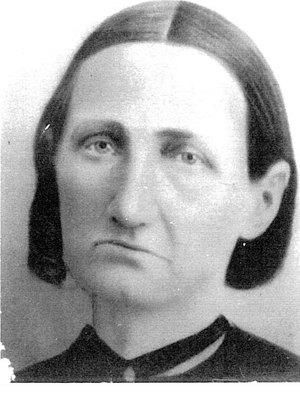
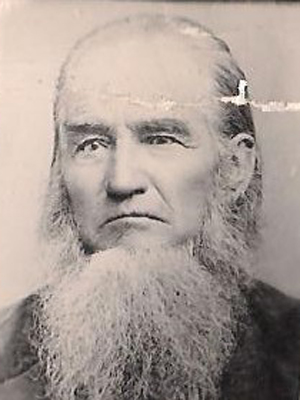
Richard Drake was born on November 22, 1839, at Palermo, Oswego, New York to Jacob Drake and Flora Hayden. This couple had four other sons: two older than Richard (Willis and Warren) and two younger (Medelson Del Roi and Jacob Moroni, Jr.). Jacob and Flora joined The Church of Jesus Christ of Latter-day Saints in New York and moved their family to Nauvoo, Illinois to be with the Prophet Joseph Smith and the rest of the church membership. Medelson Del Roi and Jacob Moroni were born while the family was in Nauvoo. However, Jacob did not live to see his namesake born. Flora was left a widow with four boys and a baby on the way. Richard must have been quite young when his mother remarried, this time to Lemuel Mallory. Flora left the house Jacob had built her and, with her new husband and her boys, traveled west to Utah in the Captain Bennet Company.
However, it appears that Flora never reached her destination in the west. Family tradition holds that Flora was laid to rest somewhere on the Great Plains along the trail to Utah. The 1850 census shows Lemuel Mallory in Utah with most of Flora’s boys, but no Flora and no Medelson Del Roi. The Drake boys lost both parents in quick succession and at an early age. Family tradition also indicates that Lemuel mistreated his foster sons. He was a polygamist and purportedly had more children than he could support. Richard spent much of his time with the Indians and learned their language. They called him “Muggins” which means “Brave.” Richard also loved music and played the violin by ear.
Phoebe Lovina Beecher
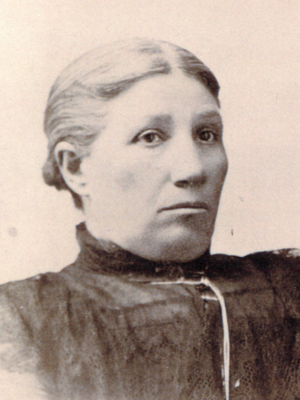
Phoebe Lovina Beecher was the daughter of Ransom Asa Beecher and Sylvia Desire Wheeler. She was born at Montrose, Lee, Iowa on September 23, 1846. Her parents were forced to leave their home in Nauvoo, Illinois by anti-Mormon mobs. They joined the great trek of Latter-day Saints west. Once across the wide Mississippi River in Iowa, the family stopped to rest and make preparations for Sylvia to give birth to twin girls. Phoebe Lovina was one of those twins.
Phoebe married Richard Drake on July 24, 1864. They lived in Willard, Utah between the years of 1872 and 1874. They moved to Elba or Connant, Idaho. Later they sold their home there and pioneered in the Teton Valley of Idaho.
Richard arrived in the Teton Valley in 1889 and stayed with his son, Richard Asa. He moved his wife and children there the following spring. He and his son-in-law, Edwin Rice, and his sons made homes in Victor and Cedron, Idaho. They grubbed the sagebrush, built good barns and homes, and established fine herds of cattle and horses. Richard and Phoebe were the parents of eight children.
One time Richard was traveling in Oregon with a team of horses pulling a wagon. He made camp and heard a cow and calf bawling. He surmised they were being attacked by a wild animal and took his gun and went to their rescue in his bare feet. He shot at the animal and quickly jumped aside to be clear of the gun smoke and gain a clear view of the scene. The wounded mountain lion was coming after him and Richard did not have time to reload his rifle, so he used it as a club to hit the lion on the head. He knocked the mountain lion unconscious, but in doing so he broke his rifle in two, rendering it useless. Knowing the lion was only stunned and that it would be angrier than before, Richard quickly retreated back to camp. The next morning Richard returned to the skirmish site and found the lion had killed and partially eaten the calf.
Ruth Rice Jenkins remembers her grandfather, Richard, as being tall, slim, and very kind. She recalls Phoebe as small, plump, and darkly complected. Richard and Phoebe knew how to make their grandchildren feel loved and wanted. The high ideals and great talents found in Richard must have been instinctive because he did not have a chance to acquire them in his youth.
The house they built in Cedron, Idaho was larger than most pioneer homes. It had a large living room, which was carpeted from wall to wall with a rag rug they had woven themselves. Under the rug was a soft bed of straw to provide some cushioning. Richard and his sons wrestled and performed competitive sports on the soft rug.
The living room also boasted of an organ, two violins, some harmonicas, and a phonograph with a big horn. All the children played some instrument. For community dances, their daughter Sylvia would chord on the organ while Richard and his son Fred played their fiddles. Richard also called for square dances. There was fun and frolic in their home. Never have we known people with such kind and happy dispositions. There was always a group of young people in their home.
Teton Valley of Idaho
In their early years in the Teton Valley, the Drakes made a living by trapping and selling fur. The Drake boys were good trappers and the beaver was plentiful at that time. They tanned their own hides for their own fancy gloves and chaps, which Phoebe “foxed” or trimmed with plucked beaver. Richard was never idle. He was a good blacksmith and loved to work in his shop when there wasn’t farm work to do. His son-in-law Edwin Rice claimed that Richard was a splendid wheelwright. He was also a farmer and stockman who raised fine horses, which he loved to race at local celebrations. He pulled the neighbors’ teeth, soled their shoes, and cut their hair. The first school in the valley was in the Drake home; they paid and provide board for the teachers.
Phoebe grandchildren vividly recall her kitchen with its big, black stove, which they called a range. There was always something tasty cooking on top of the range or in its warming oven. There was also a large waist-high wooden box with a deep shelf inside near the top. This was the flour bin. The inside shelf was always loaded with goodies made by Phoebe’s own hands. Quite often the shelf usually held “crullers,” a sweet spiced dough similar to cake doughnuts twisted into crooked shapes and deep-fried. Phoebe’s pies (mostly custard) were also available. The grandchildren reveled in knowing they could help themselves to these treats at any time without fear of reprimand or chastisement. Grandmother Phoebe told them she made the treats for their enjoyment. She allowed them to pick and eat all the strawberries they desired. Neither did she object if her grandchildren took a spoon and dug into the can of fresh honey Phoebe kept on hand or sampled the “Pickle Lilly” from a large wooden bucket.
Phoebe was extremely ambitious. Her granddaughter Arleigh recounted how Phoebe would sit by a table with a book propped in front of her so she could read aloud to Arleigh while Arleigh brushed and combed her hair. At the same time, Phoebe knitted stockings, gloves, or lace. She knit surprisingly well and only needed to look at her work occasionally. Her fingers flew and the needles clicked rhythmically. She also sheared her own sheep, washed and carded the wool, and spun her own yarn. She had much early experience in making her own dyes. She wove yards and yards of carpet. Phoebe used every little scrap of material for some project. She made hundreds of quilts, rugs of several kinds, woven carpets, knitted articles of clothing, and many yards of beautiful lace.
The young folks of the community spoke of Richard and Phoebe as Grandpa and Grandma Drake. They loved everyone and the sentiment was reciprocated by all that knew them. Their home was always open to their grandchildren and anyone else for singing and recreation. Many times Richard and Phoebe hooked up horse and buggy and traveled over rutted roads in answer to the anguished call of a pioneer mother in the travails of childbirth. Often this was in the middle of the night or severe winter cold or blizzard conditions. There were no doctors and Phoebe served as a midwife, doctor and nurse, and even housekeeper to those in need. She also was present to assist in times of death.
Before Phoebe died, her daughter Sylvia counted the number of babies Phoebe had delivered over the years; the number was something over 300! To our knowledge, Phoebe never accepted any payment for her services, though her friends sometimes gave her “gifts.” What did the Savior say? “…Inasmuch as ye have done it unto the least of these my brethren, ye have done it unto me. (KJV Bible, Matthew 25:40). Surely she was found in the service of her fellow men, so she was in the service of her God. Phoebe was the ideal of her grandchildren and was greatly loved by them. Ruth Rice Jenkins recounted how Phoebe let her get into bed with her even when Ruth was a big girl and many times she warmed Ruth’s feet with her dear, old hands.
The Drakes had a fine, tall son named Ransom who was injured in a skiing accident, which left him paralyzed from the waist down. She always tried to make others happy. During the long, helpless days before Ransom’s death, with so little he could do, Phoebe had an idea. She brought out a .22 rifle and helped her son amuse himself by taking turns shooting the images of the politicians that appeared on the newspapered wall of the cabin.
Ransom died in the fall of 1897 at the age of 16. After Ransom’s death, Phoebe grieved greatly until one night when she lay crying in her bed, she became aware of music coming from afar slowly approaching her until the sound filled her bedroom. She knew it was from heaven and its divine beauty brought peace and comfort to her heart such as she had never known before. The message it conferred to her was one of understanding that her son was in a place where this divine peace reigned and she need grieve for him any longer.
Richard suffered a stroke in 1904 and never regained his health sufficiently to do any work thereafter. However, he remained cheerful during his entire affliction. During this time he trained his two cats, Saboy and Sabi, to do various tricks. He deeded his homestead to his youngest son, Merritt. Richard passed away on March 6, 1912, at the age of 73. He was blessed in the Nauvoo 5th Ward as a small child at the same time as his brothers. He had a patriarchal blessing at about age 15 in Richardson, Utah by Charles Hyde. They were not active in The Church of Jesus Christ of Latter-day Saints and were affiliated with the Reorganized Church of Jesus Christ of Latter-day Saints for reasons unknown to us.
His youngest son Merritt died in the spring of 1916. Merritt’s wife, Eva, married Monroe Dustin. Monroe’s sons took over the home and land the Drakes had worked so hard to make beautiful. At the time of this writing, the Dustins still owned the homestead land.
One More Homestead
In 1915 Phoebe still possessed her homestead rights and decided to use them on behalf of her daughter Sylvia and her husband, Edwin Rice. She left her home in Cedron, Idaho, and the accumulations of a lifetime, except her bedding, dishes, and personal belongings. These she took with her in June 1915 as she embarked, at the age of 69, on yet another pioneering venture with her daughter and son-in-law. The intended homestead site was twenty miles past St. Anthony, Idaho on the grassy ridge prairie five miles beyond the Juniper hills west of Parker, Idaho. Her personal belongings were contained in a wooden chest Richard had made for her. Her granddaughter, Ruth Rice, accompanied her parents and grandmother on that trip from Cedron to St. Anthony. Ruth was 17 and remembers how her grandmother wore a sunbonnet and gave her one to wear.
It took two and one-half days by wagon to reach the dry farms on Grassy Ridge. The roads were little more than trails winding through the lava rock from Parker on. It was dusty and hot and rough, but Phoebe seemed to enjoy the adventure. There was a shack about 12 feet x 16 feet and a couple of tents for the family to live in. These were located up on a hill where the winds hit them full force. Despite these primitive conditions, Phoebe seemed to enjoy herself and the Rices most definitely enjoyed her.
She was there at the dry farm homestead about a month when she had an acute attack of pleurisy and was in such terrible pain that they dared not move her over the rough roads for medical attention. Instead, they brought Dr. Morefield to her, but he was unable to help her. Pleurisy affected her heart and she died July 9, 1915. She, who had been born on the flats of the Mississippi River across from Nauvoo, Illinois as a premature twin to a refugee mother fleeing anti-Mormon mobs, died in a tent on a windswept prairie of an Idaho dry farm.
When her youngest son Merritt and his brother Asa heard the news of her illness they went in a white-top buggy to see her. They returned home quite late that night. Merritt had just gone to bed when he heard the front door open. He arose from his bed, somehow knowing that his mother had passed away. When he checked with Edwin and Sylvia later, they confirmed that she had died that same hour. Merritt felt like his mother’s spirit had stopped at her old home on its journey heavenward.
Edwin and Sylvia Rice took Phoebe’s body on the long, rough road to Hansen’s funeral home in St. Anthony. From there she was taken to Victor, Idaho, and laid to rest by Richard. She was a pioneer all her life, but she endeavored to make life pleasant and comfortable for others around her. Her descendants have much to live up to if they would be like her.