Family: Rice

  • Margaret Mathews

    Margaret Mathews

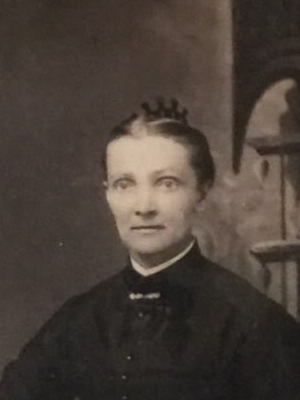
    Margaret Mathews was born in Swansea, Glamorgan, Wales on June 11, 1849. Her parents, Hopkin and Margaret Morris Mathews, joined The Church of Jesus Christ of Latter-day Saints and had both served as missionaries before and after their marriage. When Margaret was seven years of age, her parents left Liverpool, England for America. They landed in New York City six weeks later with their five children.

    They traveled overland to Iowa City where they became a part of the Edward Bunker Handcart Company and walked all the way to Utah. She never forgot the Brass Band and the hundreds of Saints who met them as those
    foot-sore and weary people entered the city. She could hardly sleep in a house after sleeping so long out of doors. In the spring of 1858, her parents took the family to Farmington, Utah. It was a town ten years old, but they decided to go on to a newer place—Providence, Utah. There they lived in the open for months. The children watched while men plowed with crude hand-made tools and planted gardens. They built a few log cabins in a fort formation because the Indians resented settlers’ presence. The Indians often stole horses and cattle, but once two squaws stole a little boy. No child had a better pair of parents. They were hard-working and faithful to the Church. Margaret learned to do as all the girls did: how to clear wool fresh from sheep’s backs, card it, spin it and knit it into socks or stockings.

    Her mother was a nurse and midwife for years. Margaret took her place in the home when her mother was called away. Their log cabin was heated from a fireplace until a bigger and better house was built. They had no matches, so it was wise to keep live, red-hot coals from night until morning rather than go out borrowing fire in the cold weather. The dancing parties she attended in a log schoolhouse and later in the larger rock building were lighted by burning logs in the fireplace.

    Margaret never had running water on tap in her life until long after her husband died. She carried it from streams near the house. Her father was in the first Providence Bishopric and her mother was a counselor in the first Relief Society in Providence.

    When the Church leaders suggested that the girls and women glean wheat behind the scythe-wielding harvesters, she became a gleaner. She gave some of the wheat she gathered to the Relief Society, which had a wheat storage project at that time. The wheat the Relief Society owned was sold for the Logan Temple Fund.

    As a young lady, she often was hired out in the homes of the Saints. She accepted all the teachings and advice of the Church leaders. She was employed in the home of Oscar N. and Jane Rice. She became the second wife of Oscar North Rice in 1869, ten years after Jane Miller had been sealed to Oscar in the Endowment House under the authority of the Priesthood of God for all Eternity. Margaret passed away on February 18, 1926, in Providence, Utah.

  • Olive Emily Smith

    Olive Emily Smith

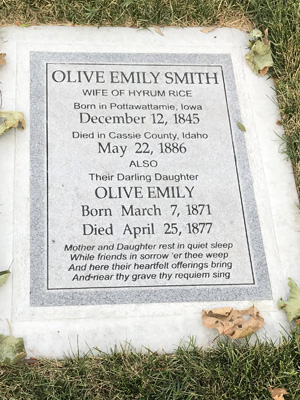
    Olive Emily Smith was born in Lee County, Iowa, on December 12, 1845. Her parents were William Orville Smith and Emily Jane Spinning. They were Utah pioneers. Olive’s father died July 7, 1849, shortly after he had settled his family in Farmington, Utah. She came from a very religious family, and so she may have had something to do with encouraging her husband to be baptized six months after their marriage. She married Hyrum Rice on December 25, 1865, in Salt Lake City, and they made their home in Cache County, Utah, until 1880. Five children were born to them in Farmington, Utah: William Hyrum Rice, Jr., born September 9, 1866; Nathaniel Abel, born July 31, 1869; Olive Emily, born March 7, 1871, died six years later on April 25, 1877, and was buried in Farmington; Mary, born November 7, 1875; and Jerry Mann, born December 6, 1878.

    After Hyrum and Olive Emily moved north to settle on a homestead near Round Mountain, Cassia County, Idaho, two more children were born. One of these children, no sex given, was born in 1880 and died in 1880 or 1881, and Edna Ann was born on March 7, 1883.

    Round Mountain was never a town. When Hyrum owned the ranch that lay east of a very large hill that rises from the flatland floors of the area, it was a way station for travelers from Oregon, California, Idaho, and Utah. By 1884, after the railroad in southern Idaho had been built, this traffic was reduced, and Round Mountain became isolated. Hyrum and his family moved to the nearby town of Almo, where a few families were beginning to settle. They lived on a ranch in what is called “The Cove.” It was located at the mouth of the canyon directly west of Almo and just south of the ranch their son, Nathaniel, bought after he was married.

    Olive Emily’s husband, Hyrum, was usually occupied breaking his colts, for he was a lover of horses, as his father and brothers before him had been. Olive Emily was forty-one years old when an unfortunate accident caused her death. Hyrum had been training a team to drive, and Emily asked that he take her and the children in the family wagon to some neighbors. As they prepared to return home, Hyrum held the horses while Emily climbed into the back of the wagon and bent to help the children into the wagon box. A chasing dog frightened the horses, and they lunged forward suddenly. Emily fell from the wagon and suffered a mangled and compound fractured arm. After getting home, Nathaniel rode a horse to Albion for a doctor who traveled the long distance to Almo in a buggy. Help was too late. She died of blood poisoning on May 22, 1886. She was a very lovely lady—good and kind to everyone.

    She was buried on the ranch, but afterward was removed, along with the baby who had been buried in 1880 or 1881, to a burial plot in Farmington, Utah.

  • Oscar North Rice

    Oscar North Rice

    Oscar North Rice was born on October 19, 1835, in a frost-bitten, rattlesnake-infested country called Washtenaw in the wild territory of Michigan, where Indians lived, wolves prowled and bears were known to snooze beside the schoolhouse on hot spring days. It was a land without roads or bridges, and transportation was by foot, horseback, or waterways. The Rice family hunted bear and deer, and other wild game in the normal course of events in order to feed themselves. In 1842, the family made the long trip from Ypsilanti, Michigan to Nauvoo, Illinois because they had joined The Church of Jesus Christ of Latter-day Saints.

    Oscar knew nothing of ease or comforts in his day-to-day life, but he did know a lot about the Prophets and leaders of the Church of Jesus Christ and would have followed them to the ends of the earth, as well as to the end of time. He was seven years old when the Prophet Joseph and brother Hyrum Smith were killed. His father left a large family, the last one a baby brother, and crossed the Mississippi in February 1846 in a raging blizzard to satisfy the persecuting mobs.

    In the spring of 1848, Brigham Young brought a message back from far-off Deseret (Utah), in which his father Ira Rice had said for them to come with the large companies crossing the Plains to their new home. Oscar was then
    thirteen years old. His mother’s health had been destroyed by hardships of the flight from Nauvoo, Illinois and she could not follow the family to Utah. Consequently, Oscar left her, three sisters and baby brother Ephraim
    to face 1,100 miles of wilderness without the support of his parents. What he found upon his arrival in Utah was of little comfort—the emptiness of a cabin shelter at the end of the journey with no mother to greet or care for
    them. Soon after arriving in the Salt Lake Valley, Oscar North was called to be a scout to help with the Indian troubles in the Lemhi Valley of Idaho. During that time, Indians killed one of his best friends.

    He with his father and brothers were the first to try to make a settlement in North Ogden, Utah. He had little formal schooling, but he learned how late frosts, bad winds, crickets, and Indians could dash the hopes of any person. From there he labored in Smithfield, Utah (1861-62), but trouble with Indians convinced him to return to Providence.

    To supplement his income, he began freighting from Utah to Salmon, Idaho, after gold was discovered there. He loved to teach the Gospel to all who would listen and many times he preached to miners and others when away from home. Goods brought back on these trips he and his brother Dell sold in the first store in Providence, known as the Rice Brothers Store. On one of these trips, he had an accident, from which he suffered the rest of his life.

    By 1870, he had taken up a homestead along the south side of the Logan River where tall willows grew far from the banks. Once when he was grubbing them, he met a bear. Later when cutting hay with a scythe, he came face to face with a mother bear. He wanted to cut her in half, but he succeeded only in snagging a bit of her hair on his scythe blade. One of his great desires was for his children have more schooling than he had. He helped build more than one public building, roads, bridges and canals. He also helped pay teachers to teach in Providence and Logan, Utah.

    Oscar North married Jane Clarissa Miller in the spring of 1859. They were listed as being among the first families to go to Providence, Cache, Utah, to establish a new settlement. No Latter-day Saint group was ever without a place of worship and hold school. He helped to supply logs in 1859, and they had a flagpole from which flew the stars and stripes for the flag they loved. He hated to think about how he had taken sweet Jane from a good home in Farmington and asked her to live in a wagon box all summer while he helped in the plowing and planting and the gathering of logs needed to build shelters for everyone. That fall they went to father Daniel Miller’s place for the winter, where their daughter Alice was born in February 1860. Undaunted, they drove back to the log cabin with willows and sod for a leaky roof, rough floorboards, and no glass windows. Like all the rest of the pioneers, a fireplace provided the heat in their log cabin.

    Oscar married a second wife—Margaret Mathews—which marriage was solemnized in the Endowment House by the authority of God in 1869. She was a faithful daughter in Zion who took an active part in the church in Providence, Utah. Oscar North Rice died on 17 September 1880 in his forty-fifth year. He was followed in death by Jane Clarissa on February 15, 1896, and Margaret on 18 February 1926.

    The Oscar Rice family knew all about going hungry and sacrificing for others. He could never tell of leisure or having plenty of anything, but dangers. His chief satisfaction was in doing the best he knew how and living up to the Priesthood he held and honored. He firmly believed in all of the teachings and commandments made by God through his authorized leaders of The Church of Jesus Christ of Latter-day Saints. He was a faithful tithe payer, he gave freely to the Church. Like Abraham of old, who would have sacrificed his son if God required it of him. Oscar was willing to obey every requirement of God—even the law of plural marriage. It was not an easy law to obey and only a few entered into that covenant.

  • Leonard Gurley Rice

    Leonard Gurley Rice

    Introduction

    Leonard Gurley’s parents, Ira and Sarah Ann Harrington Rice, were living in Northville, Wayne County, Michigan, when he was born September 3, 1829. Missionaries came to their home in Michigan while Leonard was a young child, and the family became members of the newly restored Church of Jesus Christ of Latter-day Saints and soon joined the body of the Church at Nauvoo, Illinois. He remembered well, watching his father and other men helping on the building of the Temple there. He remembered, too, those sorrowful days surrounding the martyrdom of the Prophet Joseph Smith and his brother, Hyrum Smith. He stood with the thousands of Saints in that hot summer sun when their bodies were returned to Nauvoo in an open wagon.

    The Rice home was burned by mobs the year the Latter-day Saints crossed the Mississippi River in 1846. Leonard’s father and two of his older half-brothers had preceded him to Utah to prepare ahead for the rest of the family. By this time his mother, Sarah Ann, had given birth to twelve children, ten of whom were living. Leonard, who was then 19, and the oldest son of the remaining children, carried the responsibility of bringing part of the family, Oscar North, 15; Adelbert, 9; Hyrum Smith, 4; Adeline, 11; and Caroline, about 7; across the plains to Utah. It was a great disappointment to Ira that not all of his family came with Leonard. Sarah Ann, the wife, and mother, had, no doubt, died, for no mention is made of her. The motherless children were often placed in the custody of someone in the family until they were old enough to sustain themselves.

    A Family of His Own

    Leonard Gurley returned the next year to help other emigrant trains. He met and married Elizabeth Almira Babbitt at Kanesville, who was already planning to travel West with the next company. Their honeymoon was spent driving teams along the pioneer trail to Utah. Leonard was made Captain over ten wagons and his wife did much of the driving of their own wagon. They made their home in Farmington, Utah.

    Leonard had proven himself to be an expert horseman and one who could drive an ox team with skill. He had learned the advantages of friendliness and patience with people and he had empathy for them that made him
    humble, as well as noble, and he knew how to keep the wagon train moving. These attributes of leadership put him in high demand as a wagon master for many trips back and forth across the pioneer trail.

    In 1851, Leonard returned again to Iowa, hoping to bring the rest of his father’s family. In a letter to his wife, Elizabeth, he wrote that he had seen his older sisters who had married and preferred not to join the Saints in Utah and that his younger brother, Ephraim, who would have been 5 or 6 years of age, had drowned. This loss grieved Leonard much, for he had been most anxious that all of his mother’s family be reunited in Utah. Again, he
    made no mention of his mother in his letter, so we have to assume that she had died earlier.

    On a later trip, he met his wife’s dear girlhood friend, Margaret Buckwalter, who had been widowed, but who had remained firm in her determination to get to Utah. Upon their arrival in Utah, a sweet experience saw Leonard and Margaret married as Elizabeth placed Margaret’s hand in Leonard’s in marriage on 2 January 1853. Leonard’s two families, Elizabeth’s 11 and Margaret’s 7 (though not all of these children grew to maturity) lived close for many years to enjoy a unity seldom found in single families.

    Mission Call and a New Wife

    Leonard’s life was one of sacrifice for others. Between the years of 1848 and 1867, there are repeated incidents of calls to assist not only the pioneers on their trek westward but rescue missions to destitute areas in outlying colonies. Leonard had the faith and courage of his families in Farmington while he was away from them so much of the time. Because of his skillful handling of teams, wagons, and people, he was in demand as a wagon master and Captain. He was a frequent companion of President Young on his many “preaching tours” to new colonies as the Church spread to outlying areas. He was called upon to help in the rescue of the Martin Handcart Company. He, with other elders, took six wagonloads of supplies to the stranded company under the leadership of Edward Martin.

    He was one of a party of men called to assist in the Green River Expedition to Wyoming in 1853. In 1854, he again went with Brigham Young to settlement outposts in Southern Utah and into areas that later became Southern Nevada. There was also the time he was part of a rescue party sent to meet a company of pioneer Saints stranded in winter snows. They found and carried men too weak to walk, women almost frozen, and many children through the icy waters of the Sweetwater River. Never had men witnessed so much misery and suffering. That night, the bedraggled and freezing rescue party made camp for the destitute company five miles west of the Sweetwater River. It took almost a month to get back to Salt Lake City. Leonard took cold and became severely ill, from which he never fully recovered.

    It is noted in Journal History of 1857 that Governor Young and a party of travelers left Salt Lake City to visit Idaho settlements along the way to the Salmon River Valley. The distance of this trip to Fort Lemhi was 380 miles. Their teams, carriages and wagons made the trip in 32 days. Leonard Gurley Rice was said to have driven Brigham Young’s carriage. Roads were non-existent. Fort Lemhi had only recently been established in 1855.

    On 1 May 1865, soon after the assassination of Abraham Lincoln, Leonard was called on a European Mission by the Church. He left Elizabeth Almira, whose last child was due in September of that year, and Margaret, with her
    family of young children, in Farmington, with instructions for the older children to carry on and help their mothers all they could. It was 5 July 1865, when he and Elders Nathaniel H. Felt and Aureleus Miner began their journey by Overland Stage. They reached New York City August 19, and boarded the S.S. Virginia for bound England. Leonard performed an honorable mission. Through prayer, his knowledge of the Gospel increased and he was able to overcome the temptations of discouragement and the things of the world. In a letter to his family he wrote,

    “My heart and mind are upon my children more than all things else in this world … I am thankful to say of myself (God be praised) I stand firm … I hope to perform the balance of my mission as honorable as I have what is past … May God bless you all is the prayer of your husband and the children’s father.”

    He was released from his mission on 21 March 1867.

    Leonard’s return home did not end his calls from the Church. He was assigned to be in charge of relief wagon trains sent to meet companies of Saints coming to Utah. On his last wagon train trip in 1867, he had command
    of foreign converts from many lands speaking different languages. In that last crossing was Lucy Jane Stevens, who became his third wife. Ruth May Fox was in this same company and some of her written words, expressing appreciation for Leonard Gurley as a Captain, were these:

    “No one who has not had the actual experience of crossing the great plains … can realize what it meant to be a Captain of a large company of emigrants of different nationalities, various occupations and decidedly diverse habits of life, some of whom had never camped out at night in their lives, who had not so much as seen a yoke of cattle, and of course, did not understand the language which frontier oxen were accustomed to…There were weary ones to be encouraged, the over-zealous to be held back; order must be maintained, rations measured out, and men appointed to guard the cattle and the camp; many of these had never seen an Indian nor fired a gun … With Leonard as Captain, I remember him as a fine looking man, spoken of as an ideal leader who was not known to have lost his temper the whole of the journey, and of whom I heard few complaints…Oh, what could we have
    done without a Captain? God bless his memory.”

    Source unknown

    Leonard and Lucy Jane Stevens were married in Salt Lake City on 11 January 1868. They became parents of seven children; the youngest was only two weeks old when Leonard passed away on 12 September 1886, having suffered from pneumonia he contracted in the penitentiary while awaiting trial as a polygamist.

    He saw the Church grow from a small beginning to be well established in the Valleys of the Rocky Mountains. He left a large posterity and bore a strong testimony of the divinity of the restoration of Christ’s Church on earth. He was buried in Salt Lake City, Utah.

  • Ann Victoria Rose

    Ann Victoria Rose

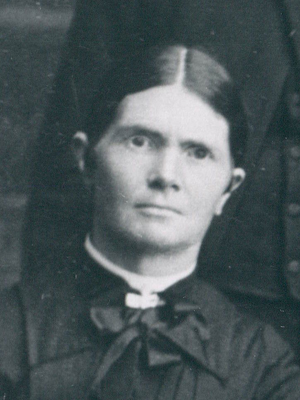
    Ann Victoria Rose was the sixth of eight children born to Abraham Rose and Catherine Nicholson Rose. She was born on June 4, 1839, in Howard, Steuben County, New York. Her parents had joined The Church of Jesus Christ of Latter-day Saints in 1836. Her father was a prosperous, well-respected farmer in Steuben County. The spirit of gathering soon urged the Rose family to join the body of the Church in Nauvoo, Illinois. They left their comfortable home, loved ones, and most of their possessions, and traveled by covered wagon and ox team. Ann Victoria was a four-month-old baby at that time.

    Arriving in the southern part of Ohio, late in the season, they remained at Carthage, Ohio until 1843. They obtained work manufacturing maple sugar and maple syrup. Two more children were born while the family resided at Carthage. They left Carthage in September 1843 and arrived in Nauvoo, Hancock County, Illinois a month later. Here they met the Prophet Joseph Smith. His noble personality made a lasting impression upon the Rose family. They had arrived at a time when persecution was severe and they were among those who crossed the Mississippi River in the great exodus from that beautiful city and temple. Ann Victoria was a child of seven years. Her family crossed the Iowa prairies with one ox and cow yoked together, as the mob had killed one of their oxen to feed themselves.

    They arrived at Kanesville, Iowa (present-day Council Bluffs) in August 1846. Here, a year later, their last child was born. They were destitute and remained in Kanesville until 1853 in order to obtain enough supplies to continue the journey across the plains. Ann Victoria was fifteen years of age when her family crossed the Missouri River with two wagons, five yoke of cattle, one horse, and provisions to last eighteen months. Ann’s younger brother, their herdsman, rode the horse, bareback all the way across the plains. They had fourteen head of cattle in all. On their arrival in the Salt Lake Valley, the Rose family decided to settle in Farmington, about seventeen miles north of Salt Lake City, Utah. By this time, the town had an organized ward.

    Ann Victoria married William Kelsey Rice, the son of a Farmington pioneer. He had crossed the plains with his father, Ira Rice, and brother, Asaph Rice. Ann became the second wife of Kelsey on June 7, 1855. They had a large family of fine sons and daughters. Ann Victoria died following the birth of her twelfth child, on May 26, 1878.

    In spite of suffering hardships, privations, and heartache, Ann Victoria never wavered in her faith and testimony of the Gospel for which she and her family had given their all. She had, like her parents, the blessed ability to smile through tears and spread sunshine about. Ann Victoria, like her brothers and sisters, was musically inclined and had an appreciation for the finer things in life. These fine qualities are found in the posterity of William Kelsey and Ann Victoria to this day. A love of a well kept and attractive home, good literature, and the various arts is a part of the distinctive heritage that has left its mark on their descendants.

  • Margaret Buckwalter

    Margaret Buckwalter

    Margaret Buckwalter was the daughter of John and Sarah Shuler Buckwalter, born November 12, 1828, in Westenantmeal Township, Chester County, Pennsylvania. At the time the missionaries came to their home preaching the restored gospel, her father was very ill. He told his family that he knew that it was the truth, but he passed away before he could be baptized. All of his immediate family joined the Church; Margaret was the oldest child. They left their home state to join the Saints in Illinois. Margaret was married to Lemon Wickel on April 23, 1847, by Nathaniel Felt. One son, Henry L., was born to this union before Lemon departed this life on June 4, 1850.

    Margaret came to Utah in 1852 with her baby, mother and brothers, and sisters. The Buckwalter children and the Babbitt children had attended the same private home school in Nauvoo. The reunion of Margaret and Elizabeth Almira Babbitt was one of gladness. There seemed to be a strong, mutual affection between these two ladies. President Young married Leonard Gurley and Margaret on January 2, 1853, and a closeness existed between their two families through the years. Margaret had seven children, four boys, a girl who died as a baby, and last, a pair of twin girls.

    The best rice grew in Farmington, Utah, it was said, as Rice sons (sometimes considered “wild rice”) appeared at frequent intervals. According to the two mothers involved, it was good rice, none-the-less.

    Margaret was of noble character, deeply religious, and always concerned more for the needs of others than for herself. She was known by her friends and relatives as an extremely saintly woman. She loved to read Church books, and was a strict tithe payer. Her cleanliness was a legend with those who knew her. Spotlessness was a ritual in her humble cottage.

    Margaret went to live with her sons who had moved to Cassia County, Idaho, about 1882. Later she settled in the Teton Valley and lived with her daughter, Martha (Rice) Drake, and her son-in-law Richard Asa Drake. When she was sixty-one years old, Margaret filed on a homestead next to Richard and Martha. To “prove up,” she had to build a house, clear land, plant crops, and build fences. With the help of Richard, she did “prove up.” Her hands were never idle—gardens grew, wheat was ground and eggs, butter and cheese were always on hand.

    Later, her family built her a good home in the village of Victor, Idaho, where she could attend church as often as she pleased. She remained firm in the faith that she had accepted from Mormon missionaries years before. She left a life that had been a challenge in trying times, in exchange for eternal joys on the 10th day of October 1918, and was buried in Victor, Idaho.

  • Lucy Witter Geer

    Lucy Witter Geer

    Lucy Witter Geer was born on 23 February 1824, at Perry, Ashtabula County, Ohio, and the daughter of Moses Geer and Sarah, his third wife.  Lucy was eight years of age when she and her father and older sister, Sarah, were baptized into the Church of Jesus Christ of Latter-day Saints.  Lucy and her sister became expert seamstresses and helped the family financially in this way.  This skill proved invaluable to Lucy in her later life.  Her parents died and were buried at McHenry, Illinois.  Lucy was the only one of her family that traveled to Utah. 

    After Lucy’s marriage to William Kelsey Rice, 9 October 1845, the newlyweds became involved in plans to leave Nauvoo to their enemies and join in an exodus to new places.  They were among the sorrowing Saints at the time Joseph and Hyrum Smith were killed.  They were among those first to leave Nauvoo in the winter of 1846.  They drove a team that consisted of a steer and a milch cow.  The cow gave them milk along the way.  It took a certain kind of courage for this young couple to leave a warm home to face the winter blasts of parts unknown.  It was a case of “I’ll go where you want me to go, Dear Lord.”  Their first camp was called Sugar Creek.  Winds howled and snow flew.  Sickness and death visited many of the homeless outcasts, but a faith stronger than the elements carried them on.  Their next camp was Mount Pisgah. 

    While Lucy’s husband was away (returning to Nauvoo for further supplies) Lucy gave birth to her first child.  She was living in a wagon box backed against a hillside and banked with dirt.  A Brother and Sister Martin H. Peck had made her bed comfortable with pine needles and cared for her and the baby, Ellen, faithfully.  This was the first of twelve children born to Lucy. 

    They finally arrived in the Salt Lake Valley in 1847.  They subsisted during the first winter in the “Old Fort” on the meager provisions they had brought with them and what they could procure from neighbors in exchange for milk.  In the following spring, they planted a crop of wheat.  Although crickets almost devastated the field, they harvested about seven bushels to the acre and ground meal for flour in a coffee mill.  Lucy gleaned early-ripened wheat heads from anthill areas and when her husband harvested, she gleaned all that was missed. 

    When William Kelsey was in Parowan, Utah to settle Indian trouble, he gave a black whip and a lariat for a small Indian boy and girl about to be killed by revengeful and quarrelsome Indians.  These children Lucy grew up in the Rice home with Lucy’s twelve children. 

    Lucy raised flax, which she cured, spun and wove into cloth.  She sheared sheep for wool and made many articles of clothing for men, women and children.  She took an active part in early Church activities and, like all the rest of the pioneers, was too busy to ever feel sorry for herself. 

    She died in Lewiston, Cache County, Utah, 28 March 1899, at the age of 75.

  • William Kelsey Rice

    William Kelsey Rice

    William Kelsey Rice was born in Manchester, Ontario County, New York on the 27th day of October 1822, to Ira and Minerva Saxton Rice.  He was the fifth child and his mother died when he was just a baby in his second year.  One year later his father married Sarah Ann Harrington and she became the mother who raised him.  The Rice family lived about the same distance from the Hill Cumorah on one side as the Smith family lived on the other side.  When William Kelsey was three years old, the Angel Moroni visited Joseph Smith.  It is unthinkable that the Rices did not know the Smiths, for everyone in that neighborhood knew about Joseph Smith’s vision in the grove of trees near their home in Palmyra.  By the time the Book of Mormon was published, the Rices had moved and were living in Michigan, first at Northville and later at Ypsilanti in Washtenaw County. 

    William Kelsey was approximately eighteen years of age when he, along with his father, stepmother and others of the family, was converted to the Church of Jesus Christ of Latter-day Saints, and accepted Joseph Smith as a prophet, and leader.  The family then moved to Nauvoo, Illinois.  He and his brother, Asaph, and father, Ira, were among those who volunteered to make the first start of the Western exodus.  Father Ira Rice owned good horses and wagons, which allowed them to help move the Lorenzo Snow and Orson Pratt families to Winter Quarters. 

    There must have been time for courting because the record states that on 6 October 1845, William Kelsey married Lucy Witter Geer at the home of Joseph Young in Nauvoo.  In 1846, this young couple joined the westward move, setting up a temporary camp at Council Bluffs, Iowa.  Because Ira and his sons had good teams, they were able to help other families move out of Nauvoo.  Ira, Asaph and William Kelsey went back to Nauvoo in late summer to recover more provisions from their vacated home.  Before they were able to return, William Kelsey’s first child, Ellen, was born 13 September 1846.  The Rice family had planned to join the first company leaving for the West, but because of the trip back to Nauvoo, they were assigned to the second company, which left Winter Quarters on 21 June 1847.  They were in Captain Hunter’s 100, C.C. Rich’s 50, and Shurtliff’s 10 and arrived in the Salt Lake Valley on  29 September 1847.  They spent the winter in the “Old Fort”, where William Kelsey, Jr. was born. 

    In the spring of 1849, William Kelsey moved his little family to a log cabin he had built in Farmington.  Together they worked to raise everything they could to supply the family’s needs and to share with neighbors, who found a welcome place to stay and were often in need. 

    William Kelsey was among those called to settle Indian troubles in Parowan, Iron County, Utah.  He saved a little Indian boy of six and a girl of three, who were about to be killed.  His wife, Lucy, raised the two with her own family.  At the time of the Johnston’s Army episode, the family was moved south until all danger subsided.  William Kelsey then joined the company led by Captain Lot Smith.  He had great faith in the power of the Priesthood and had occasion to rebuke Satan and disease on behalf of others.   

    William Kelsey Rice, one of the first pioneers in Farmington, Utah, crossed the plains to be with those of his faith.  Though his father, Ira, and his brother, Asaph, left to help colonize southern Utah and southwestern Nevada, William established his families in the valleys of the Rocky Mountains.  Perhaps there was wisdom in his choice.  He became a stalwart community leader and was often consulted when there was a bridge or similar community project to be built.  In case of any town emergency, such as a fire, he was always among the first to respond.  He was a member of the first choir organized and was in the first town band.  In April and October, his yard was always filled with wagons and horses of people going to or coming from the Church Conferences in Salt Lake City. 

    On 17 June 1855, he married his second wife, Ann Victoria Rose.  He took up a homestead south of Farmington, part of which he gave to the town of Farmington for a cemetery.  He built Ann Victoria a house on this homestead and she bore him twelve children.  The youngest, May, was only three weeks old when her mother, Ann Victoria, died in May 1877.  Uncle Leonard’s wife, Aunt Lib (not to be confused with Aunt Libby Bybee) took May and raised her as her own. 

    William Kelsey lived a long life in Farmington.  In his last five years, he moved to Centerville, where he died at the home of his daughter, Mrs. Olive Duncan, who cared for him tenderly in his last days.  He was 91 years of age when he died on 6 July 1913, and was buried in the Farmington Cemetery on July 10th.  A beautiful funeral service crowned his life with numerous tributes.  A later generation was reminded of a life well spent in generous deeds during a time of privation and hard work.  All present were reminded that there laid a man who had lived when the gospel was restored and the first Prophet in this dispensation gave his life a martyr for the truths he had proclaimed.  They were reminded, too, that William Kelsey helped to get out the logs and saw the lumber for the first meetinghouse, schoolhouse, courthouse, and mill in Farmington.  They were told that he had taken part in the Echo Canyon War and had been charged with the cattle seized by Captain Lot Smith from the approaching Johnston’s Army.  When the Mormons evacuated Salt Lake Valley, he was one of the guards left behind with orders to burn the homes of the Saints if the army proved hostile. 

    William Kelsey Rice was given a tribute in words reminiscent of mutual pioneer adventures and the faith and integrity of all the pioneers, of whom he was deemed prominent.

  • Mary Busenbark

    Mary Busenbark

    Mary Busenbark, a younger sister of Louisa, was born on 14 August 1829.  She and her parents and other members of the Busenbark family joined the Latter-day Saints Church in New York State in 1842.  They gave up relatives, money and all they had and went to Nauvoo, Illinois.  Mary went to work for different families to support herself and her younger sisters.  She came across the plains as hired help to a family and it was 1849 before she and her parents got to Salt Lake Valley. 

    Asaph and Louisa lived in Farmington until about 1852. Asaph then married Louisa’s sister Mary as his second wife and they all moved to North Ogden to live.  The Busenbarks and this branch of the Rices always found their paths following side by side.  Mary enjoyed the companionship of Louisa and her mother and father in all her pioneer ventures.

    Mary’s children born in Salt Lake City, North Ogden, Farmington and Providence, Utah.  Their days in Providence were hard and at times dangerous.  Their first homes were in fort formation and the men and boys took turns standing guard at night that they might never be taken by surprise by Indians.  They made friends with the Indians who did less damage than was done in many other settlements. 

    Mary belonged to the first Relief Society in Providence.  She was always a faithful Latter-day Saint.  She and Louisa could have rebelled when a new and seemingly unnecessary call came for another journey to a far away place needing settlers, but it did not enter their loyal hearts to do so.  Mary buried a wee daughter September 1865, in Providence and soon was told of the proposed journey.  To this family, no sacrifice was too great—if Brother Brigham called, they responded. 

    They met Brother Brigham in Salt Lake while on their way to the land of Utah’s Dixie and he asked where they were going.  When told, Brother Brigham said he did not make such a call of Asaph—that a mistake had been made and he need not go so far away.  However, Asaph had sold all he owned and felt they had just as well go on, inasmuch as they were now a part of a sixty-wagon train headed to what proved to be “No Man’s Land.”  But be it known, it was not Brigham Young’s mistake as many of his sons and families grew up thinking.  No woman was ever more dutiful to the man she had wed than Mary Busenbark Rice.  Few are like her in this day and age.  Mary Busenbark Rice departed this life on 18 December 1888.

  • Louisa Busenbark

    Louisa Busenbark

    Louisa Busenbark, born on 25 May 1827, was a daughter of Isaac Busenbark and Abigail Manning.  She came from German Jewish descent.  Her people were well-to-do in New York, but they lost everything—friends, relatives, and money—when her father’s family joined the Church of Jesus Christ of Latter-day Saints. 

    Louisa was part of a large company of emigrants that reached the Salt Lake Valley in 1847.  She came in company with her sister, Sarah Jane Busenbark Hall.  Some where along the way, she married Edwin Calkins who enlisted in the Mormon Battalion, and was killed by Indians on his way home after he was released from service. 

    After her marriage to Asaph Rice in 1850, she and Asaph lived in Farmington, Utah, where some of their children were born.  After Asaph’s marriage to Louisa’s sister Mary Busenbark in 1852, they all moved to North Ogden for a few years.   They were among the first families in that locality.  Louisa saw the Rice men folk help dig ditches, build the first meeting house in North Ogden, and went through real Indian problems brought on by a foolish white man.   

    Louisa and her children were hustled down south when Johnston’s Army came into Utah.  She lived in a wagon box all summer while the men cleared land, cut ditches, and planted crops.  Then all hands set out together to cut trees and build log cabins in a fort formation as a protection from the Indians. 

    Ten years later she was in another moving project–this time to St. George or Utah’s Dixie Land.  In this day Louisa would have refused to move again, but she made no complaints.  She was in a wagon train that numbered sixty wagons.  Slowly and warily, they all went until they finally landed in Panaca, Nevada.  Here Louisa Busenbark Calkins Rice died on 3 May 1885.  She was buried beside her husband and was followed by her sister, his second wife. 

    Louisa never saw an electric light or a washing machine of any kind.  She seldom rode in a carriage and never dreamed of a horseless carriage or an electric iron.  If she could visit some of her granddaughters now, she would marvel at the life of common housewives today.  And she would weep to find so many of them lukewarm in the Church of Jesus Christ for which she gave up so much just to be counted among the Children of God.