We realize that “so much of our future lies in preserving our past.” Our purpose is to promote the memories of Virden and the people that were part of this special place.
In July 2024, the Virden Historical Society held a Legacy Celebration and unveiled a monument celebrating its one hundredth anniversary.
The Virden Community Center with the 2024 Legacy Monument in the foreground. Photo from the Virden Historical Society.
2024 Legacy Celebration videos:
Virden Ward 100 Year Celebration 2016A brief history of the settlement of the Virden Valley
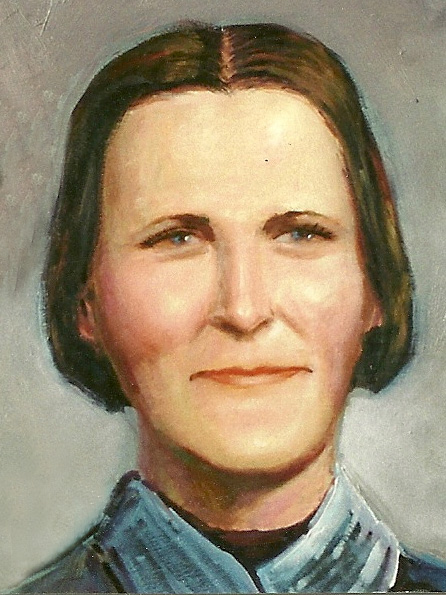
My mother’s name was Mary Ann Darrow. She was the daughter of Stephen and Harriett Burbank Darrow of Hebron, New York, where she was born 28th of February, 1818. She married Edmund Richardson on 2 August 1840.
Edmund Richardson and Mary Ann Darrow, by Owen Richardson
She was a factory girl during her young womanhood; thus early beginning her trade as a weaver, which was of so great use to her family and to the many of her neighbors to whom she taught the trade after she came to the valleys.
Once when I gave a trivial excuse for not doing some duty, she told me, “I once knew a little girl who habitually soaped her hands so that when her mother asked her to do something she could reply, ‘My hands are soapy, I can’t’” After looking at her thoughtfully a moment I asked, “Ma, was that little girl you?” A smile was her answer. I have often thought what a queer beginning that was to the wonderfully industrious life she always led in after life.
She was a very determined woman when her mind was once made up. During her young womanhood a man who had become violently insane in the town where she lived, obtained a long sharp knife, and brandishing it, defied a large posse of men to enter the room where he had taken refuge. The neighbors, knowing her capabilities, sent for my mother who came to the door of the maniac’s lair and looked at him. For a few seconds he avoided looking at her; but when his gaze finally met hers, she looked steadily into his eyes for a minute, when he dropped his hands, his knife falling to the floor, and still looking into her eyes allowed the men to tie him without further opposition. Also one of my father’s brothers, named Dan, occasionally became insane and whenever she came into the room where he was, at a look from her, he always became tractable.
She had a very good education for those times; she was an effective reader and always had a story or anecdote to illustrate her advice which was constantly sought wherever she lived. She had the keenest sense of humor and liked a funny story if it was “clean.” Her little stories to her children were endless in number. Here is one:
She said a little girl was eating her supper of porridge from a bowl on the ground between her feet as she sat on the doorstep. A little pig came along and investigating the savory food in the bowl, put in his snout and commenced to swallow it. The little girl, seeing the liquid lowering began eating as fast as she could from one side of the bowl. When she saw that the pig was likely to get the most of the supper as things were going, she extended the handle of the spoon to the pig and said reproachfully, “Take a ‘poon, pig, ‘at ain’t fair.”
One of the ardent desires of her life was that her children should have a good education, but with her first two, the frontier life in Canolton, Indiana, and neighborhood, prevented its attainment which was always a great sorrow to her. But when her last ones came she constantly labored to that end.
She could make any undesirable trait that she saw in us look ridiculous and make us ashamed of it so easily. For instance she said a family of her neighbors were eating breakfast one morning when she heard one of the growing girls scream out as if she were in agony, “Sal’s got the most grease!”
As my mother knew nothing of the teachings of the true gospel in regard to the value and necessity of children, they did not intend to have any more than the two children that they brought across the plains. So that my brother Sullie and I owe our very existence on this earth to the teachings of the Gospel after my mother became acquainted with it.
I have often heard my mother tell of their fear of the dreadful Mormons. When the oxen died at the Big Sandy River, and they knew that it would be utterly impossible to continue the journey to Oregon until another spring, they were almost overcome with the dread of having to associate even so little with the people they knew lived in Salt Lake City. But the Indians were still more dreadful so they knew it was their only hope of life.
Arriving in Salt Lake City
When they arrived in Salt Lake Valley, they decided to go over west of the Jordan River which had the advantage of being apart from the bulk of the people and with few neighbors, but near enough for protection from the Indians.
The first intercourse they had with the neighbors was when a neighbor invited them to come over to their house for supper. They were fearful of offending the neighbor by refusing to go and were fearful that their host might get offended at persons professing another than the Mormon religion, and might murder them. However at the least of two evils, the invitation was accepted and it twas to them noteworthy as the first time in their lives that they had ever tasted flour “mush.” They had always supposed it must be made of cornmeal or buckwheat in order to be eatable.
In a few days another invitation followed, acquaintance having removed some of their fear they accepted an invitation to a Mormon meeting. That was the beginning of the end, because as soon as they heard the preaching of the true gospel they lost all wish to go on to Oregon. As there was then a call for settlers to go to build a home, and it was there five and seven years later than I and my brother were born.
I have heard people tell of an incident that happened in early days at Manti. My mother at that time lived in the outskirts of the town where the Indians came first to beg or ask for food. There had been some dissatisfaction on the part of the Indians and an outbreak of hostilities threatened. One day an Indian all painted up suddenly presented himself at her door and insolently demanded bread. My mother had an oven full of biscuits just baked, setting on the hearth. She opened it and taking out some of them, gave them to the painted brave. He received them, but demanded more. When she refused, he strode up to the hearth and stooped to take out more. My mother stopped him and he immediately drew from his belt a large knife to strike her, raised it in the air, clutching the hilt. My mother sprang back and seized a long-handled heavy-bladed fire shovel, raised it in the air to strike him. As the Indian saw determination blazing in her eyes and that she could reach him with the long shovel before he could reach her with the knife he decided that discretion was the better part of valor; he suddenly exclaimed in very good English, “Brave squaw,” lowered his knife and departed. But the sight of the threatened encounter which she could see plainly from the door of a house directly across the street, so agitated a neighbor woman that she fainted dead away. The neighbor was the person who told the story.
One day mother dropped a flat-iron on her toe, causing a very bad sore where the iron bruised the bone. Proud flesh formed in the sore and it refused to heal, or yield to any treatment she could bestow. She went to the doctor and he wanted a hundred dollars to amputate it. She told him she would give him twenty-five or fifty, but she would never give him a hundred. He thought he was sure of his point and told her to go home, but that she would be in back. She became irritated with its soreness and taking a carpenter’s chisel from my father’s chest, she placed the toe on a block of wood with the chisel on the toe. She struck the chisel a smart blow with a flat iron, which of course amputated the toe. I have often seen the amputated remains of the toe. The doctor later asked about it and was very incredulous of her story of it.
My earliest remembrance in Springerville [Springville, Utah] is of hearing the clang of my mother’s loom. She wove constantly, unless something unusual interfered. She would not quit the loom seat at night unless she had earned three dollars that day. When anyone wanting to learn to weave came, she always taught them all she could, but I do not think anyone ever learned to weave the fine blue and white coverlets that were her specialty, though she always showed the different steps necessary to make them whenever asked. But many a person in that early day learned from her all kinds of plain weaving. All our clothing was made from cloth woven by her hands and it was so well woven we were proud to wear it. My father, being a first class mechanic had built her an excellent loom, which of course had helped her to produce a finished product. People came from far and near to buy her beautiful coverlets and bed spreads.
Another incident will illustrate my mother’s presence of mind. She went in company with my sister, with my father and brother to obtain their pails and berries, while my father obtained a load of logs for a school house that was being built. While she and my sister were busy picking the berries, some Indians who probably thought to enjoy their fright and obtain their pails and berries, sneaked into the bushes around them, and when all was ready set up an unearthly yelling. As it came as an unexpected surprise with all the blood curdling effect of an Indian whooping it up in a forest, my sister dropped her pail and started to run. My mother called her back, chiding her, telling her that if the Indians wanted to catch them, running would not save them as they were no match for the Indians in a race. So they kept quietly picking berries. Their coolness discomfited the Indians who soon left them in peace.
Indian Babies
by Sullie Richardson
Soon after we moved to Springville [Utah] in the fall of 1861 or the spring of 1862, the Indian interpreter, Amos Warren, went down into the “Clay Beds” to an Indian Camp. A squaw had died in the night and the Indians were going to bury her and leave. But she had a baby girl about eighteen months old. None of them wanted to care for her and besides she was the only remaining heir of a chief who was dead. With the child out of the way, quite a lot of property would be divided among the tribe.
Just before Warren came they had set the child on the mother’s breast and stood off to shoot at her with their bows and arrows. As he rode up one shot an arrow at the baby sitting quietly looking at them in wonderment. The arrow went through its neck so near the jugular vein, it was a miracle it was not severed. The baby screamed and caught hold of the arrow. Another shot her through the leg near the body before Warren could interfere. Another Indian stepped out with a laugh to take his turn. Warren called him to stop, but the arrow was fitted and the bow raised before Warren caught his hand and argued for the baby, until they agreed to sell the child for an old buffalo robe and other stuff of the value of seven or eight dollars. But he had to give his faithful promise that she would never come back to the tribe to claim the ponies and property that would have been hers.
Carefully he took the arrow from her neck and brought her home and at last chose my mother as the one who would be nearest a mother to her. He was a poor man so mother paid him in cloth she wove for his price to the Indians. But it was so long before the wounds healed that I still remember the wound in her neck.
Kate Aldura had the care of a mother as we did. Had her home-woven dresses, went to school with us, and shared our home. She tried to be a good true girl and all that was worthy until long after mother’s death, when she was betrayed by a scoundrel white man, who had promised to marry her. But he ran away and left her to care for her daughter. Kate worked in a hospital in Durango, Colorado, and later became the matron of the principal Indian Schools in the Middle West.
In Sanpete, Ma had taken a little Indian boy to save its life, and after months of care, a woman sent to see if she could take him to nurse her breasts. Being assured there was no disease or fever he would nurse, Ma consented. The assurances were false, and the little fellow who had been robust, died of convulsions.
Mary Ann’s Life Nears its End
by Edmund Richardson
When my brother Sullie and I were small tots, my mother had a very serious illness. When it seemed to her that she could not live any longer, she turned her face to the wall and almost frantically prayed the Father to let her live only until her two boys could take care of themselves, promising that then she would be resigned to His call.
In telling it afterwards, she testified that she immediately began to recover; saying that she expected another call just as soon as her boys should barely get old enough to care for themselves. The call she expected did come when we were barely old enough, for when she died I was twelve and Sullie was ten.
Almost as early as I can remember, my father went to Nevada to the mines. He did carpenter work and put the greater part of his earnings into claims. He always expected to make a fortune for his family. Mother wove, and farmed and kept things going at home. So many robbers infested the road, it was almost impossible to sent money home, but once Mother wrote that she must have money to pay taxes and other necessities. Father sent several cans of honey, one of which mother sold; and a number of small chests of tea in boxes made in China, about six inches wide and seven or eight inches deep. Mother was a bout to sell a box of the tea, also, when on opening one she found a roll of bills buried in it. He had not dared mention it or he knew it would not get to her.
During the year just previous to the last call, I often heard her say that it doubtless would come soon, and with this feeling impelling her she begged all hands to hurry to get what work could be done for their dead completed so that she could go in peace.
…Arrangements were made to go to the Endowment House in Salt Lake City in order to do it. But as my older brother did not take any interest in religious matters, she was fearful that my tender age would prevent my doing as she told me that it should be an heir, to work for her dead.
When we arrived in Salt Lake City, she visited the presiding officer of the Endowment House to ask him if a boy of twelve could be allowed to have his endowments so he could work for the dead as an heir. Daniel H. Wells was then in charge of the House, and he replied that if they would bring me to him, he would decide if I could be admitted. When we went to see him the next morning, he asked me some questions as to my belief in the Gospel, and, on hearing my answers, he emphatically told my mother that I could be trusted to have my endowments.
When he gave his decision favorably, so that it made it possible to do her work in [the temple], the satisfaction that shone in my mother’s face was supreme. When the work was done, she remarked that she was not long going to stay with us, though at the time, she seemed to be in good health. Soon she was stricken with pneumonia and died January 13, 1872. She always thought she did not have any friends, but more people came to her funeral than I had ever seen to any funeral in town.
I was born on the 13th day of February 1816, in the town of Mount Holly, Rutland County, Vermont. My father was Calvin Richardson. He was a surgeon in the Revolutionary Army. My mother’s name was Mindwell Barrett. After living with my father until of age, I started for the west. I stopped off at Washington County, New York, where I married Mary Darrow 2 August 1840. Then I moved back to Vermont where myself and wife were united with the Presbyterian Church. Since my father’s family was of the Baptist and Methodist faiths, ill feeling and persecutions arose and grew to the extent that I could no longer live in peace. Therefore, I moved to Cannelton, Perry County, Indiana, where I lived five years, spending much time and money building up and promoting what I believed to be religion. As I was trustee, much of the work fell upon my shoulders. In a word, I was like Paul, a Pharisee, living according to rigid sectarianism, but still looking for light and truth.
Edmund Richardson and Mary Ann Darrow by Owen Richardson
At last I united with a colony and started for Oregon. Money began to fail so I joined my brother-in-law in one wagon. After being out some time, division began to arise, so at last at Independence Rock, I bought me a wagon. But my cattle were weak from alkali and everything seemed against me. I kept on to the big Sandy River however where my best ox died. I was obliged to leave friends and everyone I ever saw and turn toward Salt Lake, on account of the state of my team.
We were twenty-seven days going one hundred and sixty miles. We were all alone all the time, except as we met someone now and then. We saw bodies of men that had been murdered by Indians, and we were surrounded by grizzly bears when we camped on the side of the mountain at night. But the hand of God was over us, and we arrived safely in Salt Lake City. My wife remarked that it was like Job’s captivity turning when he prayed for his friends, for our fortune turned when we turned.
Although we knew nothing of the Mormons except the false reports in circulation, we thought we might live with them for one winter. We soon began to feel the spirit of inquiry, and the consequence was that myself and wife were baptized by Ralph Thompson on the 3rd of October, 1853. In December, I was sent to Sanpete, and on 11 February, 1954, I was ordained an Apostle of the Seventies under the hand of Nelson Higgins. I was re-baptized, and on 11 February 1854 and in 1857 I paid $168.00 into the [Perpetual] Emigration Fund.
Thus far my faith has been firm in Mormonism. I know it is true and am satisfied to remain in it, which I pray may ever be the case.
— (signed) Edmund Richardson
An Account by Charles Edmund Richardson
My father told often of his early life in Vermont. They were very poor, his father being a hunter of game, rather than the head of the family. But when my father and his brothers came to manhood, things began to be financially better. The boys planted crops of potatoes and were generally successful with their farming. The best of all was that he grew up with very strict ideas of honor and integrity. He was a good father to Sullie and me. He has taken me in his arms dozens of times, telling me that he thanked the Lord for me. He never chastised, even when it seemed he ought to do so, but contented himself with a verbal chastising.
For instance he always kept a keg of whiskey under the bed. At one corner of the room under the further corner of the bed, there was a “Cat hole.” My brother George commenced to throw his saddles, straps and other boyish treasures under the bed, and while there rummaging among his things could draw a pint cupful of whiskey and shove it out to some of his pals outside. He would then come out and go down into the willows and drink it. One time my father happened to be outside and saw the cupful handed out. When he saw George come out, knowing the conditions as given, he only said, “George, you are a whale to drink whiskey.”
He loved my mother with unfeigned love, and was never tired of making things or doing all possible for her comfort. He made an arm chair with the back carved exactly to fit her shoulders. His devotion to my “stately mother,” as she was lately called by one who knew her, was unlimited.
Not long after the birth of my brother, Sullie, 26th of January 1861, my parents moved back to Springville, Utah County. My parents had two older children who had been born in the states, previous to my parents having heard the true Gospel. Their names were Emma Lynette, born 30 October 1841, in New York; and George Alvin, born 4 September, 1846. Father, mother, and sister Emma appear in an old manual—a record of the East Hebron Presbyterian Church.
Letters to the Family
(Note: The first four letters below were copied from originals in the hands of May Hatfield and Daisy Kelly, Springville, Utah, Edited by Lola Harm).
Father ran a tannery, a grist mill, farmed, and anything else he could find to do to keep his family. He soon became interested in mining. February 2, 1874, Sullie went over to father in Dragon Hollow. I was in Springville and sent him the following letter:
Springville, Utah Feb. 2, 1874
Dear Father:
Sullie thinks he will come over as he has got tired to school. Evans begins another quarter today and I do not now whether to start to school or come over there. You must write and tell me what to do, and what chance there is to get work over there. I paid the taxes out of that money you sent me over and got Sullie some boots. The goods have not come yet, and some think they will never come. But I guess they will get here some day. My shirt got so ragged that I had to get some cloth and Emma made it for me. There is not much news to write. Kindred died the other day and was buried. Erastus Jabez and Susan Kendall got married the other day and are now happy. I guess Sullie can tell you the rest.
From your loving son, Charles E. Richardson
Dear Son:
I don’t want you to be a teacher in school; if you go to Mr. Evans, attend to your own studies unless he pays you for it. My foot is lame yet. I want a pair of sox. Please send with that thirty-five and get me that pistol I wanted.
(Note: An Eastern company offered orders of goods for 25 [cents] with the order and one dollar when the goods arrived, so these were sent as orders to Emma as agent. The twenty-five cents went, but the order never came back. Evidently this letter was dictated by Edmund to his son, Charles Edmund. The S.C.R. is Sullie, Lynette is their older sister, Emma Lynette, and John is her husband, John Conover. —Lola Harms)
Dear Sisters and Brothers:
Pa says he will take a pair of boots No. eights, some flannel for shirts, 11 yards; hickory shirts 6 yards; Kentucky jeans 10 yards; coat lining for S.C.R., 1 pair galluses for S.C. R.; 1 hat for S.C.R. I sent measure. If there is any left, get it in tea and tobacco.
E. Richardson
Pa sends five dollars to help out.
Lynette:
I want you should copy this off so John shall understand it. Edmund can send for his. Dear children and grandchildren I send my love and respects to all of you, and wishing you health and prosperity.
E. Richardson.
Father worked in a tunnel of his own two or three days and about the 20th of March caught a cold. I walked over to Diamond City for some pain killer for him, and then at the instance of Dr. Wing over to Eureka. Sullie was with us then. When I saw that he was very sick, I walked down to Silver City and telegraphed to Springville for John and Emma.
Deseret Telegraph Co. Silver City, 24-1874
To: John Conover Springville, Utah
Father is very sick come if you want to see hi alive. Paid.
C.E. Richardson
During his sickness of one week, Sullie and I [Charles] were his only nurses. And as Sullie was too young he could not stay awake. I passed a part of the week when he was the worst with only a few hours sleep. John came over in the night in a wagon, and was there a short time before my father’s death, which occurred while Sullie and I and a stranger were with him.
Dragon, 25 March 1874.
Dear Sister:
We are all here. John got here alright but pretty tired. Pa is pretty bad yet, but I think he will come out alright again. He does not eat much. Dr. Wing is doctoring him. John is going over to Eureka to get some medicine. Pa wishes all the time he was over there and says he is going over there as soon as he can get well enough. I cannot write much this time, but I will write again pretty soon. John says he will not be over till Pa gets better and he can fetch him over so you must get along the best you can.
Well good by for the present.
Your affectionate brother, C. E. Richardson.
John took our dead father back in the wagon. We wrapped the body in bed clothes and started. But as the strain and anxiety had ended, I laid down in the wagon beside my dead and slept most of the way, not in his arms as I had been accustomed, but along side his beloved body, completely overcome with exhaustion.