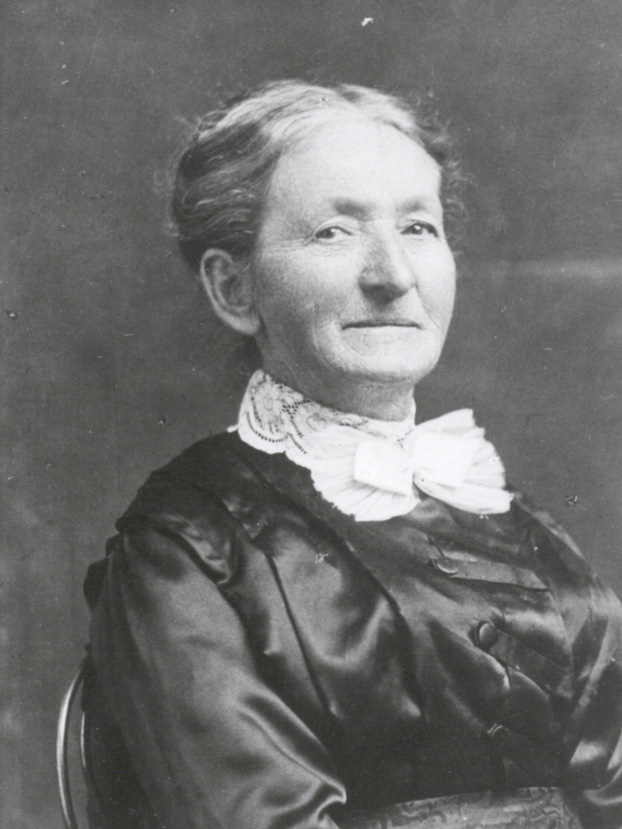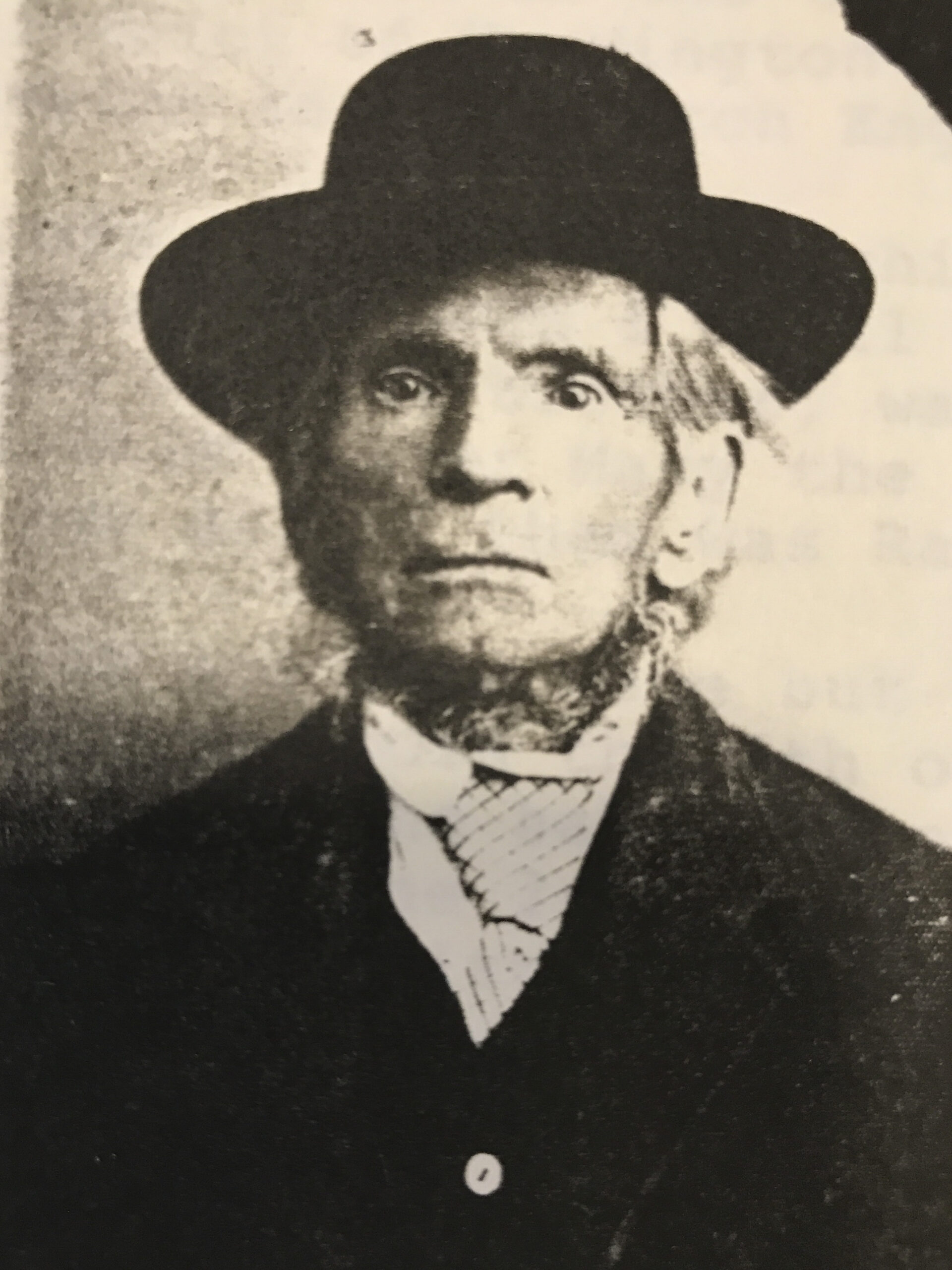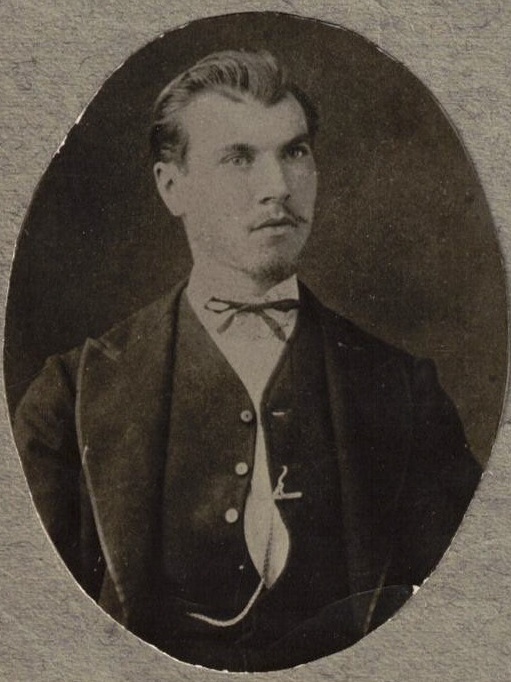
Wilhelm Wilker was born on January 12, 1847 in Solothurn, Solothurn, Switzerland to Johann Wendel Wilker and Anna Katharina.
As a young man, Wilhelm, left Solothurn and settled in or around Zürich. He was a painter and an artist. Perhaps he was looking for better employment, perhaps his sensitive nature for beauty and cultural arts could find better satisfaction in a larger city. In Zürich he met a young woman, Maria Küenzlin, who was born in Oberbaldingen near Danaueschingen, Baden, Germany, on October 17, 1842.
Family tradition holds that Maria Küenzlin was employed in the household of a well-to-do member of the nobility, Frau von Meyerburg. Maria enjoyed her association with this lady and hated to terminate it. But the prospect of marriage was much more important.
When Maria left her employment, Frau von Meyerburg presented her with a book, entitled: Martin Luther’s Christian Doctrines for Each Day of the Year. Her autograph is on the inside page in German script: “In remembrance of Frau von Meyenburg, 15 February 1872.” A month later, Maria married Wilhelm Wilker on March 20, 1872. The young couple took good care of the book. They thought so much of it that they recorded their marriage date in it. They also recorded the births of all their children, and the date when Wilhelm joined The Church of Jesus Christ of Latter-day Saints.
The first two children were born in Wädenswil on the left bank of Lake Zürich. The next four children were born in Schaffhausen, the capital of the Swiss state by the same name.
The family record listed the following:
| Name | Role | Notes |
|---|---|---|
| Wilhelm Wilker | Father | born on January 12, 1847, in Solothurn, Switzerland |
| Maria Küenzlin | Mother | born on October 17, 1842, in Oberbaldingen bei Donaueschingen, Baden, Germany |
| Maria Emilie | Child | born on June 20, 1873, in Wädenswil, Switzerland |
| Heinrich Wilhelm | Child | born on March 20, 1875, in Wädenswil, Switzerland |
| Albertina Hedwig | Child | born on August 29, 1876, in Schaffhausen, Switzerland |
| Ernst Herman | Child | born on 24 March 24, 1878, in Schaffhausen, Switzerland |
| Friedrich Karl | Child | born on October 24, 1879, in Schaffhausen, Switzerland |
| Emma Julia | Child | born on 3 January 3, 1883, in Schaffhausen, Switzerland |
While living in Schaffhausen, Wilhelm and his wife, Maria, joined The Church of Jesus Christ of Latter-day Saints. Wilhelm was baptized in the cold waters of the River Rhine on January 23, 1882, and confirmed the same day. His wife, Maria, and the oldest daughter, Maria Emilie, not yet nine years old, followed about three weeks later on February 16, 1882.
The Wilkers were enthusiastic members of the Church, filled with a great desire to help build up the Kingdom, and to cast their lot with the main body of the Saints in Utah in the United States.
They must have been aware of the announcement in the March issue of “Der Stern” that the first date for emigration for this year had been set for May 17, 1882, in Liverpool, England; and that all Saints from Switzerland who wanted to join were requested to meet in Basel on the May 10, 1882. There was a goodly response to this announcement, more so than usual. Friends and relatives in Utah had generously supported an appeal to help the poor people emigrate to Utah.
The Fischer family in Schaffhausen was one of the families that decided to emigrate. The family consisted of father, mother, two young daughters, and one son. The Wilker family was well acquainted with and on good terms with the Fischer family. Wilhelm would also have liked to emigrate with his family, but financial and other circumstances did not permit such an undertaking at this time.
Still, Wilhelm was not satisfied. After much praying and contemplation, it was decided to, at least, make a start, and send Maria Emilie, their oldest daughter, with the Fischer family. Maria Emilie lacked four months of being nine years old. She was rather young to be going into a strange country alone, but she would be taken care of by a good family, and within a year they would be united again, and all would be well. Such was the faith of the Wilker family.
On May 10, 1882, the Swiss emigrants met in Basel, and the next morning started on their journey to Liverpool, England. At 8 PM they reached Mannheim, where an overnight stop was made and where they met the emigrants from Southern Germany. The emigration party now consisted of 77 Saints from Switzerland and 55 from southern Germany. Early the next morning, they boarded the steamer Willem, which had been chartered to take them down the River Rhine to Rotterdam, the Netherlands. The weather was clear, but cool; and the saints entertained themselves with singing and admiring the lovely landscape. After crossing the North Sea, it was but a few hours’ ride until they reached Liverpool, their embarking station. They arrived in Liverpool on May 15, 1882.
Upon arriving in Liverpool, they had the sad task of burying Sister Lehmen’s youngest daughter, who had caught a fever just a few days before they emigrated.
The SS Nevada was ready to receive its passengers. The company boarded the steamship on May 16, 1882, and the following day sailed into the Atlantic Ocean. The company consisted of 239 Saints from England, Scotland, and Wales; 138 from Switzerland and Germany; and 15 missionaries who were returning home, for a total of 392 members.
After leaving Liverpool, the returning elders completed an organization, with W.R. Webb as president and A.H. Cannon as clerk. Four wards were organized, and the English- and German-speaking Saints were placed in different compartments. The weather was generally fair, with very little seasickness. Children played together as though they had known each other all their lives.
Sweet, little, and delicate Maria Emilie got homesick, and began to cry. Then she spotted a young boy, a few years older than herself, who had a handkerchief tied around his head, and whose face was swollen. She felt sorry for him, and forgetting her own misery, went and put her arm around his neck, and tried to comfort him.
The boy was between twelve and thirteen years old; he was from Zürich. His name was Julius Billeter. Like Maria Emilie, he was alone and the first member of his family to emigrate to Utah. One of the returning missionaries, Ulrich Stauffer, had promised his parents to look after him and provide a home for him on his farm in Willard City, Utah.
The companionship of Maria Emilie and Julius turned out to be something more than casual acquaintanceship. In the meantime, life went on as usual. All the passengers were well enough to attend morning and evening prayers, and the meetings that were held on board.
One passenger, Ellsbeth Sturzenegger, came from Toggenburg, Switzerland. She was the mother of two daughters, one of whom was a six-month-old baby. Life at sea was too hard for the tiny babe; she passed away and was consigned to the sea a day before the boat landed in America.
The Nevada arrived in New York City, New York, on May 27, and by evening of the same day, the Company was able to continue their journey to Zion across the country in a comfortable train. The train arrived in Ogden, Utah, on June 4, 1882, at 1:00 AM. By noon, it proceeded to Salt Lake City.
The Fischer family, with Maria Emilie, very likely disembarked at Montpelier, Idaho, in the Bear Lake country. From there it was a rough wagon ride of about twelve miles to Paris, Idaho, their destination.
Young Julius and his guardian, Ulrich Stauffer, left the train at Ogden, and proceeded north to Brother Stauffer’s farm, about fifteen miles beyond Ogden.
Only those that know the paths of love will ever understand how Maria Emilie and Julius contrived to meet again and nourish the bonds of friendship and love that had been kindled on board of the ship Nevada.
The year 1882 had been an eventful year for the Wilker family, but the start of 1883 surpassed it in excitement and important changes. The New Year had barely started, with the arrival of a new family member. Emma Julia was born January 3, 1883. An announcement of it was published in Der Stern on January 15, 1883.
Wilhelm attended Sunday School from time to time, where he assisted the Sunday School Teacher in the presentation of his lessons. Attendance varied from an average of fourteen to nineteen children, and the subjects discussed were taken from the Song Book, the Catechism, and the New Testament.
Wilhelm bore a strong testimony. He submitted a written version of it to Der Stern, where it was published along with several other testimonies.
Wilhelm’s testimony reads as follows:
“On the 23rd of January, I became a member of The Church of Jesus Christ of Latter-day Saints. Like the majority of people, my outlook on life was indifferent; unconcerned about spiritual matters. I flitted through life aimlessly. But now that I have been awakened from my spiritual slumber, I am happy in the knowledge that salvation comes from keeping the Commandments of God. Just like 1800 years ago, the servants of God teach to one and all Faith and Repentance, Baptism by immersion, and the Laying on of hands for the Gift of the Holy Ghost. Freely have they received, freely are they giving. The Gospel, as preached by them, was given to the Prophet Joseph Smith by an Angel; he, Joseph Smith, was called and ordained by revelation to lay the foundations for the establishment of the Kingdom of God. While churches and other religious groups continue to split up, and are rapidly wasting away, the Church of Christ increases in might and power, because its members accept the commandments and teachings as contained in the Holy Scriptures. Let us all be faithful in keeping the commandments, walking uprightly before God, so that unitedly we may be able to support this sublime and lofty work; overcoming all trials and temptations, because this is the work of the Lord and our only salvation.”
But the event of overriding importance was the prospect of emigration. This was an event that Wilhelm had been looking forward to ever since he was baptized. But such an undertaking, especially with a large family, required a lot of preparation, both financially and otherwise. But since the previous year, there had been another incentive to emigrate. They missed Maria Emilie very much. They wondered how she was getting along, and whether she was receiving proper care. They longed to see her and have her reunited with their family.
Emigrants received ample instructions. Der Stern, dated May 1, 1883, contained a two-page supplement with instructions from Mr. Louis Kaiser, Emigration Agent in Basel. It contained both specific instructions for the company leaving May 10, 1883, and general instructions applicable to all companies. The general instructions were basically as follows:
“Trunks must be sent to Basel (for Swiss emigrants) at least ten days before the departure of the Emigrants. It is suggested that they contain, in addition to clothing, bedding, etc., also a few bars of soap; an iron; some kitchen utensils. Weight should not exceed 50 lbs., unless one is prepared to pay extra for overweight.
All persons must have certificates of citizenship, or acceptable substitutes; those subject to Military Duty must have been cleared as evidenced in their Military Service booklets.
All passengers must be vaccinated, unless they have been vaccinated within the last seven years, otherwise they will not be permitted to land in New York. Vaccinations can be obtained on board of ship, free of charge. They can carry song and other books in their hand luggage for easy accessibility and use on the trip. They should wear older, sensible, warm and clean clothes; it may be cool on the ocean. Children’s hair should be cut short to avoid annoyance. Hand baggage should include enough underwear for three changes, some handkerchiefs, soap, hand mirror, comb, knife, fork and spoon. Only one hand baggage per person, plus wool blankets. Important: Prevent overloading of hand baggage; it causes inconvenience and difficulty for everybody, and sometimes loss of luggage. For the ocean part of the trip, take along some vinegar, green cheese, dried fruit, perhaps some smoked meat, and for the children, condensed milk, toasted bread, etc. Never stray from the group, or trust strangers. Disregard of this advice may result in unpleasant consequences: Last fall, a young man had his watch and chain stolen; a thief ripped a piece of paper out of a woman’s hand, mistaking it for money; four people missed the train. When changing trains, arriving at hotels, etc., each one is responsible for his own hand luggage. It is important to follow the guide’s instructions at all times. There is no duty to pay on patience, forbearance, obedience, cleanliness, good will; whereas impatience, selfishness, stubbornness, uncleanliness, etc., cause much ill-will. All honest debts should have been paid; if there are some that haven’t done so, it is desired for Conference and Branch Presidents to so notify us; we do not want to do any business with them.
From Liverpool on, Adults are entitled to 120 pounds of free baggage; and children, five to twelve years old, sixty pounds. This should be sufficient to eliminate problems with overweight.”
During the year 1883, the Church arranged four Emigration parties, all leaving from Liverpool, on the veteran, dependable steamship, Nevada. The first one was scheduled for departure on April 11, 1883, the next two for May 16 and July 20 respectively, and the last one was set for August 29.
| Name | Role | Notes |
|---|---|---|
| Wilhelm | Father | age 37 years |
| Maria | Mother | age 41 years |
| Heinrich Wilhelm | Son | age 8 years |
| Albertina Hedwig | Daughter | age 7 years |
| Ernst Herman | Son | age 5 years |
| Friedrich Karl | Son | age 4 years |
| Emma Julia | Daughter | age 8 months |
The Swiss members of the last company met in Basel, Switzerland on September 23, 1883, where they were welcomed by Mission President Cannon and several elders. Early the next morning the party left by train for Antwerp, Belgium. The Saints were wide awake, full of anticipation and yet regretful about leaving their homeland. The fruitful plains, green with mowing hay, and yellow with ripening grain, stretching endlessly toward the horizon, and mountains disappearing into invisibility made them realize more than ever that they were embarking on a new and different life.
In Strassburg, France, the train stopped long enough for lunch in a nearby hotel, and at 6:00 PM it stopped at Luxemburg, for overnight accommodations. Due to a misunderstanding, arrangements had been made for only forty people, whereas accommodation was needed for twice that many. It took the Emigration Agent considerable time to make additional arrangements, but finally all the passengers were somehow taken care of. The next morning, September 25, after a hearty breakfast, and a snack tucked away, the travelers continued their journey, arriving at the seaport of Antwerp at 5:00 PM, weary and tired. After a good supper and some rest, the party felt refreshed and by 10:00 PM they were on board the Fairy crossing the North Sea. Bathed in full moonlight, the boat resounded with songs of Zion and Swiss yodeling until late at night. September 26 dawned without a trace of wind or waves, with sunshine that was pleasant, but not oppressive, which made for a most unusual departure from the stormy and violent mood for which the North Sea is famous. By midnight the Fairy arrived in Hull, England. The morning of September 27, the party landed, had breakfast, and after a short ride on a special train, arrived in Liverpool, their embarking destination.
By 4:00 PM on the same day, the company was on board the Nevada. Later on they were joined by the Scandinavian Saints, and from time to time by smaller groups of English emigrants. The evening passed away with singing, music and dancing; and the same was true of the following evening. By now almost all the passengers were on board. The next day was Wednesday, September 29, and a few more passengers arrived, and by evening the Nevada was floating down the Mersey River out into the ocean.
There were 682 Saints on board; 263 from England, 282 from the Scandinavian countries, 106 from Switzerland and Germany, as well as two returning ladies and 29 returning missionaries. Elder P. F. Gass, one of the returning missionaries, was appointed President, with Elder Hyrum Evens in charge of the British, Elder Ledermann in charge of the Swiss and German, and Elder Hansom in charge of the Danish Saints.
As soon as the Nevada hit the ocean, the music end merriment gradually changed to groans, misery, and lamentations. The winds increased, the waves grew ever larger, the boat tossed and shook violently, and by Friday the boat was engulfed in a violent and severe storm. People were bounced around like straw. The rudder broke, and for six hours the boat heaved and rolled at the complete mercy of the ocean, with the result that it was blown fifty miles off course. The captain worked all night like a regular sailor, and by morning the rudder was repaired and the ship under contro1 again. During the height of the storm, almost all passengers were seasick; only four showed up for meals.
An older sister decided to get out of bed. Before she knew it, she was picked up by the storm and violently thrown from place to place, sustaining severe injuries.
About halfway on the trip, a baby boy was born. The baby boy and his Swedish mother were healthy.
Toward the end of the trip all passengers recovered. Smiles returned to their faces, the Swiss and Germans started singing again like sparrows. Two concerts were given and enjoyed by passengers and crew alike.
On Sunday morning, September 9, land was spotted and by 3:00 PM the Nevada was able to dock, having made the trip in twelve days, despite the stormy weather.
From New York City, the emigrants were able to travel west by train all the way to Utah. Destinations included Salt Lake City, Ogden, Logan, Utah, and Montpelier, Idaho. Montpelier was the nearest railroad station for Paris, Idaho. It was the stopping off place, not only for the Wilker family, but also for the Hauser family, and Anna and Marie Schmidt.
Paris was still more or less a pioneer settlement. The first wagon train of pioneers, consisting of more than thirty families, arrived on September 26, 1863. More pioneers followed. The first winter some of the pioneers lived in huts built from quaking aspens; some managed to build log cabins. The next spring, 700 more people arrived in the valley. The second winter was most severe, but the pioneers persevered and remained. They thought they were in Utah, until a boundary survey in 1872 determined that this land belonged to the state of Idaho. When Bear Lake County was established in 1875, Paris became the county seat.
The early settlers included several Swiss families. The first mayor of Paris was Swiss. His name was John Ulrich Stucki, and he was a native of the state of Thurgau. He was a staunch believer in the future of Paris and Bear Lake County. In a brief note, in the May 1st issue of Der Stern, he stated that Bear Lake had many advantages for new settlers, and encouraged them to settle there or in Cache Valley. Land was cheaper and conditions more suitable for raising families, especially larger ones, than in Salt Lake City, Utah.
The Fischer family that had left Schaffhausen almost a year ago, seemed to be happy and doing well in Paris.
On the July 24, 1883, (although not published in Der Stern until the first of November) Sister Fischer reported that she felt fortunate to be in Zion, redeemed from Babylon. They had their own home, and some land. They had everything they needed, more than they ever had in Babylon. There they had lived in constant fear of what they could cook and eat, because their income was insufficient. Here, they had enough. The letter closed with a testimony and a prayer to remain faithful.
The Wilker family could hardly wait until they covered the fifteen miles from Montpelier to Paris. They were anxious to see their daughter, Maria Emilie, again, and to find out more about their future home. They were shocked when they saw Maria Emilie. Before she left Switzerland, she had been provided with a bundle of fine clothes. But they were gone; the clothes Maria Emile wore were poor and shabby. The parents suspected that life had not been easy for her, and they were appalled at her condition.
The family settled down, presumably in a one- or two-room log house. They barely had time to adjust themselves to their new conditions when an epidemic of scarlet fever swept through the town. The whole family fell victim, except Wilhelm. In time, they recovered, all but the baby, Emma Julia. She died within the first month of their arrival in Paris.
Frontier life was entirely different from what Wilhelm had enjoyed in Switzerland. There, he had been an artist, unrestrained in the exercise of his sensitive nature and love of beauty. Here, he was a farmer and settler, and life was raw and hard.
Wilhelm had an opportunity to work on the finishing of the Logan temple. He assisted in painting the murals on the temple walls. Wilhelm’s granddaughter, Maya (Wilker) Muir, noted, “In my Book of Remembrance is a picture of a group of workmen on the Logan Temple and Grandfather Wilker is in the picture along with some of my other progenitors. My father explained that his father was a sick man with consumption when he came to this country; the altitude was too high, and he died from that disease and also dronsey (dropsy? edema). Painters were also subject to lead poisoning, and perhaps that was a contributing factor.” (Beverly Wilker, descendant of Wilhelm, reported that when the Logan temple was remodeled in the 1990s, the murals were removed.)
The Logan Temple site was dedicated on May 17, 1877, by Elder Orson Pratt. The temple was completed seven years later and was dedicated on May 17, 1884, by President John Taylor.
William’s health became poor, and it continued to get worse. Perhaps it was tuberculosis. Two months after the Logan Temple was dedicated, and less than a year after his arrival in Paris, Wilhelm succumbed to the frailties and difficulties of life. He passed away in July 1884, still a young man of 37 years. He was buried in Lot 5, Block 56 of the Paris City Cemetery. Years later, a flood rushing down the mountainside destroyed this part of the cemetery, and fire consumed the city cemetery records.