Doc Type: History

  • Asaph Rice

    Asaph Rice

    Asaph Rice, born January 3, 1817, was the second son of Ira Rice and Minerva Saxton. His parents lived in Farmington and Palmyra, New York—not far from where Joseph Smith and his family lived.  Asaph had two sisters and two brothers when his mother died. He was seven years old at the time and oldest living child in his father’s motherless home. After the sadness of losing his mother, his father brought a new mother into their home.  She was Sarah Harrington—a young woman about 25 or 26 years old.

    After his father married Sarah Harrington, the U.S. government offered land located in the wilds of Michigan to the veterans of the War of 1812.  Ira Rice took his family there to take advantage of the offer.  The country was wild; it was wooded and suffered cold winters.  The wolves and Indians were constant terrors.  Ira and his sons learned to be great bear hunters.  Asaph slept under the heavy warm hide of many a bear, which he or his father had killed. 

    Some time in the year of 1840, the Latter-day Saint missionaries found the Rice family, and all that were old enough to become members of the church were baptized.  No record was kept of it, so Asaph was rebaptized in 1848, in Salt Lake City, Utah.  The census records of Washtenaw County, Michigan, 1829, shows the Ira Rice family in Plymouth, Washtenaw County, Michigan.  They were next found in Nauvoo, Illinois, in 1842.  Asaph, his brother Bill, and his father were among the first to cross the Mississippi River in the winter of 1846.  He arrived in the Salt Lake Valley, September 1847.  The Rices were sent to North Cottonwood (Farmington), which extended to North Ogden at that time.  

    Few men of the Church experienced more trials and setbacks than this Asaph Rice.  He was left motherless at seven years of age; but he was a dutiful and kind son to his foster mother.  At 23 he joined the Latter-Day-Saints [sic].  In Nauvoo in 1844 he suffered the sorrow of all good men at the death of his good friend and leader, Joseph Smith, and his esteemed friend, Hyrum Smith.  He was respected and trusted constantly by his great friend and spiritual leader, Brigham Young.  He was well acquainted with all the great men who were the church leaders of that trying day. 

    Asaph had his patriarchal blessing under the hands of John Smith in Nauvoo, Illinois, a month before he and his father, and brother Bill crossed the river in the dead of winter to satisfy the mobs.  He was a seventy in the 13th Quorum.  He did not marry until he was 42 years of age, as he had been so constant in his efforts to help his family and friends. 

    After Asaph married Louisa Busenbark Calkins, the widow of Edwin Calkins, they moved to what is now North Ogden.  This family moved south at the time of the Johnston Army troubles and then back to North Ogden.  Then they moved to Providence, Cache County, Utah in 1857.  Ten years later they were again on the move to the land of Utah’s Dixie. 

    In each settlement where Asaph lived, one finds lasting evidence of Asaph’s having lived there.  In North Ogden, there is a creek called Rice Creek; and he is credited with helping to build the first house and the first meetinghouse there.  The first school in Providence notes Asaph and his father as being those donating to its construction and helping to hire the first teachers in the school. 

    He knew no other mode of travel than horseback, mule, walking, or by ox team.  If he saw his few remaining grandchildren swiftly going over oil-surfaced highways in a few minutes, distances which he took days to cover, he would marvel.  But his heart would ache to find so many of his great-grandchildren disinterested and many disdainful of the church for which he was willing to give all just to be counted a member. He died in Panaca, Nevada on February 3, 1872.  The ward records said Brother Asaph Rice died in full fellowship in the Church in good standing.

  • Ira Rice

    Ira Rice

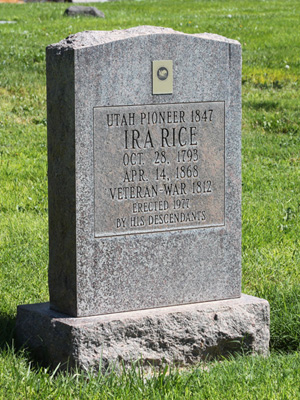
    An admirable attempt has been made in recent years to establish verification for the incidents and circumstances that surround the life and works of Ira Rice.  Some details have been rather elusive and what has been written concerning him has not always been accurate.  The following is written according to that which has been given in several accounts and includes such statements that seem to have common agreement.

    Ira Rice & the War of 1812

    Ira was born on 28 October 1793 at New Ashford, Berkshire County, Massachusetts, the son of Titus Rice.  His mother’s name is recorded as Lois, but her maiden name is yet unknown.  Ira was the youngest child in his family and became an orphan early in life.  We find him living with relatives in Western New York State where he grew to manhood.  A state of unrest existed in his home area following the boundary dispute that had been settled after the Revolutionary War.  The British, in that particular area, held territories to the West of the thirty-mile distance of the Niagara River, between Lake Ontario and Lake Erie.  Ira became familiar with the fertile land that bordered both sides of the river and he, no doubt, had heard much about the importance of waterways to American shipping.  The British, holding the opposite bank of the river, were well fortified.  For some time prior to the War of 1812, both British and Americans engaged in preparation for a coming conflict. 

    It is noted that Ira enlisted in the War of 1812 when he was 19 years of age.  His enlistment papers describe him as a farmer, five feet eight inches tall, light hair, blue eyes, having come from New Ashford, Berkshire County, Massachusetts. 

    The American recruits were poorly equipped and wretchedly disciplined.  Their weapons were personally owned and they were without uniforms, but their cause was real.  During Ira’s eighteen months of service, and while at Fort Erie, the near defeated British put the American Independence to one more of its many tests.  They set fire to a powder magazine, resulting in an explosion that scattered a small force of two hundred or more men in every direction.  Nearly all of the American boys were either drowned trying to escape across the river or were shot at the bank.  Ira slid over the bank and saved himself by swimming downstream four miles to safety.  He liked to tell how he leaped over the steep bank into a small hemlock tree, broke off a limb, and with it slid into the dancing waters below the falls of the Niagara River to escape with his life.  It was January 1, 1813, the end of his last enlistment period. 

    The Ira Rice Family

    A year later Ira married Minerva Saxton, and to them was born five children: Ira, Jr., Asaph, Maryette, Juliette and William Kelsey.  They lived in Farmington, Palmyra, and other near areas of Ontario County, New York. 

    Details grow dim, but the Rices, who were living so near the place where the Prophet Joseph Smith received his first vision, must surely have heard of this sensational event.  It was in this area that Ira’s wife, Minerva, died in 1824, and it seems evident that, shortly following, Ira accepted a Government payment to veterans of the War of 1812 in the form of a land grant in Michigan.  Though the land was considered unfit for habitation, it must have given Ira one of his greatest challenges. 

    It has been said that Ira married his second wife, Sarah Ann Harrington, before leaving for Michigan.  She was the daughter of Benjamin and Ruth Harrington.  Census records of Wayne County, Michigan list Ira and Sara with five sons and three daughters which, no doubt, included the three living children of Minerva, showing that Sarah Ann had added five children to Ira’s family.  By 1831, the Rice family had moved to Ypsilanti, Washtenaw County, Michigan, and six or seven more children were born to them while there. 

    In spite of the unfavorable account given concerning the wilds of Michigan, men such as Ira tackled the task of cutting down trees, building log cabins and planting crops.  Ira and his sons shot bears and their pelts were used as bed coverings and rugs.  Fish, wild game and wild fruit were plentiful and, at times, their only food supply.  His land holdings, as well as his personal property and livestock gains prove that Ira’s move to Michigan was a successful venture.

    Pioneering West

    The Rices were visited by missionaries of the newly organized Church of Jesus Christ of Latter-day Saints and the family became members in about 1840.  The spirit of gathering urged them to join the driven Saints in Nauvoo, Illinois.  Records show the extensive property and livestock holdings of Ira Rice and his sons in and near Nauvoo, as well as farmland property in Pontoosuc Township.  Had the Rices renounced their religion and remained in Illinois, they could well have become wealthy people.  We are told that their comfortable home near the Temple was burned by the mobs.  It is thought that Ira and his family were among the many who left Nauvoo in February of 1846 and crossed the Mississippi into a snow covered wilderness. 

    While at Mt. Pisgah, Ira and his son, William Kelsey, returned to Nauvoo to obtain grain and other supplies from their farms.  They were successful in obtaining as much as could be loaded in their caravan of wagons.   

    Early in the Spring of 1847, Ira was preparing to leave Council Bluffs with the first company of emigrants.  Once more President Young felt that it would be wise for Ira to return to Nauvoo for more grain and supplies.  Ira owned good teams and wagons and was able to freight supplies and assist many families to get to Winter Quarters, including the Orson Pratt and Lorenzo Snow families.  For this reason, the trek further West, for the Rices, was delayed until a later company left.  One written sketch asserts that they were assigned to Captain Hunter’s 100, C.C. Rich’s 50, and Shurtliff’s 10 that left Winter Quarters 21 June 1847.  In the same sketch we are told that Ira Rice, his two sons, Asaph and William Kelsey and William Kelsey’s wife, Lucy, and their baby daughter, Ellen, arrived in the Salt Lake Valley, 28 September 1847, and spent the Winter in the Old Fort.

    Ira Rice in Utah

    In those early companies, it was not unusual for the men to precede their families to Zion to prepare for them.  This was the case with Ira.  He sent word back for his family to come to the Valley in the Spring of 1848.  Ira and Asaph had built a log cabin in what is now known as Farmington, Davis County, Utah, hoping that Sarah Ann and the rest of the family would soon be united with Ira.  When the expected company arrived, it was found that his son Leonard Gurley, but 18 years of age, had brought his three brothers, Oscar North, age 13; Adelbert, age 9; Hyrum Smith, age 4; and two sisters, Adeline, age 11 and Caroline, about age 7.  Data is indefinite regarding the death of Ira’s wife, Sarah Ann.  She had given birth to twelve children under most difficult conditions.  The sacrifices occasioned by the cruel treatment of the mobs and the exposures that were endured by the pioneers had undermined the health of many.  This we know — Sarah Ann died, but the where and the when has not been established to date. 

    When Ira’s son, Leonard Gurley, returned to Iowa in 1851, he wrote to his wife, Elizabeth Elmira, saying that he had seen his older sisters, Harriet and Henriette, but that his younger brother Ephraim, who would have been 5 or 6 years of age, had drowned.  This grieved Leonard much, for he had been most anxious that all of his mother’s family be reunited in Utah.  He made no mention of his mother in his letter, so we have to assume that she had died earlier. 

    Ira did not remain long in Farmington.  When a settlement was opened up in North Ogden, he is given credit for building the first log cabin there.  An excerpt in the North Ogden Centennial, reads, “On March 4, 1853 … Thomas Dunn, who had been President of the temporary Ward (Branch), set up the previous December, became Bishop, with Ira Rice and Edwin Austin his Counselors.”  It was here in North Ogden that Ira married his third wife, Elizabeth Ann Morris Butler, November 20, 1856.  Ann was a handcart pioneer of 1856, whose husband had died in South Wales.  She and her two fatherless children had found the stability of home and family once again.

    Cache Valley, Utah

    The glowing report of Cache Valley reached the ears of Ira and his sons, Asaph and Oscar North, and they moved in 1859, locating in what is now Providence.  During the first few weeks, and until logs had been hauled from the canyons for building homes, each pioneer family was sheltered in their wagon boxes.  Houses of logs with dirt roofs and rough board floors and with cloth covered windows were soon built.  Each house had a fireplace in one end where fires were started with a flint and tinder. 

    In a local history written by Joel E. Ricks, it is noted that on 29 November 1859, High Priests came together at a meeting and among those from Providence was Ira Rice.  By 1866, Providence was a thriving settlement; Ira and Ann were living in comparative comfort.  Ira was 73 years of age and his eyesight had been impaired by an infection.  When the call came from President Young for volunteers to go on a colonizing mission, called the Muddy or Cotton Mission to the south under the direction of Erastus Snow, Asaph accepted.  Ira and his son, Asaph, had remained close associates through the years, living and working together much of the time, so Ira again chose to accompany him on this mission.  Reference has been made, though the source is unavailable, that President Young advised Ira and Asaph to return to Cache Valley, rather than continue on to a new settlement in their waning years.  But they had already sold their properties in Providence and the lure of the trail won out.

    Washington County, Utah

    The journey became even more difficult as the desolation of the land was encountered.  From a journal of Ephraim Hall, who was with the company called at the same time, we understand that when they reached Ash Creek near St. George, President Snow instructed them to go on 90 miles further South and settle in the Muddy Valley.  Most of the company did go directly to the Muddy, but Ira and Asaph, with a few other families, settled at Beaver Dam, now in the state of Arizona.  In another journal, William E. Jones wrote:

    “On the 23rd of December, 1867, flood waters came down the Beaver Dam Wash and raised to the top of its banks.  The next day, the bank where the homes stood, began to cave in.  By noon, all had moved their goods from their houses.  Some of the houses went in the flood.”

    William E. Jones

    The Rices were left homeless.  According to several reports, Ira worked so hard helping in the move to higher ground, not just once but two or three times, that he became severely ill as a result of over-exertion and exposure.  The story, as told by descendants of Ann’s children, relates the fact that Ira never fully recovered from the experience of the flood at Beaver Dam.  From the time of the flood in December of 1867 and April of 1868, Ira and Ann moved from the flooded settlement back to Ash Creek near St. George, now known as Washington, Utah.  Ira died 14 April 1868, at Washington.  Verification of details is found in Ann’s application for a War of 1812 widow’s pension. 

    Ira’s grave may never have been marked, but if it was, it has long since been obliterated by time.  Only through a recent investigation has the location been established and a worthy monument been placed at the site.  No pioneer is more deserving of words of praise in his memory.  His sacrifices for the restored Gospel of Jesus Christ in latter days and for the establishment of Zion in the West can be matched only by a few of our pioneers.  He left an emulative heritage that can only be compensated by posterity through individual loyalty of faithfulness.

  • Albert Francis Richins

    Albert Francis Richins

    Sheepscombe, England to Grouse Creek, Utah

    Albert Francis Richins was the son of Joseph Richins and Jane Morse Richins. He was born at Sheepscombe, Gloucestershire, England, on May 3, 1855. He was baptized on October 8, 1864, at Caudle Green, England, by John Dalton, and confirmed on the same day by Robert Jones. He immigrated to Utah with his parents in the fall of 1872, as converts to the LDS Church, settling in Henefer, Utah, where he went to work for Bishop Charles Richins. He was about seventeen years old at the time. He later worked as a section hand on the railroad for a time.

    He formed a friendship with Mary Jane Jones and they were married on November 16, 1874 in the old Endowment House in Salt Lake City, Utah by Wilford Woodruff, Albert being nineteen years of age and Mary Jane being sixteen. He was ordained an Elder the same day by William J. Smith. They went to Salt Lake City with Sandy Glenn, who was taking a load of grain. The load being heavy, it was necessary for Albert and Jane to walk up all the hill and then they would ride on the load downhill.

    After their marriage, they returned to Henefer to make their home. They lived in the home of William Betteridge, where their first baby boy, Sidney, was born on August 8, 1875. He died on August 16, 1875 of prematurity. The following winter they moved to a house closer into the settlement where their daughter, Eliza, was born on October 9, 1876.

    In the winter of 1877, there appeared in the Deseret News a letter from Isaac Kimball, son of Heber C. Kimball, giving an account and description of the Grouse Creek Valley, saying that it was a good place for settlers. A few days later, five young men, desirous of finding places where they could build homes, decided to go to Grouse Creek and look the situation over. Those who made the trip were: William Betteridge Sr., William P. Paskett, R. Allen Jones and Albert F. Richins and Philip A. Paskett. They left Henefer on March 16, 1877 and arrived in the Grouse Creek Valley on March 21, 1877.

    The Heneferites, as they were known, decided that two men should remain at Grouse Creek and hold the land while the others returned to Henefer for their families. Richins, Jones and William Paskett returned by train from Terrace to Henefer in April. Allen Jones decided he did not want to move. On May 24, 1877, Albert Richins and his wife and small daughter and James Simpson and his wife and child, left Henefer for Grouse Creek. They traveled by ox team in the same wagon, with a milk cow tied behind the wagon, her calf riding in the wagon and a coop of chickens tied on the back of the wagon. It was a long, slow journey with plenty of trouble. At Uintah their wagon broke down, which delayed them three days, and it rained on them most of the journey.

    When they reached Locomotive Springs, they turned their oxen loose to graze for the night. They strayed away and got mixed with a large herd of cattle scattered in the swamp land. The cattle were in charge of one white man, one Indian and a Negro. Albert and James Simpson walked for miles the next day trying to find their oxen. Jane was also in search in another direction, when she came upon the Negro. She told him about their trouble and he helped locate the missing oxen. He was on a horse, which he rode out into the swamp to bring the oxen out.

    Arriving at Dove Creek, some forty miles east of Grouse Creek, they were met by William Betteridge and Philip Paskett. They left Dove Creek and were at what is known as Pucket Springs, when Jane became sick and asked to get out of the wagon. There being a steep mountain to climb, the rest of them went on to the top. Albert then came back to where Jane was and helped her on up to the wagon. She had hoped that they would not return for her. She was so sick. They were soon on their way again, arriving at Grouse Creek on June 10, 1877. Then, upon their arrival, William Betteridge and Philip Paskett returned to Henefer to move their families, which they did the following October.

    Farming in Grouse Creek

    Albert and James built a one-room dugout, in which both families lived until they could build a house for Albert on the piece of ground he chose at the mouth of Cook’s Canyon. He moved there in the spring of 1878. The dugout which they shared with Simpson’s was located on the lower part of the creek where the old Mecham place is now.

    The land Albert located on proved to be the best land for farming in the valley. It was covered with about sixteen acres of white sage, which was good winter feed for cattle. The following spring, after the settlers had started working their farms, Albert lost both of his oxen from weed poisoning. They were found dead close to the house. This was one of the biggest heartbreaks of his pioneering.

    In the fall of 1878 Albert and William Paskett went to Ogden, each with a load of wheat, to obtain flour for the winter. It was found that there was smut in Albert’s load and the mills at Corrine and Brigham City would not have the wheat at any price. He was thus forced to haul it to Ogden by ox team, where a miller there gave him 200 pounds of flour and a sack of sugar for the entire load. On their way home they worked at a molasses factory for five gallons of molasses each. When Albert arrived home, he was greeted with the news that his son, George, had been born on October 26, 1876, at the Simpson home.

    The following winter there was very little snow, and so Albert herded sheep for Hubbard & Company in the Pine Creek Country. The outlook for summer water was so very bad that he even offered his entire holdings in Grouse Creek for $100.00.

    In the fall of 1879, all the families moved up on the flat near Cook’s dam. They wanted to be close together where their children could go to school and where they could gather together in church, all the settlers being members of the LDS church. A ward was organized and a one-room schoolhouse was built, about where the old Hadfield house now stands. Annie and Louisa were born while the family lived there.

    In the spring of 1884 they moved back on their farms, and that year they raised good crops and gardens. Albert raised 1,300 bushels of oats and wheat that year. One day while Albert and others were cutting and binding the grain, one man was heard to say, “I’m going to Salt Lake and take this land. Richins cannot hold it. He is not a citizen and he has no papers to show that he can hold it.” So while the other men were eating their dinner, Albert went into another room, got ready to leave, borrowed a horse from William Paskett and rode to Terrace. There he borrowed $30.00 from S. H. Cave and went to Henefer by train, where he obtained witnesses. From Henefer he went to Salt Lake City and took out his citizenship papers and secured his land the same day.

    Piller of the Community

    Albert was ordained a Seventy on December 28, 1884 by Lorenzo Hunsaker. Alma was the first one of their children to be born on the original homestead.

    Children of Albert Francis Richins & Mary Jane Jones

    ChildrenBirth DateBirth Place
    Albert SidneyAugust 8, 1875Henefer, Utah
    Eliza HarrietOctober 9, 1876Henefer, Utah
    George RobertOctober 26, 1878Grouse Creek, Utah
    Annie JaneOctober 24, 1882Grouse Creek, Utah
    Louisa EmalineDecember 24, 1837Grouse Creek, Utah
    William AlmaJune 29, 1885Grouse Creek, Utah
    Wilford FrancisNovember 20, 1887Grouse Creek, Utah
    Orson ChesterDecember 10, 1889Grouse Creek, Utah
    Joseph EtherJanuary 29, 1892Grouse Creek, Utah
    NewellJune 1, 1894Grouse Creek, Utah
    Wellington IrvinApril 29, 1897Grouse Creek, Utah
    Orita EllenNovember 12, 1899Grouse Creek, Utah
    Nola MarySeptember 13, 1903Grouse Creek, Utah

    In 1892 Albert Richins started in the store business, which proved to be a big help to the people on Grouse Creek. He was a very liberal man and gave much of his merchandise out of credit. When he went out of business many years later, he had many outstanding customers’ debts, which were never collected.

    He was ordained a High Priest on April 20, 1896, by Moroni Pickett, and sustained as a counselor to Bishop David Harry Toyn on the same day, a position he held for twenty years. Being in the Bishopric, he saw the need of a granary in which to store grain and other farm produce, as it was customary in those early days to pay their tithing in kind. Albert headed the building of this granary, which was built of sandstone and equipped with bins, scales, etc. The building still stands.

    Albert was made the postmaster of Grouse Creek on December 1, 1894 and held that office until June 1915. For several years he served as Justice of the Peace and was a Notary Public until the time of his death.

    He was called to serve a mission to England when Nola, his thirteenth and youngest of his children, was only two months old. He left home in November 1903 and returned in 1905, having filled an honorable mission.

    Three of his sons also served on missions: George went to Australia in 1900, before his father, Alma served in England and Wilford went to the Dakotas.

    Albert was instrumental in carrying out many community projects, which added convenience and prosperity to the people of Grouse Creek. In 1908, when it was decided to run a pipeline from Buckskin Springs to the community, a distance of three miles, Albert was the main push behind that project. The Bishopric at that time, David H. Toyn, William Paskett, and Albert F. Richins, went to Salt Lake City and talked with President Joseph F. Smith and through his influence, they borrowed the money to complete the project, Albert taking the main responsibility.

    In 1912, the same Bishopric, upon the permission and vote of the ward members, decided to build a new chapel. It was built of sand rock at a cost of $10,000.00. Albert took the lead and shouldered the main load of responsibility of this project. The money was raised, Albert taking the responsibility for the wages of the masons. He and Jane boarded fifteen of the masons who worked on the chapel.

    Albert was the first person to have gas lights in his house. It was a considerable expense, but quite enjoyable. However, they were a lot of trouble to use, as the gas had to be brought into town in large cans, air pumped into the tanks and the lights ignited with wood alcohol, and it required more time than he could devote to the project, so the gas lights were finally abolished.

    Albert owned a lot of range land and for years he pastured and cared for horses belonging to J.G. Read of Ogden. He bought harnesses, saddles, etc., from Read Brothers. He also installed the first commercial and livestock scales that were on Grouse Creek, for the use and convenience of the community as a whole.

    When Philip Paskett was brought home to Grouse Creek from Basalt, Idaho, sick and destitute, Albert gave him a piece of ground to get started on and helped him build his house on it. The piece of ground was located between the old Dry Canyon Creek and the Allen Tanner farm. Although some thought that this gesture was more than they could afford, it proves the generosity of this great man.

    Besides raising lots of grain, Albert had a good potato crop each year. He used to get the Indians to help harvest the potatoes.

    Father raised lots of white-faced cattle, and the surplus was sold each fall to raise money for their winter expenses. At one time he bought fifty head of purebred Jersey cows at Ogden and had them shipped to Grouse Creek via the railroad to Lucin. He sold the cows to the farmers to supply good milk and butter products for their families. He bought a cheese press so the ladies could make their own cheese.

    Also, Father built a smoke house where he cured his own meat, as well as that of many of the others. He provided for his family well and taught us all to work, help and share, all the basic virtues that make up the useful fulfillment of one’s life. His desire was to build a home that would be a sanctuary for themselves and for their family, and hopefully for their grandchildren.

    Albert and Mary Jane celebrated their Golden Wedding Anniversary on November 15, 1924.

    I remember the old log house by the creek and the blacksmith shop. Many times I have turned the bellows for Father as he did his blacksmith work. I remember the well and the windmill by the old house, the sheds, especially the old shed in the dry creek bed where the cattle sheltered in winter and where we would gather mushrooms in the spring.

    I remember large stacks of hay and bins full of grain, potatoes, apples and garden produce, fat, well-kept horses and white top buggy that took us on trips occasionally, our pet horse, Baldie and the old black dog, Toby.

    I remember the threshing crews we used to feed. The townspeople bought a threshing machine in later years, which they ran with a horse-powered machine. The threshing crew consisted of from fifteen to twenty men.

    Father believed in the security of family prayer. We were called together every morning, each one taking their turn at saying the prayer. Many times we were late for school because Father kept us on our knees for longer than we thought necessary. Father took us to our church meetings and taught us that Sunday was a day to worship the Lord.

    He was free and generous with his money, and as a result, he was taken advantage of many times. He was stern, but he had his good qualities. He lived the gospel and taught his family the best he knew how. I never saw Father ever use tobacco or strong drinks. He did drink tea for his breakfast and felt justified in doing so.

    Grouse Creek had long, hard winters, usually with lots of snow. But we made our own good times, sleigh riding, parties, dances. One winter the whole town was stricken with smallpox. There were some very bad cases, but no deaths. At another time, there was a typhoid fever epidemic. Louisa, the 17-year-old daughter of Father and Mother, became fatally ill with the dread disease and died on October 11, 1899. Their young son, Ether, was also severely ill for three months with the same dread disease.

    Two sons, Wellie and Ether, were called to serve their country during World War I. Both were fortunate enough to be able to return home after the armistice.

    One by one, the large family left parents and home and were married. Each of the eleven who grew to maturity were married in the Salt Lake Temple, a record to be proud of.

    The drought, the depression and the effects of the war, together with his advancing years, slowed down Father’s pace so that the prosperity of the old farm and home began to deteriorate.

    Father enjoyed really good health most of his life and worked around the place as much as he could. In the fall of 1931 he became ill with a kidney ailment. On January 17, 1932, after some persuasion, he was taken to Ogden to Eliza’s home. He passed away on April 26, 1932 and his body was returned to Grouse Creek where the funeral and burial took place on April 30, 1932.

  • Joseph William Bond, Sr.

    Joseph William Bond, Sr.

    On a Thursday, Thanksgiving Day, November 25, 1852 at Fall River, Bristol County, Massachusetts, along with turkey and dressing and all other good foods and garnishes to make a Thanksgiving Dinner complete, a precious gift came to the home of William and Mary Ann Barker Bond. A lovely baby boy was born, who was the second son and sixth child of their family. The parents were especially proud and thankful their baby arrived on this glorious day. This lovely baby was given the name of Joseph William Bond.

    Joseph’s parents had accepted the Gospel message given by the first early Mormon missionaries who had been sent from America to Manchester, England. And for the sake of this religion had left their home and loved ones, crossed the deep blue sea and landed in Boston Harbor, USA. They later located in Fall River where they stayed for almost eight years. Joseph’s father, William Bond, was called to serve as Presiding Elder of the Mormon Church while here. Then they moved to Iowa Camp grounds to await the time for them to be sent to the far west, the long wished for “Promised Land of Zion.”

    When Joseph was but four years of age his parents and members of his family, with others in camp who made up this Company, crossed the plains with ox teams and wagons with the William B. Hodgetts Handcart Company. After months of strenuous strife and trouble, sadness and joy, this long, yet glorious journey was ended. They had arrived in the long looked for Promised Land—the beautiful Valley of the Great Salt Lake.

    In 1864 the Bond family moved on north eastward to a small village called Heneferville, where they had purchased 25 acres of land from Colonel Curtis Appleby. Joseph, only twelve years of age, drove 25 or 30 head of sheep from Salt Lake City over what was called Big Mountain to the newly purchased farm land.

    For his watchful care and help with the sheep on this journey, Joseph’s father presented him with a young steer calf. Joseph then proceeded to trade about with other things to acquire a mate for this calf. He was successful in doing so and raised the two animals until they were full grown. Joseph himself broke them to wear the yoke and harness, and with this yoke of oxen he plowed much of his father’s farm. The first plowing was done with a beam or hand plow, one man driving the oxen, the other holding and guiding the plow in the furrow.

    Here in this village Joseph received his early education, Joseph Foster and his own father, William Bond, being his teachers. School in the 1860’s consisted of a few months of their time and the subjects were reading, writing, spelling and arithmetic. Joseph went as far into arithmetic as long division.

    Joseph was very musically inclined. He became interested in learning the concertina and purchased the instrument from Charles Burton for the sum of $25.00. Stephen Beard gave him his first lessons. He practiced much and mastered playing the concertina well. Then he wanted to learn the violin. Going to Salt Lake City he visited the music store where he found a certain violin that he loved. As the dealer, Joseph Dayn, drew the bow over the strings of the instrument, the sweet, mellow tones penetrated his soul. He purchased the violin for the sum of $50.00. Sometime later he traded this violin with $50.00 for his brother, William’s violin. This he kept throughout his life, which is in the possession of his daughter, Naoma B. Ball. His violin instructor was James Lythgoe.

    The young folk of Heneferville had a great love for dancing. A violin, organ, cornet, concertina, or even a harmonica was all that were needed for a dance orchestra. Joseph was an early dance musician, he with his teacher, James Lythgoe, played for many a dance to add to the joy and merriment for both young and old. Dancing followed by a supper at 12:00, and often danced until 2:00 or 3:00 a.m., sometimes sunrise. The musicians were paid $2.00 to $3.00. The dances were held once a month.

    Joseph remembers the emigrants coming into Salt Lake City from Iowa Camp grounds and camping on the Eighth Ward Square. The mail to loved ones and friends was carried in covered wagons drawn by ox teams and delivered by a Mr. Charles Beaumont, a French trader. The first post office was established in Heneferville in 1867, and was in the Bond’s General Store (Joseph’s parents). In a lean-to room built onto the Bond home, Joseph Foster was the first postmaster. He was followed by William Bond.

    At the age of fifteen Joseph carried the U.S. Mail by horseback from Heber City to Heneferville. He would sleep over night in Heneferville, on to Ogden, staying overnight and back to Heneferville. The round trip covered 180 miles.

    In his early manhood Joseph met the girl of his choice, Prudence Priscilla Richins. Blonde and blue eyed, she was the lovely daughter of Bishop Charles W. and Louisa Shill Richins. Joseph loved this young lady and with months of courtship asked her to become his wife. They were married August 7, 1877 for time (later sealed) in the Endowment House in Salt Lake City, by President John Taylor of the Church of Jesus Christ of Latter-day Saints. It was then Joseph placed upon the third finger of Prudence’s left hand a gold wedding band. The ring Joseph had made by a silversmith from a five dollar gold piece. Joseph was then twenty-four years of age and Prudence just “sweet seventeen.” The gold ring Prudence wore throughout her earthly wedded life 55 years. Always did this gold band remain shinning and bright, as did their love and happiness.

    Joseph remembered the first two dollars he earned after leaving his father’s home. He drove George Roberts’ pair of mules and wagon into the nearby canyons and hills, chopping tree limbs into posts and loading them on the wagon, bringing them to Henefer for fencing purposes.

    Joseph was employed by Bishop Charles Richins on his large farm. Then a contract was signed by Bishop Richins to furnish all the ties for the U.P. Railroad which was to run from Echo to Henefer. Men from Henefer and Coalville were hired to fill the jobs of chopping, hewing, hauling and laying of the ties which were to be brought out of the canyons. Joseph was one of the men hired. Upon completion of this U.P. Railroad contract, Bishop Charles Richins was paid the sum of $1,000 in a currency bill. He let Joseph hold and look at it. This was the only $1,000 green back Joseph ever saw or held in all his life.

    On Oct. 3, 1877, Joseph and Prudence with Wellington Richins and young bride, Alice Bond, the mother Louisa Shill Richins and two young children, Rebecca and Marland, started for Arizona. They had heard of this wonderful country, and President Brigham Young of the Church of Jesus Christ of Latter-day Saints had encouraged them to go help settle this new land.

    They had gathered together all their earthly possessions and loaded them in covered wagons which were drawn by ox teams. Wellington drove two yoke of oxen and Joseph three, given him by the Bishop along with fifteen head of cattle and provisions. (These were Joseph’s pay for working on the farm and to help defray expenses of Louisa and children.) The names of Joseph’s oxen were: Wheelers (Cromp and Dick), Swing (Brin and Rabbit), Leaders (Barney and Berry). They went from Henefer to Heber City, down Provo Canyon to Provo. Here the food supplies were purchased, enough to make the journey to Arizona. In Richfield, Utah, they overtook the Redden Allred family with their two yoke of oxen and wagon. They, too, were headed for Arizona. Joining with them, their small company was complete.

    On they traveled overtaking a larger Company with trains of covered wagons, the Pomeroy’s, Sirrine’s, Crimson’s and Jones’. They traveled for days and months, the two companies trailing then passing each other many, many times.

    The journey continued onward up to the Severe River to Panguitch, Johnson City, over the Buck Skin Mountain, camping at Lee’s Ferry. Here they ferried over the deep muddy waters of the treacherous Colorado River. Two trips were made, first taking the families and provision, second the cattle.

    Along the way a wild steer had followed in their herd of cattle. He also entered upon the ferry, frightened he jumped off into the waters of the river swimming the stream and joining the herd on the other side. Rebecca and Wellington rode over with the second load almost getting tipped over. Throughout this long journey Rebecca rode the horse back and with Marland’s help drove and herded the cattle.

    Prudence had not been well, to her the way seemed long, rough, and tiresome. The company camped at Navajo Springs, Arizona. Here Prudence gave birth to a son. She became very ill forcing a night drive to Willow Springs into the larger camp where help could be obtained. The baby died and the tiny body was placed in a crude built coffin made of rough lumber and lined with cotton cloth. Wellington Richins and Francis M. Pomeroy carried the corpse on horseback fifteen miles to Moenkopi, a Mormon settlement. A short service was held and the baby buried. The company stayed in Willow Springs until Prudence was able to travel.

    They continued their journey on across the Little Colorado River heading southward traveling fifteen miles and camped. Arising the following morning in the bitter cold and fog, they prepared themselves to continue their journey. They traveled for half a day bearing to the right in direction and because of dense fog, by noon they found themselves at the same camp they had left that morning. The mileage chart—a complete circle in one half day’s travel.

    But with that ever determined spirit they chose to go on. They followed into what was known as the Beal road, which led through a dense thicket of pine trees. It was very hard for them to keep track of where they were going because they had to follow where trees had been blazed.
    The women rode in the wagon and Joseph walked and drove the oxen. He would crack and snap the black whip at the oxen and away they would tear through the forest, sometimes running into the trees the front wheels of the wagon, which would become lodged. But Joseph would catch up with them and manage to unloose the wagon and away they would go again. This happened time and time again. Finally they came to Flagstaff Springs (now known as Flagstaff). The gentleman who owned the ranch where they chanced to stop was very accommodating. His name was Mr. Hull.

    It was Christmas night when they landed in Flagstaff. They awoke the next morning to find a snow storm had visited them through the night and one foot or more of snow covered the ground. Traveling to Chino Valley the wind was cold and the mercury had drop to 10 below zero. Joseph went up into the canyon bringing down an old tree log for firewood to make warmth for the family. From here they traveled on to the John Ales ranch at the head of Skull Valley, then to Thompson Valley, the distance of eight miles.

    They called Thompson Valley their home from January the eighth (Prudence’s birthday) until the middle of July. They lived in a log house consisting of one room made of ash tree logs. The roof was covered with shad scales which kept out cold and rain (shad scale is a weed similar to an onion.) During their stay in Thompson Valley Joseph spent his time in freighting, hauling wood, logs, and hay to Prescott.

    The three yoke of oxen and wagon were traded for four horses and wagon. Becoming dissatisfied from all their trials, heartaches, sorrow, and this new country, Joseph and Prudence decided to go back to Utah. They took with them Louisa Shill Richins and her two children, Rebecca and Marland. The Wellington Richins and Redden Allred families continued to live here for some time. They then moved southward to Lehi, staying there for a short time. Later they went on to Mesa where they purchased property and made their home.

    The return journey back to Utah by Joseph and Prudence and Louisa Shill Richins with her two children was by covered wagon, but this time drawn by horses. The traveling was much more relaxing and the horses took them much faster. They returned by Walnut Grove and Mineral Springs. Crossing about thirty miles of desert they came upon the Colorado River. They ferried over at Stone’s Ferry, following up the Virgin River to St. Thomas. Here they camped for two days. Joseph obtained work on a grain thrasher to get barley to feed his horses.

    On they traveled crossing the Virgin River several times and eventually came to St. George Utah. In St. George they saw and visited the newly erected and dedicated (6 April 1877) St. George Latter-day Saints Temple. What a thrilling sight this temple was to them, and filled their hearts and souls with joy and happiness. Along through the southern settlements of Utah they traveled coming to the edge of Provo. Following up the Provo Canyon they arrived in Henefer in the middle of September and stopped at the home of Bishop Charles W. Richins. Here they lived for one year.

    Joseph obtained work on the Bishop Richins’ farm. In his spare time he would take his team and wagon going into Franklin’s Canyon cutting and sawing pine trees. He brought many loads into Henefer. He asked his eldest brother, John Bond, who was an excellent wood cutter, to help him hue and split the logs so he could build a house. The house, or cabin, was built on two vacant lots located on the west side of the village of Henefer. The lots had been given to Joseph by his father, William Bond.

    On August 27, 1879, while staying at the home of Bishop Charles Richins, a baby son was born to this young couple. He was given the name of Charles Marlow Bond. The new log cabin was completed and consisted of one long room. Joseph and Prudence with their small baby son moved themselves in to the new log cabin. Working at odd jobs, Joseph earned money to provide for his family. Two years passed and happiness reigned in this little cabin. Then on July 17, 1881, came a wee little daughter born in this cabin. She added more sunshine and love to this home. To this baby was given the name of Louisa Pearl Bond.

    The family lived here until the winter of 1882. Joseph and Prudence had decided to go back to Arizona to make their home. Letters received from relatives and friends told them of the many opportunities which would be theirs if they would but come to this new land. Joseph sold their house, two lots, and two teams of horses, namely wheelers (Charles and Pomp), leaders (Johnny and Billy) and a wagon to Bishop Charles W. Richins for the sum of six hundred dollars cash.
    With Grandma Louisa Shill Richins, her two children, Rebecca and Marland, Joseph, Prudence and their two small children left Henefer. They went into the town of Echo and purchased tickets to ride the train to Arizona. They boarded the train following the Union Pacific Railroad to Ogden. Here they changed trains to the Central Pacific Railroad, getting on what was known as the Emigrant train. Going by way of California, the train entered upon the Southern Pacific Railroad lines.

    In Fresno California, the train had a one-half hour lay over and Joseph left the family group with the thought that he would look over the town. Joseph had in his possession all the tickets and money. He found a music store and the time was well spent. By the time he got back to the depot he found the Emigrant train had pulled out moving on its way to Arizona. Was this a surprise! Knowing his family could not go far without money or tickets, he hurried into the depot office to obtain information as to how he could catch up with his family. As luck would have it, he found the fast passenger train would leave at six o’clock P.M. This cost Joseph $6.00 for the purchase of a ticket. At eleven o’clock P.M. the passenger train over took the Emigrant train. Joseph got on with his family who were indeed grateful to see him, but frantic with worry of Joseph being lost and they put off the train alone on the desert. The Emigrant train was slow moving and also had to wait at track changes for the faster trains to pass before going on. Sometimes these waits were quite long. Joseph learned his lesson and stayed close by regardless how long the stop or wait might be. They arrived at Maricopa, Arizona which was the terminal of the railroad at that time. Maricopa was located about fifty miles south and west from Mesa.

    Wellington Richins, who had been notified of their coming, was there in Maricopa with his wagon to meet them. The wagon journey took one whole day. It was in the early spring, February 3, 1882, when Wellington took them to his home in Mesa located on the corners of Main and Robson Streets where the Peterson Bros. Service Station now stands. Living here for one week, Joseph set out observing the town of Mesa looking to locate a home for him and his family. Joseph found the place he wanted located northwest of Mesa one-half mile, owned by David P. Kimball. Inquiring as of its sale, he found he could purchase one-half of a quarter section (80 acres) for one thousand dollars. He gave six hundred dollars cash he had brought from Utah and signed a note for the remaining four hundred dollars. Here Joseph and Prudence made their home in a two room adobe house with a dirt roof previously constructed by Charles Peterson. Living with them was Grandma Louisa Shill Richins and two children, Rebecca and Marland.

    The land purchased was nothing but desert covered with cacti, mesquite trees, chaparral and sage brush. Only five acres of this land was cleared. Days, weeks, and months Joseph spent chopping, digging, dragging and burning getting the land in readiness for the crops to be planted. Water for irrigation was obtained from a ditch which ended at that time on the northeast corner of Joseph’s property. This canal water was also used for drinking and household purposes, dipping it up from the stream and hanging it in ollas (earthen jugs) to cool.

    Going upon the Verde River Joseph obtained some small ash trees and a cutting of a sycamore tree which he planted along the front of his property. The sycamore cutting was placed in the north east corner. This tree grew in size, grace and beauty over the many years making a beautiful land mark in front of his home which faces a main traveled highway known as N. Country Club Drive.

    Joseph brought along with him from Utah his violin and concertina. He made music for parties, dances and etc. which were held in the adobe house where they lived. A friend, Wiley Jones, who lived in Lehi five miles away, would sponsor dances and socials and always asked Joseph to furnish the music. Wiley allowed him four dollars each time he played to be credited on a wagon Joseph needed. By so doing, Joseph soon had a wagon paid for but no horses. Trading around Joseph was the proud possessor of a horse. But not for long, as one week later the horse laid down and died. There were troubles, heartaches, discouragements, yes, but only to test their ability, strength, and courage that they must fight and work harder to get a start. Joseph borrowed a team of horses from his brother-in-law, Wellington Richins, to plow and till the soil. Grain and alfalfa, with a few fruit trees, grape vines, and a vegetable garden was planted.

    A team of horses was a must and much needed on this farm. By working and trading about Joseph managed to get them. He obtained a freighting job and hauled loads of grain, hay, and food supplies to Maricopa, McDowell, East on the Verde River, over the mountain to Pinal, Silver King, and Superior. Supplies were furnished by Charles Trumble Hayden of Tempe.

    In 1883 Joseph left his family going to the Mines in Pinal to hunt work. Luck was with him. Mr. Hank Martin gave him a job as a brakes man on the ore teams hauling ore from Silver King Mine to the Mill, a distance of five miles. Joseph worked at this hauling for several months and was then placed at the Mill wheeling ore to the battery with a wheelbarrow. Then a promotion came. Joseph was placed on the concentration tables making three dollars and seventy five cents a day.
    While working here in Pinal, Joseph purchased an eight day clock which he took home with him as a surprise to his family. Through all these years this same old clock ticks steadily away day after day striking the hours with a fast, sharp tone. It sits upon the mantle of the present home.

    After having lived away from his family for two years while at work, except for a few visits at intervals, Joseph quit his work and went home. Here he worked on the home place for some few months, making ready the land and planting crops. But money was needed badly and Joseph left again in search of work. This time he went to the Alvesia Mine about thirty miles south of Tucson. He did find work, but not for long, as in fifteen days the mill burned down and Joseph was again out of work. Going back to Tucson he applied for work at the railroad station. The foreman asking his age said he was too old, for now he had reached the age of forty.

    His wife and children moved with him to Superior, leaving their farm in charge of Boyd Passey (a neighbor boy) and a friend, James T. Lisonbee. In superior Joseph found work at three dollars a day. He also played for dances and parties at night time making ten and fifteen dollars a night. Joseph could have made double money to play on a Sunday or late Saturday night, but no, when the hour of twelve came he ceased his playing and the violin was put in the case. He had been taught and true to his teachings that Sunday was the Lord’s Day.

    Prudence and the children were unhappy here in Superior. She and the children had to stay alone while Joseph worked all day and then went to play for dances at night time. They were afraid of the Apache Indians, a more vicious tribe than the Indians in Mesa. She and the children decided to come home. Joseph continued to work making good money and saving these hard earned dollars to meet obligation of the home. He wanted to be with his family, so he came home and relinquished the responsibilities of the farm life from his good wife and children who had so patiently taken care of the farm. Prudence had also been taking in washing to help provide the way.

    Selling twenty acres of land to Wellington Richins, and twenty acres to Bishop Charles W. Richins, who gave it to his son, Orson Richins, Joseph received four hundred dollars cash. This money was used to pay off the note to David P. Kimball. To Joseph it seemed as though the weight of the whole world had been lifted from his shoulders. Forty acres remained which was paid for and could be called their very own.

    During all these years, Joseph, accompanied by his sister-in-law, Rebecca Richins, made the music for socials, dances and parties here in Mesa and neighboring towns. They furnished the music for numerous wedding dances. A few remembered were the Jed Peterson, Orlando Merrill, Charles Wing, and Ed Brizzee. On one occasion they took Rebecca’s organ on Joseph’s wagon along with the violin, to the home of William Standage. Here they furnished the music for a triple wedding dance, that of Joseph and Jane Standage, Charles and Josephine Pew, and Woodruff and Elizabeth Rogers. The vows were read by President Alexander McDonald on February 26, 1883. It was to this beautiful wedding and dance that Benjamin Blackburn fell in love with Rebecca Richins, whom she married a few years later. Years later Joseph played for the Golden Wedding Dance of Bishop Issac Dana and wife, Fannie

    After Rebecca’s marriage, she moved to Pinal. Ellis Johnson and Talmage Pomeroy would accompany Joseph with his music. Joseph’s young daughter, Goldie, was musically inclined and had learned to play the chords on the organ. She accompanied her father to all socials and dances until her marriage.

    Joseph had a well built physique, with broad shoulders and a thick chest. His height was near five foot ten, and his average weight was one hundred and seventy-seven pounds. Joseph had kind and expressive grey blue eyes, with black hair, olive skin, and long features. He was honest, kind, and true, and possessed a noble character. He was physically strong and a very hard worker.

    There were long hours of hard work on the farm for Joseph. He purchased from Hank Willis a small dark red cow for fifty dollars—the first cow they had owned in Arizona. Then a white cow was purchased from Bill Lewis in Pinal for eighty-five dollars. Later a few calves were purchased and soon Joseph had a small herd of milk cows. The milking of the cows provided ample work for his children, and plenty of milk for the household use. The milk was sold to the creamery and the money received was used to pay for water assessments, taxes, etc.

    The family had grown in number and the two room adode house with the one lumber room by its side was becoming very congested. In 1896 Joseph purchased a two room lumber house from a neighbor, William Passey, and moved it into the Bond yard, butting it beside the lumber room which already stood in the yard. Tearing down the old adobe house, a lean-to of two rooms was added to the lumber house. Now the house had five rooms to enjoy and live in. To this family the house seemed a mansion. Indeed, it was a home sweet home.

    School buildings were being built and Joseph in his spare time from working on the farm, with his team and wagon, would haul brick, rock, sand, and gravel. He hauled some of the brick which was laid in the Irving School Building. His small son, George, loved to go with his father hauling. Joseph would place a plank slant wise to the wagon and George would walk up the plank carrying a brick at a time helping his father.

    In the year 1895 the LDS Tabernacle, the new stake house, (now the Mesa Third Ward) located at the corners of 1st Ave. and Morris St., was being shingled. Joseph and his eldest son, Marlow, were making a delivery of a load of loose hay to Wellington Richins’ home. Turning the corner, which is now W. Main St. and N. Country Club Drive, Joseph slipped off the load of hay fell to the ground and dislocated the hip bone of his right leg. Arthur Openshaw, who was shingling the Tabernacle building, saw Joseph fall and hurried to the scene of the accident. A Dr. Wilbur, passing by with his horse and buggy on a call to Phoenix, took Joseph to his home and then went on his way. A Dr. Sabin was called into the home to give aid and assistance and stated that the leg had been badly sprained. For one year it was impossible for Joseph to get around except with the aide of crutches. Much pain and suffering was endured. His leg mended with the socket bone of the hip pushed inward, leaving him crippled for life.

    Joseph helped to clean and enlarge the Montezuma Canal from the Division Gates up to the first dam this side of Granite Reef following on down to the Mesa Canal ending at the corner of Joseph’s property. Year later Mr. A.J. Chandler purchased the canal and made two canals running east and south going into the new town of Chandler (named for Mr. Chandler) located directly south of Mesa eight miles. The water was used on this new farming district.

    Joseph had a chance to file on some School Land one-half mile north and west from his home place. By doing so, and keeping the land which consisted of fifteen acres cultivated and planted in productive crops each year, the land then was deeded to Joseph. He was indeed grateful to get this land under such favorable conditions and he always put it to great use.
    Throughout Joseph’s life he never forgot the religious teachings of his early childhood given him by his parents. He was taught to be honest, trustworthy, and kind, to pray and give thanks to the “Lord for his many blessings.”

    Joseph worked in his church. He served as Young Men’s Mutual Improvement President in the Alma Ward, with James Vance as first counselor and Joseph Hawks as second counselor. He was always ready to furnish the music for all dances and socials which took place in the ward, donating of his time for money raising socials for the young men answering a mission call. He was a ward teacher. Never known to shun a turn in visiting the families assigned him and his companion. Most usually walking miles to the homes visited. He was ordained a High Priest Sept. 7, 1914 by President James LeSueur of the Maricopa Stake.

    His eldest son, Marlow, now eligible, had received a mission call. Marlow graciously accepted this opportunity of filling a mission. Money in those days seemed so very hard to acquire. A farewell social was held. Joseph furnished the music. The total amount of funds raised was five dollars. It took much scheming and saving for Joseph and Prudence to raise enough money for his transportation to Kansas City, Missouri, known as the Central States Mission. He labored in St. Johns, Kansas traveling without purse or script. The blessings of the Lord guided all missionaries to the homes of those of the honest in heart. Surely the Lord blessed this family at home in saving their meager amount of money to sustain their missionary son. Two years lapsed, how proud Joseph and Prudence were for the return of their son who had been given an honorable release from his mission, and the humble testimony he possessed. His mission term was from Feb. 10, 1902 to June 9, 1904.

    In 1905 Joseph and Prudence took up a desert claim at Queen Creek, Arizona, located about sixteen miles south and east of their home in Mesa. They lived there while their children looked after the farm, milked the cows, and attended their school. Again Joseph and Prudence had much work ahead of them as this desert claim was nothing but chaparral brush and mesquite trees. Three hundred twenty acres of land in those days was a huge acreage. Several acres of land were cleared and grain was planted depending on the rains for moisture.

    A well eighty feet deep was dug. The land was fenced and a corral and shed made of mesquite poles. The cows and calves were driven here for grazing and milking. The water was drawn from the well with buckets by hand to water the thirsty animals. Later a gasoline pump was installed.

    Trips to the home in Mesa were far between. Traveling by team and wagon it would take most of the day with perhaps an all night stay over to make the round trip. Prudence most usually left alone with only the dog, Jack, for protection. To her the night was long and still with only the calling of a quail, the song of a cricket, and the howling or coyotes. In the year 1912 the land was deeded to this couple by the State of Arizona. Now they could come back to their home in Mesa and live with their family. Yes, indeed, they were pioneers with much faith and courage.

    On Joseph’s sixty-second birthday he was happily surprised when a baby daughter was born to Ellis and Eliza Bond Pew. This was their second child. The baby was given the name of Mary Louise Pew (Miller). This was Joseph’s eighth grandchild and to be born on his birthday made him gratefully pleased. With their mutual birthday falling on or near Thanksgiving Day each year, the family dinner would be in their honor, usually being held at the Pew residence located at 540 N. Grand St. It was a day of feast and thankfulness enjoyed by all.

    Peace and happiness. Then the terrible out break of World War One in the year 1917. America was now at war. Only the elect young men were called to serve their country. Thousands of young men were drafted. Joseph and Prudence’s son, George, was one chosen. With saddened hearts and tear filled eyes they bade him goodbye. From the east coast to the west coast he traveled. While he was stationed in San Diego, Joseph went by way of train to visit him. Soon afterwards he was sent over seas to France. Months passed with much anxiety and worry. Finally came that great day–the signing of the Armistice. The war was over. George returned safely home.

    In the year of 1919 Joseph sold off all their cattle. The land was cultivated and cotton was planted. Cotton was a new and very productive crop being planted by farmers. Beautiful were the fields with the tall green leaved stalks with delicate yellow color blossom which later developed into large pods and burst open into cotton. After the first frost the leaves and stalk would turn brown and all the pods on the stalk would burst into beautiful white cotton. The fields were a beautiful sight to behold. Colored people and Mexicans were hired to pick the cotton. Huge loads of now white cotton was hauled by team and wagon to the gin and sold. Many pay checks were received by Joseph for his months of hard labor.

    Another accident, one morning Joseph was chopping wood for the cook stove. Clinging to the ax was a piece of wood going up on the ax and falling off on the downward stroke. With this downward stroke of the ax Joseph chopped into his instep with the sharp blade cutting a deep gash. He was immediately rushed to the office of Dr. Frank W. Brown where six stitches were taken to sew up the gash. The ax had severed deep into the instep bone. Again Joseph was on crutches for weeks.

    Into the years Joseph continued hauling. Gravel, sand, and rock was hauled from the Salt River bed and loaded in a wagon with loose dump boards in the wagon bed to make it easier for unloading. Joseph would load the wagon by hand and shovel. He sometimes would haul as high as three loads a day. Joseph hauled gravel for the Mesa High School, the bank buildings on the corners of Main and McDonald Streets, for the Maricopa Inn building and numerous residential buildings. Joseph, accompanied by one of his grandsons, William Lane Pew (age nine years), hauled the first load of gravel to be used in the construction of the beautiful Arizona Temple, which was dedicated October 23, 1927. Most of this material was hauled from Tempe, a distance of seven miles by team and wagon.

    After tearing down their old lumber house they built a new brick house. Since childhood Prudence had always wanted a red brick house. Now her wishes were granted. On June 13, 1927 they moved into the red brick house with modern conveniences.

    In the early spring, March of 1928, Joseph, who had been in perfect health all his life except when he took the small pox, now had the flu becoming bedfast for three long months. His heart became very bad from this illness and dropsy set in causing his feet and legs to swell. With skillful attention given by Dr. Frank W. Brown, and by following strict orders of the doctor, Joseph regained his health.

    During Joseph’s sickness, John Richins of Provo, Utah, came to visit at this home. Upon finding Joseph so very ill John proceeded to cultivate and till the farmland and planted it into cotton for Joseph. The crop was beautiful and very productive in spite of the fact that John knew very little about farming and had never seen cotton grow.

    The following year his son, George and his wife, LaPrele, and baby daughter, Marian, took Joseph on a vacation trip. They went to Salt Lake City, Ogden, Henefer, and on to Blackfoot, Idaho. Here Joseph met and visited his eldest brother, the John Bond family, whom he had never seen before. On to California they traveled visiting his son, Joseph Bond Jr. and family. Here was his wife, Prudence, who had ridden to California with the F. Leo Willis family. George Bond and family came on to Mesa. Joseph stayed to visit longer coming back with Prudence and the Willises. This was their first vacation in many years together.

    Love and happiness reigned in the new red brick house. Joseph and Prudence, now in their advanced years, were enjoying the conveniences they had worked for throughout the years, but for only a period of five short years. Sorrow came with the illness and death of his beloved wife, Prudence. A mother and life-long companion was called to the great beyond on May 5, 1932.

    For three lonely years Joseph and his youngest daughter, Naoma, lived here in his home. He continued to do his farm work. The years were creeping upon him and he found he no longer could take the work and responsibility. He divided his property equally among his children and each assumed their duty of caring for this wonderful gift.

    The City of Mesa had expanded in size, thus the farm Joseph had equally divided among his children fell within the city limits and acreage became a city flat and was subdivided into city lots to be known as the “Bond Acres.”

    Joseph’s worries were over. He didn’t even have to chop wood for the cook stove. He would purchase loads of wood from the Indians who were his friends. The Indians would bring their wood from the reservation into town to sell. Joseph was a good customer of Juan Burton, the son of an old Indian man, Sawadick Burton, who in the early days would help Joseph on the farm. Through the years Joseph gave many an Indian work helping to irrigate the land, harvesting watermelon and cantaloupe crops, milking cows, and hauling and staking hay and grain.

    In 1932 sixteen small citrus trees were planted in the back yard of Joseph’s home. Joseph loved flowers around each tree. The soil was cultivated and circles were made where zinnia flower seeds were planted. This was Joseph’s project beautiful were the flowers that grew beautifying the back yard. He loved zinnia flowers and the white ones were his favorite. Each year the zinnia flowers were planted until the trees grew large and their foliage covered the ground with shade.

    Three years had passed since the death of Joseph’s good wife. On the day of his wife’s death, Naoma, his youngest child, had promised him she would never leave him to live alone. On June 4, 1935, Naoma married Robert A. Ball. They had planned an extensive honeymoon. Joseph was extended a very cordial invitation to accompany them, which he did. The honeymoon trip took them through ten western states. They were gone six weeks and Joseph, at eighty-three years of age, enjoyed every minute of the trip. He kept a diary of each day’s activity and travel. Upon their return home Joseph was indeed happy to know they were to live here with him and not in the “Shanty”—a little home Robert had purchased for them in Phoenix, Arizona.

    Joseph loved and enjoyed his family. On each of their birthdays he always arranged for a little party or gathering. On one occasion, at the home of his daughter, Perilla B. Millett, he took his violin. He rendered several lovely dance ballads of which he loved to play, and his children always appreciated. He requested someone to sing a song, but no response. Then he told this story:

    A few year before he was married, across the river from Grandfather Bishop Charles W. Richins’ home in Henefer, Utah, one and one-half miles toward the town of Coalville, President Brigham Young’s son, Brigham, had contracted to build a railroad from the head of Echo Canyon to Ogden, Utah, known as the U.P. Line. The contract was subdivided under other contractors. Sandy Glenn, Joseph’s brother-in-law, contracted to do one fourth of a mile of the railroad. Joseph was hired by Sandy to run a dumpcart drawn by a mule. It was while on this job of work that the men made up a song dedicating it to the contractor, Brigham Young Jr.

    At the head of the great Echo the Railroad’s begun
    Mormons are cutting and grading like fun
    They say they’ll stick to it until it’s complete
    While friends and relations are longing to meet.

    Chorus
    Hurray, Hurrah, the Railroad’s begun
    Three cheers for our Contractor
    His name’s Brigham Young
    Hurray, Hurrah, the Railroad’s begun
    Three cheers for our Contractor
    His name’s Brigham Young.

    There’s Mr. Green, he’s a gentleman too
    He knows very well what the Mormons can do
    He knows in their work they are lively and gay
    And are just the right boys for to build a railway.

    The boys in our camp are light hearted and gay
    They work on the railroad ten hours a day
    They’re thinking of the good times
    They’ll have in the fall
    Take their pretty ladies and off to the ball.

    Joseph sang the whole song through. It was beautiful to the ears of his daughters, for never before had they heard their father sing. This was Feb. 9, 1937.

    Joseph was very fond of his grandchildren. He always carried with him two pocket knives, a good one and one a trading knife not so good. Whenever the older grandsons came around he loved to hit them up for a trade “sight unseen”, especially the Millett boys, George Wm. and Dwight. It was very seldom failed they didn’t have to settle for the old knife. How he would laugh. But the next time he saw them the trade would be their win. He would sit in his rocking chair on the front porch of his home and, with the twins, Dorris and Dortha, test their knowledge in arithmetic with problems of addition or subtraction to see which one could get the answer first. His grandson, Kenny Bond, always came two weeks before his brother, Karl’s, birthday to remind his grandfather, then every day until the birthday, when both he and Karl would come. If grandfather gave Karl fifty cents then he was sure of the amount he would receive when he came to visit grandfather on his own birthday, which followed only three weeks later.

    Joseph was a member of the “Old Timers Get Together Club” which met once a month in the Mesa First Ward Chapel. Each member was given the opportunity of rendering a program. On May 8, 1939, the program was presented by Joseph’s family. They presented a skit, “Down by the Old Mill Stream.” The stage was beautifully decorated with an old mill and waterwheel turning and lovers standing by. There was also a room scene with an old couple. It was a very fitting program. A grandson, Weymouth D. Pew, made the mill and waterwheel for the scenes.

    Joseph lived to see four generations of his own immediate family. On his eighty-seventh birthday, a picture was taken of Joseph, his eldest son, Charles Marlow, and Charles Marlow’s second son, Thomas Lloyd, and Thomas Lloyd’s eldest son, Delwin Kay, all carrying the name of Bond.

    On April 3, 1940, the “Old Folks Party” was held in the Mezona under the auspices of the Maricopa Stake Mutual Improvement Association of the Latter-day Saints Church. All local residents over sixty-five years old were entertained. There were addresses by Governor Robert Jones, Lorenzo Wright and Ronald Ellsworth of Maricopa Stake Presidency and by Rial Randall, Maricopa Stake Y.M.M.I.A. Superintendent. The invocation was given by M. C. Phelps.

    Years bring honor to those who are older. Most important on the program was the selection of the King and Queen. Those chosen were Joseph William Bond, 87 years old and Mrs. Caroline Sheehan, 88.

    They were crowned in a very effective ceremony under the direction of Mrs. Joseph Reed, Maricopa Stake Y.W.M.I.A. President. Poetry for the ceremony was written by Mrs. Bertha Kleinman.

    Only a few days following Joseph’s 88th birthday he became ill. Perhaps he could have had a slight stroke as he fell on the floor in the bathroom. It seemed as though his feet and legs had gone their last step, so he took to his bed never again to walk. Hours, weeks, months, even into one year and a half Joseph lay bedfast. He was tenderly cared for by his daughter, Naoma, and her husband, Robert, and others of his family.

    His mind was alert and each day the daily newspaper was carefully read to him. He was interested in the news of the Second Great World War. He was especially interested in his nine young grandsons who were scattered throughout the different nations of the world giving their all in the service of their country. Letters from these young boys were greatly appreciated by Joseph as they were read, and sometimes reread, to him telling him of the countries, the people, and their habits, extending their love for him and expressing their appreciation of the heritage he had given them. They said that one day they would be back to visit again with him.

    Many, many friends called to visit Joseph at his bedside. He still loved his concertina and often asked for it playing the old dance tunes sitting propped with pillows and backrest on his bed. Every day his little grandson, Paul M. Bond, a first grader, would come with his sister, Joyce, to read to his grandfather the story of “Dick and Jane,” the part of the story he had learned to read that day in school. Sometimes it took all of thirty minutes, but Joseph appreciated every word read. His granddaughters, Pauline Slade (Voorhees) and then Louis Pew (Cluff) would come every day after school to help his daughter, Naoma, to sit him in his rocking chair for one hour to rest him from the bed.

    April 17, 1943 at 4:00 A.M., with his immediate family by his bedside, Joseph’s eyelids closed. He had answered the call from the Master. A life of fourscore years and ten had ended.

    A beautiful funeral service was held April 20, 1943 in the Mesa Third Ward Chapel at the corners of First Ave. and South Morris St, under the direction of Bishop J. Wallace Bond.

    Six grandsons were his pallbearers: Darrel E. Slade, Palmer E. Amundsen, Weymouth D. Pew, Milton B. Millett, George W. Millett, and Frank B. Slade.

    Interment was at the Mesa City Cemetery with Joseph being laid to rest beside his beloved wife, Prudence.

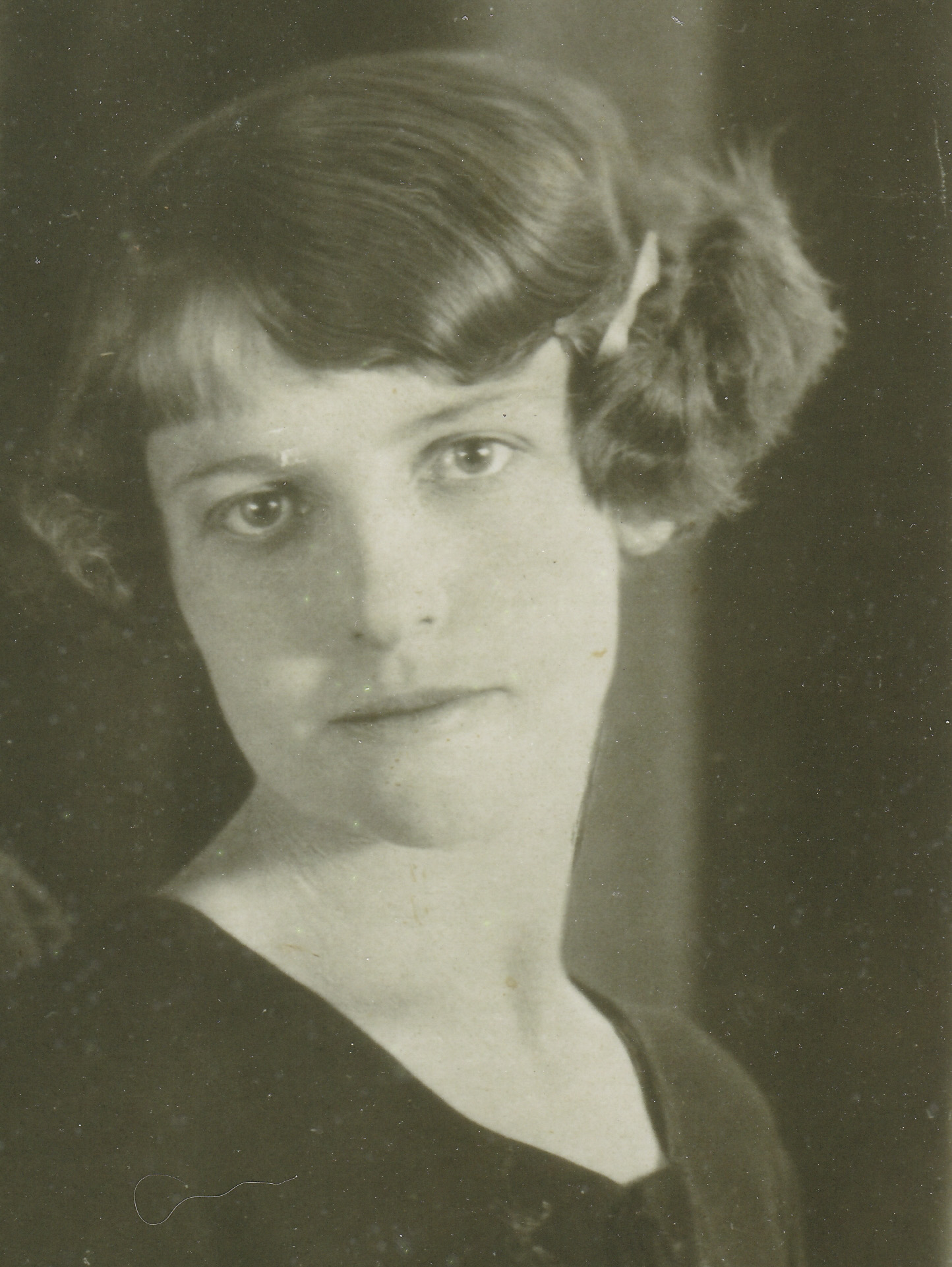
  • Prudence Priscilla Richins

    Prudence Priscilla Richins

    The New Year of 1860 had been ushered in but a week when on January 8, in Salt Lake City, Utah, a baby girl was born to Charles Wager Richins and his wife, Louisa Shill. She was the second daughter and fourth child of a family of ten.

    The baby was named Prudence Priscilla, the given names of both her grandmothers. She was loved very dearly, being the only living daughter as her sister had died. Her round happy face and baby smile seemed to radiate sunshine.

    In 1861 Prudence, a toddling child of one year, with her parents and older brother, Wellington, moved to Heneferville, Summit County, Utah. (A brother, Charles Robert, had also passed away.) Her father, Charles Wager Richins, had been called by President Brigham Young, of the Church of Jesus Christ of Latter-day Saints, to go and help settle this village. He was made Presiding Elder of the Church Branch. Later, in the year of 1877 he was ordained bishop.

    Prudence, the eldest daughter, proved very helpful to her parents. On one occasion, when she was only eight years of age, she was left with the responsibility of caring for the family and the small baby. Her brother, Wellington, was to take care of the chores. Her parents drove to Salt Lake City by ox team and wagon to deliver their butter, milk, and eggs and do some shopping while there. This trip took from early morning until late at night. They traveled by way of Weber Canyon, having to cross the Weber River several times.

    Her mother purchased a small china jewel box made in the shape of a dresser with shining celluloid mirror. This was a surprise gift presented to Prudence for taking care of the children. Prudence loved this gift, keeping it all through the years. She gave it to her eldest daughter, Louisa Pearl, who also treasured it until her death May 6, 1958 when Prudence’s youngest daughter, Naoma, became the proud possessor of the gift. To her it is not only a valued heirloom, but also signifies love, helpfulness, and trustworthiness—exemplifying the life of her mother, Prudence.

    Prudence was jovial, happy and kind. She made many friends. By her early teens she had developed into a lovely young lady with blue eyes and flaxen blonde hair. She possessed a lovely personality and had a smile for everyone.

    Like most girls, Prudence loved to dance. The boys showed an interest in her as she began attending social gatherings and dancing parties. It was through these entertainments that Joseph William Bond became interested in her. As Joseph helped provide the music for the dances, he would often dance with Prudence while playing his concertina. He courted his lovely girl, Prudence, for some time before asking her to be his wife.

    Bishop Charles Wager Richins and wife, Louisa, knew Joseph to be an ambitious and kind young man and consented to their marriage. They were married in the “for time only” in the Endowment House in Salt Lake City, August 7, 1877 by President John Taylor of the Church of Jesus Christ of Latter-day Saints. They would later be sealed for “eternity”. Joseph a young man of twenty-four and Prudence just seventeen, their hearts filled with devotion and contentment started on life’s long journey together.

    In the fall of 1877 the young couple, with Wellington Richins, his young bride, Alice Bond, Louisa Shill Richins and her two young children, Rebecca and Marland, made plans to leave for Arizona. They had heard of this wonderful country and President Brigham Young had encouraged them to help settle this new land.

    They gathered their earthly belongings, loading them into two covered wagons; Joseph driving three yoke of oxen and Welling two. With the creaking of wagon wheels and the bellowing of oxen and cattle which they were taking, they started for Arizona. From Henefer they traveled to Heber City, down Provo Canyon to Provo. Here enough food and supplies were purchased to make the journey.

    In Richfield, Utah, they overtook and joined the Redden Allred family with their two yoke of oxen and wagon. They, too, were headed for Arizona. On they traveled, overtaking a larger company of covered wagons: the Pomeroy’s, the Sirrine’s, Crismon’s and Jones’. These two companies traveled for months trailing and then passing each other many, many times as they traveled through the rugged Buckskin mountain area in southern Utah. Beyond the mountain they traveled on into the desert arriving at the Colorado River where they crossed at Lee’s Ferry; the family crossing first, then the cattle.

    To Prudence the way was long, rough, and tiresome. They camped at Navajo Springs, Arizona, where she gave birth to a son. She became very ill forcing them to drive by night to Willow Springs. The baby died. The tiny body was placed in a crude coffin made of rough lumber and lined with cotton cloth. Wellington Richins and Francis M. Pomeroy carried it on horseback fifteen miles to Moenkopi, a Mormon settlement. There a graveside prayer and dedication was held and the body of Orson Obed Bond was buried.

    The company stayed until Prudence was able to travel. When they resumed their travels, the weather was bitter cold. They landed in Thompson Valley on January 8, 1878, Prudence’s birthday. Here in a roughly built log cabin they lived for six months. Joseph obtained work by hauling wood, logs and other items to Prescott which was about fifty miles away. With trials, heartaches and sorrows, they became dissatisfied. Trading their oxen for horses and wagon, Joseph, Prudence, Louisa Shill Richins and two children, Rebecca and Marland, returned to their home in Utah. The Wellington Richins and Redden Allred Families remained in Thompson Valley for some time. Later they journeyed on to Lehi and then to Mesa, Arizona.

    It was September when the Bond party arrived back in Henefer. They lived in the Richins home known as the “big house” for one year and Joseph worked for his father-in-law, Bishop Charles Wager Richins. It was in this lovely home that Prudence became the mother of another son, Charles Marlow, on August 27, 1879.

    In Joseph’s spare time he hauled logs from the nearby canyons. With the help of his brother, John, he split and hewed enough logs to build a one-room cabin. It was here he moved Prudence and their small son. Happiness was theirs in this log cabin.

    Joseph left his family to go to Green River, Wyoming. The trip was made by team and wagon. Green River was a railroad town and Joseph with his team worked on a grader helping to build the railroad to Ogden, Utah.

    Two years later, in the little log cabin, a baby daughter, Louisa Pearl, was born to this couple. Joseph was working in Wyoming when, by mail, he received the news of their new baby. Joseph left his team on the job and went home to his wife and family. He stayed several days and then returned by train and continued working until November. He then quit his job in Wyoming.

    Shortly after arriving home he got work at the Devil’s Slide rock quarry down the canyon from Henefer. It was here he saw a friend, Joe Edgeworth, seriously injured when struck with a falling rock. After seeing this, Joseph decided that this work was too dangerous. He resigned and walked back to Henefer, a distance of about five miles.

    Several letters had been received from loved ones in Arizona telling of the progress they were making and of the many opportunities which were there. They asked Joseph and Prudence to come and join them. In 1882, Joseph and Prudence and two small children, along with Grandmother Louisa Shill Richins and two children, Rebecca and Marland, left Henefer. They purchased tickets at the U.P. Railroad at Echo, Utah for their trip to Arizona. Wellington Richins had been notified of their coming and met them at Maricopa, Arizona, which was the railroad terminal. It was a full day’s trip to Mesa by team and wagon, a distance of thirty miles.

    In Mesa, Joseph and Prudence purchased eighty acres of land and a two-room adobe house with a dirt roof. It was located one-half mile northwest of town, now boarded by North Country Club Drive one the east and 4th Street on the north, Clark Street on the south and North Extension on the west. For the property and house, Joseph paid one thousand dollars. Joseph gave $600 cash and signed a note for the remaining $400. Grandmother Louisa and her two children lived there with them.

    The land was covered with sage brush, chaparral, mesquite, and cacti. Only five acres was cleared and ready to farm. It took months of hard work digging, dragging, cutting, and burning to get the land prepared to plant crops. Yes indeed, it was hard work with no equipment and no money to buy the needed tools. The money had been expounded in making the payment on the acreage. Joseph borrowed a team, wagon and necessary equipment from Wellington Richins to cultivate and till the soil. Grain, alfalfa, fruit trees, and grape vines were included in the first planting.

    Water was scarce and had to be taken from the canal that ended at the northeast corner of the farm. Prudence had to carry the water for drinking and household purposes. The water was poured in ollas (earthen jugs) and hung under a tree to settle and cool for drinking.

    Money was needed badly. Joseph set out for the mines farther east where he obtained work. He left Prudence, Grandmother Louisa and small children behind to care for their newly purchased acreage. The eldest son, Marlow, helped his mother greatly by doing the light chores and running errands. If the irrigation came at night, as it often did, (and the nights seemed extremely dark) he would shovel the openings in the ditch and assist by carrying the coal oil lantern which lighted their way.

    In 1887-1888 Prudence had purchased a white treadle sewing machine with money she had made from the washings and ironings she did for other families. She was indeed grateful for this machine since most of the clothing had to be made. Only a few items of wearing apparel were available for purchase. At night, after the children had been tucked in bed, Prudence would sew for the family by the light of a candle or coal oil lamp. Marlow would stay awake with his mother and study his school lessons. Lying on the floor by the old fire place he learned his multiplication tables while his mother sewed.

    A kind neighbor and friend, Mrs. Mary Leebrick, who was a talented seamstress and excellent cook, gave Prudence many pointers on sewing and cooking.

    The Indians, carrying their bow and arrows and clad in g-strings with feathers in their hair, would often hunt rabbit through the chaparral bushes on horseback. The adobe rooms in the Bond home had open doors and windows. Blankets or sheets were hung to close them off when needed. Often the rabbits would run into the house for protection with the Indians running in after them. This would frighten Prudence and the children, but never did the Indians hurt or molest them in any way.

    Through the years the Bond family became great friends with many of the Indians. Having to walk past the Bond home on their way to town they would leave their belongings by a tree in the yard while they went on into town to shop. They knew Prudence would never allow her children, or any other person, to touch their treasured things which were usually tied in a cloth into a small bundle and carried on their heads.

    Joseph worked at the mines for three years. He came home frequently to make sure his family was alright and not in need. These visits took time from his work because of the great distance to travel by team and wagon. Consequently, he found work at the Pinal mines which brought him closer home.

    He moved Prudence and children to Superior to live with him. Their stay there was short because Prudence and the children were afraid of the Apache Indians, a more vicious tribe of Indians than those at Mesa. Prudence and the children returned to Mesa to live. Joseph quit his job in the mines about one year later and came home to relieve his wife and family of the responsibility of caring for the farm. He sold forty acres of the farm land for $400 cash. The note for the farm was paid off and the remaining forty acres of land was theirs to call home.

    There was much work to be done on this farm. Each year fields of grain were planted. At harvest time the wheat was taken to the mill and ground into flour which was stored in the mill to be used when needed. There were many chores to be done with the cows, calves, pigs, and chickens. Prudence always raised many beautiful white ducks which swam in the nearby canal. Prudence would pluck the ducks and the down from these ducks was made into pillows.

    In the summer, fruit was picked and canned. A wooden barrel was always filled with clusters of spiced, pickled grapes and placed on the north side of the house to keep fresh and cool. When the children came to visit, bunches of spiced grapes, which they dearly loved, were given them to eat.

    Prudence suffered several serious illnesses during her life. In 1889 before the birth of her daughter, Eliza, she contracted whooping cough. The baby was born and immediately developed symptoms of the disease. For seven weeks Joseph and Grandma Louisa took turns sitting up nights with Prudence and the baby. The disease left Prudence in a weakened condition.

    Several years later she became ill with yellow jaundice and was bedfast for weeks. High fever and sweats left the bed sheets and her clothing stained yellow. About 1913 Prudence suffered a stroke causing her to be totally blind for three months. Normal sight returned to her left eye, but double vision to the right. This handicapped her in her work. Then a year later another stroke partially paralyzed her left side and caused a complete loss of vision in her right eye.

    In 1900 the adobe home was torn down and a two-room lumber house was purchased to replace it. This was located south and it joined a lumber room which was already being used by the family. Two rooms were added making it a five-room house. This was the family’s to enjoy. To them it seemed a mansion.

    Prudence was a good housekeeper, a trait she taught her daughters. For this new home she made throw rugs out of rag strips torn from the children’s old clothes. With the help of her daughters, curtains were made for the windows. Beautifully patterned pieced quilts were made for the beds. This was their home where many friends, neighbors and children were always welcome.

    She was an excellent cook. The family dinner of the year was on Thanksgiving Day in honor of her husband, Joseph, whose birthday was November 25th. The English plum pudding was made in October. Prudence would mix the ingredients; pout it into clean white towels and tie them very tight. These were dropped in boiling water, which was heated in a galvanized tub over a grate and fire in the back yard. The water was kept boiling for eight hours. It was the children’s job to keep the fire burning under the tub. They carried buckets of chips and wood. To them, eight hours seemed an eternity. When the puddings were cooked they were hung up to age until Thanksgiving and Christmas dinners. To prepare for serving, it was re-warmed and served with a dip or hard sauce.

    English Plumb Pudding:

    • 2 pounds currants
    • 2 pounds stoned-chopped raisins
    • 1 pound chopped suet1 pound brown sugar
    • 1 pound sifted flour
    • half-pound chopped citron
    • half pound fine bread crumbs
    • 1 large cupful molasses
    • 1 tablespoonful salt
    • 1 teaspoonful cinnamon
    • half-teaspoonful cloves
    • 3 grated nutmeg
    • 2 tablespoonfuls baking powder
    • 8 eggs
    • juice of 3 lemons
    • 1 cupful of brandy
    • 1 wine glass of rosewater (may be used in place of the brandy or it may be entirely omitted)

    Directions:

    Mix the flour, sugar and spices and molasses, then add the well-beaten eggs, next the suet and lemon juice, then the fruit; mix well; next add the 2 tablespoonfuls of baking powder and the brandy, the mixture to be quite stiff.

    If there is not sufficient moisture, use a little rich, sweet milk to thin it. Then put in a well-greased mould or a large tin pail, keep covered tightly, steam 8 to 10 hours; as the water evaporates add more; it is very excellent, having been used in one family more than 50 years.

    Brandy Sauce

    One quart of boiling milk and water, 1-½ tablespoonfuls of cornstarch, wet with cold water; stir it in the milk and water, boil 5 minutes, add 1 cup of granulated sugar, a little salt, a tablespoonful of butter, juice of lemon, wineglass of brandy.

    Pickled Grapes

    Four quarts of water, 2 quarts of vinegar, 1 quart of sugar, 2 tablespoonfuls of (stick) cinnamon, 2 tablespoonfuls of (whole) cloves. Put cinnamon and cloves in a clot bag, drop into solution of water, sugar and vinegar. Boil ½ hour. Wash grapes, cut in clusters, place into jars, pour boiling syrup over grapes filling jar, drop in small piece of (stick) cinnamon and (whole) clove for added looks in the jar. Seal while hot.

    The English Plumb Pudding and Brandy Sauce recipes were taken from a family cookbook, printed in the year 1899 by G. W. Berton.

  • Ether Wellington Richins

    Ether Wellington Richins

    Living a Pioneer Childhood

    I think my mother, Arminta Gordon met my dad, Ether Wellington Richins, in Red Rock, New Mexico. They may actually have met in Virden, New Mexico, because I remember my mother talking about traveling to Virden for a church meeting and I believe her mother, my grandmother, Alice Gordon was going to a church meeting (probably Baptist) in Red Rock. The river was up so high she couldn’t cross it, so she went to the Mormon church with my Grandpa Horace Gordon and my mom. Grandma Alice Gordon converted soon thereafter, and joined the Church of Jesus Christ of Latter-day Saints.

    Ether and Arminta were married in Thatcher, Arizona February 26, 1924. (I think they were married by President Spencer W. Kimball’s father.) I believe they were sealed in the Mesa Arizona Temple in May 1928. They had three children: Ether Wellington, Jr. (Billy), born February 3, 1925; Alice Orene, born November 26, 1928; and me, Rachel Lorraine, September 16, 1930. From the three children were born 21 grandchildren.

    My father told us about some of his childhood. He was the next to youngest of Orson Oriel & Rachel Richins. He was was born in Colonia Diaz, Chihuahua, Mexico on October 14, 1902. They were run out of Mexico in 1912 by the “Red Flaggers” (Mexican revolutionaries that were associated with Pancho Villa) when he was about 9 years old. His family fled to the United States, entering at the Corner Ranch in southwestern New Mexico.

    He got his early start as a pioneer when the family started a homestead in the Hatchet Valley south of Hachita, New Mexico after fleeing the Red Flaggers. The homestead was about three miles west of the Mexican border. Father said he always carried a rifle when he was sent out to do chores, or travel on horseback or in a wagon . The bandits were always a threat. Shortly after their arrival in the United States, my dad climbed a small hill behind a ranch house and found some pretty flowers he wanted to pick for his mother. They were the cactus blossoms. He gathered them into his shirt and carried them down the hill to give to his mother. He said there were many mothers assisting Grandma Richins in removing all the cactus thorns from him.

    Father was sent to school on the Corner Ranch and traveled there by wagon or horseback. The school was right on the international border. There were 17 pupils in classes from the first through the eighth grades. He later was boarded with the teacher, Elmer Johnson, and his wife and two children. He spent one year in that school before his mother, and the children, moved to Hachita, New Mexico. Grandpa Richins (Orson Oriel), and his oldest son Orson remained on the farm.

    Grandpa & Grandma Richins (Rachel) were very devout Mormons, and they took the family to church every Sunday. This required a trip of about 20 miles each way. It took 2½ to 3 hours to drive the distance in a light wagon. They had a cover for the wagon for stormy weather. Church began at 10:00 A.M., which required them to leave their home by 7 A.M. They later bought a Model T Ford and could get there in an hour. They did not have a spare tire so they carried a hand pump and patching material in case of a flat.

    A drought finally drove the family from the farm. Grandpa Richins sold out to the Hatchet Cattle Company. They moved to Virden and bought a farm where water was available from the Gila River. Many of their friends from Mexico had already settled in the Virden valley.

    Ether was always interested in mechanics. He was also very curious. Aunt Ena Mitchel told us about the time he found a watch (either belonging to a guest or his big brother, Orson) on the dresser and he literally wanted to see what made it tick. He took it apart and put it back together again. I think he was in big trouble. Aunt Ena was really worried for her brother, because I think she was his lookout. She kept telling him he was really going to get into trouble. I do not know if there were any consequences.

    Depression & World War II

    My father was very mechanical. He could build, rebuild, or repair anything. Aunt Ena would take her car to him and ask him to put his hand on it because it wasn’t running right. He later had his own mechanic shop in Lordsburg in the early 1930’s, and for another period of time after WWII in the 1940’s. Daddy, Uncle Babe Bowers, and O.J. Richins (Uncle Orson’s oldest) were involved in this venture . It was very successful. When this partnership ended, Daddy and his brother, Orson and his son, Darrow partnered in yet another undertaking— opening up the Animas Valley for farming. This was my dad’s “heart’s desire” – he seemed to be driven to pioneer & develop the land.

    I think my parents lived a few years in Virden, New Mexico early in their marriage, and owned the house next door to Grandma Richins. This would be in the late 1920’s. Later they moved to Lordsburg, New mexico where Daddy built the house we lived in for many years on Shakespeare Street. I recall that he ran the projection machine at the theater in Lordsburg (probably a second job) while he had his mechanic shop. That was during the depression era.

    I believe we lived in Silver City, New Mexico for a brief time in 1934. We lived in a place called Cottage Sands, and later in Silver City proper. I think Aunt Mae & Uncle Babe Bower may have been living there as well. I suppose Daddy was in the Civilian Conservation Corps (CCC), but I don’t really remember. We returned to Lordsburg and lived there until we moved to El Paso around 1936. I remember being baptized in El Paso in 1938, so we were there about 4 years. My dad and Uncle Babe were in the Motor Vehicle maintenance at Ft. Bliss (CCC). I think it was around 1939 or 1940 when we moved back to Lordsburg.

    World War II

    WWII broke out in 1941, and the Department of Defense built an installation about three miles out of Lordsburg for holding prisoners of war (POWs) and housing a complement of military personnel. The installation needed barracks for the soldiers with a commissary, PX, and a theatre. They needed electricians, plumbers, and carpenters to build the camp. Daddy applied for a job as an electrician, but did not have an electrician’s license. No problem for him—he went to Las Cruces and took the electrician’s test and got his license. He worked there until the jobs played out.

    Sometime during his employment at the POW camp, my dad and Uncle Charlie Walters (Aunt Ena’s husband) went into the mining business. With the war going on, the ore that was mined at the Walrich mine (“Wal” for Walters & “rich” for Richins) was vital to the war effort. They built a small mill that processed the ore before shipping it to El Paso. It was really an interesting process. The ore was first crushed by a large ball mill (which was bought in the Silver City mining area and hauled down to the mine). Once they got the ball mill set into place, I remember Aunt Ena, Uncle Charlie, Mother and Daddy inside this huge (ball mill) rock crusher, chipping out all the pieces of gold embedded in it. They removed enough gold from it to pay for the ball mill.

    After being crushed, the ore was filtered through several processes of floatation machines and classifiers to separate the different ores: lead, copper, zinc, silver, gold, etc. As little kids it was a neat place to go and see all the different procedures. During this time my brother Billy was in the Army Air Corps, as were all the young men at that time. The mine contributed to the war effort, whih allowed them to receive a “C” ration for gasoline, a commodity that was rationed. Most people received an “A” sticker on their vehicle. I don’t remember how much gas you were entitled to, but it was not very much. However, I remember that with the 3 large trucks that the mine owned, and the amount of gas we were allotted, we seemed to fare better than most. There were many things that were rationed, and everyone had to be very conservative during the war. Some restricted items I remember, other than gas, were shoes, sugar, tires, and meat. You couldn’t even buy cars at that time.

    Farming in Animas and Rodeo, NM

    Uncle Charlie died of a heart attack, and the mine was leased out in 1946. In 1947 Daddy, Uncle Orson and Darrow, Uncle Orson’s son, went into a new farming venture at Animas, New Mexico. I had left for school at Brigham Young University, and Daddy was living in Lordsburg. I learned about his new venture while I was at school. It was somewhat of a surprise to me, but then again it wasn’t really, as we all knew Daddy had a strong urge to pioneer and develop land—always trying new ventures. They bought some old barracks from the now deserted POW camp east of Lordsburg, and made their houses out of them.

    I know that a well for irrigation was drilled that had a good supply of water (2,200 gallons a minute), which was pretty awesome. It was the first irrigation well in that area and this started a new booming farming development. The Richins had about 900 acres in farmland and five sections of Taylor grazing land. Western Cotton Oil came into the valley, erected a gin, and before the 1948 season was over there were over 9,000 acres of cotton in the valley, with more farmers moving in.

    Daddy sold his interest in the farm to Uncle Orson & Darrow and moved on west about 15 miles. That was the first of the three valleys he developed and pioneered. He later bought undeveloped land in the Rodeo area of the San Simon Valley (Cienega area), about 12 miles north of Rodeo, New Mexico, and put down three wells where all three of his kids and their spouses and children built homes. We farmed and helped develop the land also. I guess he felt his kids should share that “good ‘ole pioneer spirit” like he did. This opened up the area, and other farmers moved in. Eventually 10,000 acres on the eastern slope of the Chiricuahua Mountains were developed for cotton, milo-maize, corn and alfalfa. When that property was sold four years later, he turned his attention to developing land about 14 miles southeast of Lordsburg in the Muir Ranch area. He drilled two wells and developed about 200 acres. Farming in that area spread to 12,000 acres as more farmers moved in.

    An Example To Us All

    My father served faithfully in may leadership positions in the church. He also served two terms as a Hidalgo County Commissioner, and later served as a Municipal Judge. While serving as County Commissioner, on one of his trips to Santa Fe, he found land east of Lordsburg (what is now called the Pyramid Valley) that could be homesteaded. He was instrumental in developing that valley.

    Daddy was a hard worker, as were all his brothers and sisters. A work ethic was certainly instilled by their parents and grandparents. He was a loving husband, father, and grandfather and a righteous man. He and Mother taught us honesty, integrity, a love of God and our Country, and like him, a good work ethic. He led us in our daily prayers and taught us to respect and love our church leaders. His grandchildren adored him and he was always a great example for them. He was a busy, hard working man, but he always had time for teaching moments in daily life and in spiritual needs.

    He had a tremendous influence on those he came in contact with and he and my mother were instrumental in many of their friends’ conversion to the church. We always had company drop in and they were always invited to dinner and spend the night. They gave up their bed, after changing the sheets, and they would retire to another bed, sometimes the sofa. That always amazed me that they insisted giving up their bed. The same with the meals, regardless of how much we had or didn’t have, they were always fed a good meal.

    Near the close of Father’s sojourn on earth, Aunt Ena and Mother rushed him to El Paso to the hospital. He had severe heart problems. After he was admitted, Aunt Ena & Mother came to our home in El Paso and Aunt Ena said, “We will never bring him home.” That was rather distressing to us because we certainly didn’t want to lose him. Aunt Ena told us the reason he wasn’t coming home: while waiting in the hospital room, my dad said to her “Ireta is here with us, she is sitting in that chair.” Of course this bothered Aunt Ena, because Ireta died many years ago, and Aunt Ena knew she was there to take him home.

    Ether Wellington Richins died in El Paso, Texas January 21, 1973. He lived a long and fruitful life, leaving a great and fascinating legacy. It would take a giant of a man to follow his footsteps.

  • Ena Agnes Richins

    Ena Agnes Richins

    Introduction

    My mother, Ena Agnes Richins was born in Colonia Diaz, Chihuahua, Mexico on January 3, 1906 and died December 1, 1992 in Las Cruces, Dona Ana, New Mexico. She was buried on December 5, 1992 in Lordsburg, Hidalgo, New Mexico.

    Her father, Orson Oriel Richins was born in Heneferville, Summit, Utah on April 2, 1862 and died December 16, 1926 in Virden, Hidalgo, New Mexico. He was buried on December 17, 1926 in Virden, Hidalgo, New Mexico.

    Her mother, Rachel Hennefer Richins was born in Henneferville, Summit, Utah on October 30, 1861 and died April 10, 1946 in Lordsburg, Hidalgo, New Mexico. She was buried April 12, 1946 Virden, Hidalgo, New Mexico.

    Ena was born under the new and everlasting of the Church of Jesus Christ of Latter-day Saints. She was the ninth and youngest child of Orson O. and Rachel Hennefer Richins (6th daughter). Ena was named after a member of English royalty that the Hennefer family knew in England.

    Her early childhood days were spent on the farm in Colonia Diaz, Mexico helping her mother with household chores and playing with her brothers and sisters.

    By the beginning of 1912, Colonia Diaz had become truly an oasis in the Northern Chihuahua desert. Rumors of a revolution were heard from time to time, but no one took any stock in it. However, by early summer definite clashes of rebel factions against the federal government were reported to be true. Now the feeling of insecurity concerning this matter came home to the majority of the people. The story of the Mormon colony of Colonia Diaz is a twenty-eight-year chronicle of an Oasis in the Northern Chihuahua desert.

    “The first two years had been full of anticipation and apprehension. Challenged by long and primitive hardships, this faithful people never gave up. Since the suffering of the Saints driven from their Nauvoo homes to the Rocky Mountains, this was as trying a test as would be experienced by the Mormon saints anywhere.

    “Uncertainty was a wolf that hounded them always through their Mexican stay. In the first years, they never knew from one day to the next whether they would find land on which to put down roots or would be driven back to the polygamist persecutions. And now, after building fine homes, planting gardens and orchards, and becoming a delightful LDS community—indeed, flowering like a rose—it was over, though unbeknownst to them at the time.

    “Their leaders had decided that they, along with all the other colonists in Mexico, should leave their homes immediately for fear of their lives and return to the United States. Of course, they hoped it was not permanent. But only a few—a very few—ever glimpsed their homes again, since all but three homes were burned later during the revolution. This village that kept the faith became a ghost town when a cruel revolutionary colonel, named “Rojas” burned Colonia Diaz. Not much more than memories of the true and of the faithful remains.”

    History of the Mormon Colonies in Mexico (The Juarez Stake) 1885-1980, compiled and written by Clarence F. Turley and Anna Tenney Turley.

    Exodus from Mexico

    Advised to Evacuate

    On July 26, 1912, a bomb exploding in Colonia Diaz would not have had a more startling impact on the town than did a message delivered to Bishop Ernest V. Romney from the Stake Presidency. The messenger, Levi S. Tenney, who had driven his team hard most of the night, arrived in Colonia Diaz before most people were awake. He immediately sent Frank Whiting to awaken part of the town while he headed for the Bishop’s home to deliver his message.

    The letter stated that the colonists were in great danger, as the rebel chieftain, Ynes Salazar, had demanded all the guns and ammunition held by the Mormons be delivered to the rebels by July 28. Apparently they were ruthless in enforcing this demand. The women and children from the upper colonies were being evacuated to El Paso, and the Colonia Diaz people were advised to flee immediately across the border.

    Soon the church bell, silenced now except for emergencies, clanged loud and clear through the morning air bringing men hurriedly to the church-house. At this meeting the message from the Stake President, Junius Romney, was read and discussed. Every man realized the danger the town would be in if left unarmed and at the mercy of marauding rebels. It was decided that the townspeople would go overland, cross the international boundary line at the Corner Ranch some 19 miles northwest of Colonia Diaz, and proceed to Hachita, New Mexico.

    Preparing to Leave

    Plans were made for every man owning teams and wagons to take his family and as many as possible of his neighbors who had no outfits. They were to take only bedding and enough provisions to last four or five days because all felt that the danger would pass after the rebel army moved on to its field of battle. Since the rebels might arrive any minute to demand the guns, guards were placed around the town to prevent a surprise attack. Everyone was instructed to be ready to leave at 10:00 am.

    Colonia Diaz was a beehive of busy people, arranging, repairing and greasing wagons; scouting the range for work horses; and in some cases putting a “half-broke” horse with a tame one to make up a team. Sister Anna Sariah Egar Tenney’s answer to the call was, “We will obey authority and not falter, shed tears, nor sigh; rather, go straight ahead with a prayer in our hearts, asking God for guidance.” Some of the heads of families were absent from home, and in these cases the oldest son jumped in and served as head of the family with his mother’s sanction.

    Granary doors were nailed up. Chicken-run doors were opened. Calves were turned out with their mothers, hogs turned loose to forage for food. On the way to town, Elmer and Annie Johnson met droves of cattle, horses, and pigs moving out into the mesquite flats. Back at the Button Willows Ranch, Mark found Sister Rosetta Norton Scott and her two children, Wesley, ten, and Sophronia, eight, the only occupants of the ranch that morning. They were all ready to leave for Sunday School in town. Hurried preparations were later detailed by an older daughter, Lucy. She said: “We turned out the cow and calves, and a large fat hog ready to butcher, scattered a sack of grain in the chicken coop, set extra water out, and sawed a hole in the door so the chickens could go in and out. Into a tin tub we packed all the cheese, butter, and eggs on hand, rolled the tub in several quilts, and tied it to the running gears (the only means of conveyance on the ranch) along with a trunk of clothing.”

    Brother Elmer Johnson, Sr., wrote: “I readied two teams—one pair of colts that had been hitched up only three times and another consisting of a good work horse and a partly broken colt. I drove the colts, and my daughter-in-law, Annie R. Johnson, drove the other team. To make room for other people to ride, we had to leave the trunk of wedding presents, feather bed, and new carpet.

    Heading for the Border

    As each family took its place on the line, it was as if the history of the town fell into place, chapter after chapter, to begin the final pages of the Colonia Diaz story. The people were unaware of it, because they all felt they would return in a day or so, as they drove away. Only the stark empty houses denoted the fall of the curtain on a 28-year saga of work, faith, courage, and cooperation.

    The lineup was completed. Bishop Romney gave the “go ahead” gesture. Driver after driver spoke to his team and slapped the lines over the horses’ backs. The horses leaned into the collars to begin that unhappy trek back to the United States.

    Levi S. Tenney, delegated to take charge of the move, reported about 85 assorted vehicles. Others reported that as many as 96 vehicles, loaded with 800 people, drove out of Colonia Diaz about 10:00 am that morning. Tenney, his wife, Clara Acord Tenney, and five children, made the trip in a one-seat buggy. The two oldest girls, Maudie and Hettie, rode standing on the axle, back of the seat. Tenney reported that the caravan stretched out more than a mile.

    James Jacobson was put in charge of a body of scouts who rode out on all sides of the caravan to prevent any surprise attack from the Red Flaggers. He detailed several scouts to patrol and spot any trouble or any illness developing among the people. Among them were Leon Jackson, William Johnson, Aryan Mortensen and others.

    About six pm that night, July 28, 1912, the Diazites crossed the international boundary line. They made camp at the nearby Corner Ranch. They had traveled nineteen miles in eight hours. They finally arrived at Hachita, New Mexico, on August 3, 1912. Refugees in Hachita, New Mexico

    Bishop Ernest V. Romney and others had remained in Colonia Diaz to try to care for the town. After several visits of revolutionists, the stores had been raided and ransacked, and two of their number taken for ransom. They were able to escape their captors and left Colonia Diaz in the night. They abandoned the town to the Red Flaggers. On August 5, 1912, at 10:00 am, they joined their families in Hachita, New Mexico.

    The experiences of these refugees in the United States were similar to those had by the other colonists evacuated by train to El Paso, Texas. The Colonia Dublan, Colonia Juarez, and mountain colonies camped in the lumberyards in East El Paso, Texas, where heat and mosquitos were almost unbearable. Those from Colonia Diaz put up in a tent city in Hachita, New Mexico, and hauled water from the railroad water tank.

    The U.S. federal government distributed food and was very helpful to all in relieving what could have been more severe suffering for these poor, homeless saints. But many problems arose in the Diaz tent town, because of unsanitary conditions and no running water. This unhappy time surely remained in the memories of Diazites during the rest of their lives.

    When the U.S. government offered railroad tickets to all parts of the West, most took advantage of the offer. Many were taken to various points in New Mexico, Arizona, Utah, and even as far away as Idaho. Some chose to remain close to the border, longing to return if and when the opportunity arose. A few took up homesteads in and around the southern New Mexico border.

    Homesteading in New Mexico

    Hachita Valley, New Mexico

    Ena’s father, Orson Oriel Richins, homesteaded property south of Hachita in what is called the “boot heel” of New Mexico on the eastern side of the continental divide in Hidalgo county. The Richins homestead was located on Range 30 south, 14 west, Township 30 and consisted of eight 40-acre blocks (quarter-quads) arranged in a rough “U-shape.”  Five blocks were located in Section 28 and 3 were located in Section 33.  The legal land description, including the Township and Range designation are only important for locating the property location on a federal Bureau of Land Management map.  The  official description of the land is:

    “the southwest quarter of the southwest quarter and the north half of the northwest quarter, the southwest quarter of the northwest quarter, and the northwest quarter of the southwest quarter of section twenty-eight and the north half of the northwest quarter and the northwest quarter of the northeast quarter of section thirty-three in Township thirty south of Range fourteen west of the New Mexico Meridian, New Mexico, containing three hundred twenty acres.”

    The area the Richins homesteaded is known as the Hachita Valley, which runs northwest to southeast. It is bordered by the Big Hachet mountains to the southwest and the Sierra Rica mountains to the northeast.  The Mexican border is about three miles east and 23 miles south.  The homestead was a “dry farm,” meaning it was not irrigated.  When I visited the homestead site in May 2002 I observed it was the best land in the area for farming.  I believe Orson Oriel was familiar with the area from his freighting route between the Mormon colonies in Mexico and southern New Mexico.

    Ena attended the Hachita Branch of the Church of Jesus Christ of Latter-Day Saints. On June 30, 1914 Ena became a baptized member of the Church of Jesus Christ of Latter-Day Saints. Her father, Orson O. Richins was serving as the “Presiding Elder” for the Hachita Branch of the Church. Ena was well schooled in the Gospel, and of gospel principles. She always set the proper example for her family and those around her. Her faith and dedication not only made her a stalwart in the Gospel but a sterling example of to all on how we should conduct our lives and treat our fellowmen.

    Ena continued her education in the Hachita school system by staying initially with her older sister Ireta and her husband Jim Wright, and after Ireta’s death she lived with her older sister Mae and her husband “Babe” Bowers in Hachita. She spent her school vacations and summers at the homestead. From the homestead site Ena and her family saw the smoke from Pancho Villa’s attack on Columbus, New Mexico on March 9, 1916.

    Red Rock, New Mexico

    On January 8, 1923 Orson Oriel Richins was granted a patent deed for his Hachita homestead. Shortly, thereafter he sold the homestead to a cattle company to become part of a large cattle ranch. He then moved his family, which included Ena, to a farm near Red Rock, Grant county, New Mexico.

    One afternoon while living on the farm near Red Rock Ena went horseback riding with a friend. During the ride they discovered a wild beehive loaded with honey. Carefully extracting some of the honey, Ena and her friend had a sweet feast. Shortly thereafter Ena became violently ill. As they made their way back to the farm Ena prayed she would be able to make it home and recover. They did make it back to the farm, but it was a very close call. After much prayer and care from her mother she began to recover and after a few weeks was back to normal.

    Virden, New Mexico

    The farm at Red Rock was not very productive, so Orson Oriel sold it and moved the family to Virden, Hidalgo county, New Mexico.

    During her stay in Virden Ena visited her married sister Mae at a mining camp in the Burro Mountains north of Lordsburg, Hidalgo county, New Mexico. Mae’s husband “Babe” had been a “mule skinner” in General Pershing’s army and stationed at Camp Shannon to the north of Hachita. “Babe” was discharged from the army and had taken a job as a master mechanic at the mine in the Burro Mountains. The foreman of the mine was Hanson Caldwell Walter, and his son Charles David Walter (recently discharged from the Navy in World War I) worked in the mine with his father. While on this visit Ena met and fell in love with Charles D. Walter.

    A Family of Her Own

    On September 25, 1924 Charles David Walter and Ena Agnes Richins were married in Lordsburg, Hidalgo, New Mexico. To this union was born three sons: Charles Raymond C. Walter, Howard Martin Walter, David Wayne Walter.

    After just over 18 years of marriage, Ena’s husband Charles D. Walter passed away on October 24, 1942. This must have been a very trying time for Ena, she was seven months pregnant with her third child when she lost her husband. The United States was engaged in a great global conflict (World War II), and her oldest son would soon be serving in the military. Howard, her second son had suffered life-threatening injuries as a result of a childhood accident when he was 2-3 years old. As a result of this accident Howard had become a special needs person and required extra care and guidance. One can only imagine how depressed and lonely she must have felt.

    A Tribute to the Life of Ena Mitchel

    Not one to give in to self-pity, Ena soon established herself in a career of public service. In 1986 a friend of hers developed the following summary of some of her public life accomplishments:

    “Ena Mitchell’s life of public service encompasses a colorful variety of noteworthy positions including an appointment by the Democratic County Chairwoman as Case Worker, for the State of New Mexico under the organization then known as the Federal Emergency Relief Agency/1934—November 1942. This was during the presidency of Franklin D. Roosevelt.

    “Ten years service as Director of the Hidalgo County Office of Public Welfare led to another public position. Clerk in the Office of Price Administration, an appointment made by the Hidalgo County State Rationing Board, during World War II.

    “Ena has supported the Democratic Party all of her adult life. Attending State and County conventions and serving as Precinct Chairman increased her interest in State and Local Political efforts) in which she has continued to play an active role.

    “Elected to the office of Hidalgo County Treasurer (1953), Ena served four years in that capacity followed by two years as Deputy Treasurer.

    “Appointed by the Board of Hidalgo County Commissioners in 1975 to attend an organizational meeting of the District State of New Mexico Council of Governments, Ena became aware of the Older Americans Act. Interest in this legislation spurred her to greater activity in founding an Older Americans Program in Hidalgo County.

    “With the cooperation of State, County and City Governments and interested citizens of the community, Ena wasted no time in formulating plans for the creation of the Lordsburg-Hidalgo County Senior Citizens Center.

    “Established in 1976, this program continues to provide congregate meals and hot meals delivered to homebound elderly citizens of Lordsburg. The companionship, friendship and recreational activities offered in the Center lend relief to hours otherwise spent in loneliness and solitude. In addition, daily contact with homebound clients gives assurance that someone is aware and cares about them.

    “Ena’s community interests are endless. In addition to her commitment to the Senior Citizens program, she was appointed to the position of Co-chairwoman of the Lordsburg Bicentennial Committee (1976). For her untiring efforts she was presented the Lordsburg Bicentennial Flag by the State Bicentennial Committee, met the Bicentennial Wagon Train six miles out of town and rode the New Mexico [wagon] into Lordsburg where she had assisted in preparations for a County Bar-B-Q and celebration. She was also given a certificate of appreciation from the Commonwealth of Pennsylvania, signed by the Governor and Lieutenant Governor of that state.

    “Not wishing to waste time in idleness, Ena proceeded to compile and publish a book of stories containing information of early events in Lordsburg and Hidalgo County. Presenting a better understanding of the struggle and hardships endured by earlier residents, the stories were gathered to preserve the heritage of this particular area of New Mexico, “In the Shadows of the Pyramids.”

    “While serving as Chairwoman of the State of New Mexico Area Agency on Aging, in 1978 Ena received certificates of appreciation from Southwest New Mexico Council of Governments and New Mexico Resource Conservation and Development of District V.

    “1979 brought an appointment of Colonel, Aide-de Camp from Roberto Mondragon, Lieutenant Governor of the State of New Mexico.
    Appointment as a Member of the State of New Mexico Area Planning Board for District V by Governor Bruce King came in 1981, and Ena has for the past three years presided as District V Chairman of the New Mexico Coalition for Senior Citizens.

    “Ena’s concern for her fellow beings has not been confined to the elderly. She has served as American Legion Auxiliary State Chairman, District President, Local Unit President and is now Secretary of the Local Unit.
    In her service to others she is functioning as Auxiliary Girls State Chairman, working with Lordsburg High School Junior Class Girls, advising and preparing them for the opportunity to attend Girls State each year. Sponsored by the National and State American Legion Auxiliary, she contacts various clubs and organizations in Lordsburg for their support in the Girls State Program.

    “Interest in people of all ages has led Ena to sponsor and work with the New Mexico Extension Service, primarily for the benefit of 4-H youths. She has also sponsored and worked with Cub Scouts, teaching the Scouting Program.

    “Ena is a member of the Salvation Army Sponsored Program in Lordsburg, cooperating with the Phoenix, Arizona office. The Lordsburg High School Band Organization was not neglected when Ena served as President. Senior Citizens have never been deserted, as Ena presently serves as Chairman of the Lordsburg-Hidalgo County Commission on Aging, a guiding force in the Senior Citizens Program (1976, 1977 and 1980 to 1985, also 1986 to 1992).

    “Ena has, for the past eight years presided as Probate Judge of Hidalgo County, an elected position. She is honored, respected, loved…and has never had to purchase an oversized hat.”

    Sarah, 1986, a Registered Nurse employed by the State of New Mexico.

    Also during this same time she served in Relief Society, Mutual (Young Women), Sunday School, and Primary organizations in the Church of Jesus Christ of Latter-Day Saints. Always faithfully discharging her duties and responsibilities in those organizations.

    In 1945 Ena remarried. She married Wayne Virgil Mitchell originally from Raymondville, Missouri. Wayne was a car inspector for the Southern Pacific Railroad. Wayne passed away in May 1960 in Tucson, Arizona. From 1952 to 1960 they had a 320-acre desert-claim homestead about 10 miles east of Lordsburg, New Mexico.

    Ena passed away after a short illness on December 1, 1992. She was buried next to her husband Charles in the Mountain View cemetery in Lordsburg, New Mexico on December 5, 1992. At the time of her death she had 7 grandchildren, and 19 great-grandchildren.

    Ena’s commitment to her family, Church, fellowman, country and community are an example we can all emulate. Life demands courage, and courageous families pull together. It is my hope and prayer that her posterity will always be mindful of her sacrifice and service. A finer legacy cannot be found.

  • Charles Richins

    Charles Richins

    Life Sketch

    Charles and Louisa Shill Richins were pioneers of 1853. They were converted to the Church of Jesus Christ of Latter-day Saints in England and Charles, his wife and a daughter—Hannah Louisa—crossed the plains with an ox team company and arrived in Salt Lake City, Utah October 16, 1853. They lived in Salt Lake for 7 years. Then in 1860, Charles [aka Charles W. Richins] received a call from Brigham Young to go to a little valley situated on the Weber River to help settle the country. He moved to Henefer with his wife, Louisa, and one child and his new wife Ester, to the sage-covered valley to make their home. Charles pitched two tents near the banks of the Weber River and this was “home” to the Richins family for some time—Louisa with a baby and Ester a brand new bride.

    Charles began immediately to provide better living quarters for his families. A great deal of hard labor and time was spent digging and clearing out three dugouts in the hillside. The first year Charles built two brick rooms over the dugouts, then the year after, three more rooms. Additional rooms were made year after year, until the house contained two stories and 15 rooms when it was finally finished. The Big House, as it was referred to, was a mansion compared to the tents, and dugouts of earlier years.

    In 1878 Charles married Agnes Wilmot. She was a beautiful girl—very frail and delicate. She was 20, while Charles was 50 years of age. So the third bride came to live in the Big House.

    Perhaps, I should add that Charles was the father of 30 children. Louisa was the mother of 5 boys and 5 girls. Esther had 5 boys and 5 girls. Agnes had 4 boys and 6 girls. Aunt Beatrice Richins Smith and Uncle John Richins are the only two living children from Charles and Agnes Richins.

    Charles Richins was Bishop of the Henefer Ward from 1861 until the Manifesto was issued, which made living in polygamy illegal. Charles sold The Big House and moved to Mexico. He died in 1903 at the age of 75 years in Mexico.

    James Hennefer (son of James Hennefer, Sr. and Charlotte Hickens) was born January 2, 1820 in Woodsley, Staffordshire, England. He came to Utah in 1853 and died August 1898 in Henefer, Utah. James was a blacksmith by trade. He married Sarah Hulks August 30, 1846 in England. She was born November 25, 1825. She came to Utah with her husband in 1853.

  • Thomas Richins & Harriet Deveraux: A Short History

    Thomas Richins & Harriet Deveraux: A Short History

    On June 9, 1856, they left Iowa City, Iowa, with the first handcart company of which Edmund Ellsworth was captain. Thomas Richins was 30 years old, his wife, Harriet, was 22, their little son, Albert Franklin, was 16 months, and Harriet’s father, John Deveraux, was 57.

    Provisions became scarce so they were put on rations, one pint of flour per day per person. This they cooked as best they could. They told of one day that they mixed too much water with the flour and all they could do was drink it. One time Thomas was so hungry he cut pieces of rawhide from the cart to eat.

    Harriet told how a band of Indians came into their camp. One of the Indian squaws who had a papoose saw a poor hungry pioneer woman trying to nurse a little undernourished baby. The Indian mother felt so sorry for them she took the poor baby in her arms and nursed it. However, it made the baby sick because it was not used to such rich milk.

    The travelers did have some meat. At one time a deer or elk was served out. Once Brother Ellsworth killed a cow. On August 6, they saw thousands of buffalo. Four were shot. The next day their hungry appetites were satisfied with buffalo meat but they had to dig for water and it was very thick. A few days later, all or most of them had bad diarrhea or purging—they didn’t know whether it was the buffalo or the muddy river water.

    They traveled through dust storms, electrical storms, and bright sun that sunburned and baked them. To keep their sprits up as they traveled they would sing. A few lines of one of the songs they sang are:

    “Oh some must push and some must pull
    As we go marching up the hill
    Then merrily on our way we go
    Until we reach the valley-O!”

    They camped about 19 miles from Fort Laramie. Here they had plenty of wood to burn and they said it was quite a treat after burning so many buffalo chips. After nearly four months of weary traveling, having been delayed by sickness and deaths, and the breaking down of handcarts which were made of unseasoned lumber, they reached Salt Lake City September 26, 1856. The company was met by Brigham Young and a large number of saints in emigration Canyon and given a hearty welcome. Harriet used to tell of them bringing watermelons to them on their arrival.

    Church Emigration publications give this report of their arrival:

    “In the evening of September 25th it was reported that Captain Edmund Ellsworth’s company was encamped at the Willow Springs for the night. Consequently, on the 26th, President Brigham Young, Heber C. Kimball, and Daniel H. Wells and many other citizens in carriages and several Gentlemen and Ladies on horseback, with a part of Captain H. B. Clawsen’s company of lancers, and the brass bands under Captain William Pitt left the President’s Office at 9 a.m. with the view of meeting them back of the Little Mountain.

    “President Young ordered the party to halt until the handcarts should arrive, and with President Kimball drove to meet them. Soon the anxiously expected train came in sight led by Captain Ellsworth on foot, and with two aged veterans pulling the front cart, followed by a long line of carts attended by the old, middle-aged, and young of both sexes.

    “When [they were] opposite the escorting party, a halt was called and their captain introduced the newcomers to President Young and Kimball. This was followed by the joyous greeting of relatives and friends, and an unexpected treat of melons.

    “While thus regaling, Captain Daniel D. McArthur came up with his handcart company, they having traveled that day from the east of Big Mountain. From the place of halting to the public square in the Sixteenth Ward [later the University site] the following order of march was observed, under the supervision of Captain Clawson:

    • Lancers
    • Ladies on horseback
    • President Young’s, Kimball’s, and Wells’ carriages
    • The bands
    • Captain Ellsworth’s and McArthur’s companies
    • Citizens in carriages and on horseback

    “The line of march was scarcely taken up before it began to be met by men, women, and children on foot, on horses, and wagons, thronging out to see and welcome the first handcart companies, and the numbers rapidly increased until the living tide lined and thronged South Temple Street.

    “The procession reached the Sixteenth Ward Square about sunset, when the lancers, bands, and carriages formed in a line facing the line of handcarts; and after a few remarks by President Young, accompanied by his blessing, the spectators and escort retired, and the companies pitched their tents at the end of a walk and pull of about 1300 miles.”

    What a joyous day that must have been for Thomas and Harriet to finally reach their destination after traveling such a long and hard journey from their home in England!

    Thomas and Harriet lived in Salt Lake for four or five years where two children were born, Alice Marinda (January 22, 1857) and Esther Ann (April 6 1860). Esther Ann died when she was two months old and was buried in Salt Lake City. On August 8, 1860 they went to the Endowment House and received their endowments and were sealed to each other for time and eternity.

    They were called to go south and help settle what is now known as Goshen, Utah County, Utah. Thomas and his brother John and their families left Salt Lake in 1860, traveling south crossing the Jordan River south of the Point of the Mountain and traveling along the west side of Utah Lake. As they neared the river, the oxen Thomas was driving, being thirsty, made a rush for the water and went down a steep bank into the deep water. The wagon box tipped off and floated down the stream.

    Thomas managed to catch hold of the cattle and they swam to the bank. The women and children were in the other wagon with Uncle John. A just Thomas had in his wagon went bobbing down the stream and in the excitement, Harriet, thinking it was he, cried in alarm, “Save Tom! Save Tom!” Then she saw him safe on the other bank. After the danger and fright were over, they had many a laugh at this incident. The wagon box and some of the things were recovered a few miles down the river.

    Arriving at Goshen, Thomas engaged in farming and working at his trade of blacksmithing. While living there, three sons were born to them: Abner (August 31, 1861), Arthur E. (October 5, 1863), and Thomas A. (May 15, 1866).

    They next moved to Pleasant Grove, Utah County, Utah, then known as Battle Creek, because a battle with the Indians had been fought there. They lived on what was then called Farnsworth’s Hill on the road to Battle Creek Canyon. Here Harriet Priscilla was born (December 22, 1868). They then built a log house north of the flour mill. The logs for this house were split on the old pit near Battle Creek Canyon.

    Thomas’ brothers, Charles and Edward, who had settled at Henefer, Summit County, Utah, wanted him to come to Henefer and work at blacksmithing, so in 1869 they moved there. The railroad was being built down Weber Canyon at this time, so there was much work there. On November 9, 1870, my father, Oscar John Deveraux Richins was born.

    Thomas had occasion to go to Echo Canyon and as he was driving along, a band of Indians on horses stopped him. They took their bows and arrows and circled around the wagon. He thought his time to die had come, but at some words from their chief, they all rode away.

    When they had lived in Henefer a little over a year, the blacksmith shop burned down, so they moved back to their home in Pleasant Grove. On their journey back from Henefer, Albert, then about 15 years old, and Alice, about 12, walked and drove their stock from Salt Lake to Pleasant Grove. Albert walked barefoot. They tried to take a short cut over the hills and became lost. They did not arrive home until a long time after dark.

    The mill ditch had been dug right next to their home while they had been gone, so they had to move farther east on their property to avoid being so close to the water. The United Order was in effect when they returned so Thomas took his blacksmithing tools and worked in the Order Shop, which was located just east of the old mercantile store.

    Harriet’s brother, Joseph Deveraux, with his wife and six children came from England so she and Thomas took them into their small log house to live with them until her brother could find a home for his family. Later Thomas built a larger soft-rock home which is still standing, although it has been remodeled and has been built onto.

    Thomas and Harriet’s son, Marcus E., was born January 1, 1873 and their last child, Nettie E. was born February 7, 1875.

    Harriet did much toward helping with the finances. Besides caring for her large family, she dried fruit and took in sewing. Her special line of sewing was making men’s and boys’ suits and overcoats. She also made fancy gloves made from buckskin which she obtained from the Indians, stitching them with bright colored silk. While living in England she worked making kid gloves.

    She was called on to help care for the sick, sometimes being both doctor and nurse. She took care of her aged father who was blind and bedridden for the last six years of his life. She did everything she could to make him comfortable until his death.

    The children helped too. They gleaned wheat from the fields after it had been harvested and gathered ground cherries which were scalded to remove a gummy substance, and then dried or made into preserves to sell. They had one pair of shoes each fall and went barefoot the rest of the time.

    Thomas and Harriet were the parents of ten children—six boys and four girls. Four of these children pioneered Ashley Valley (or Vernal, Uintah County, Utah):

    • Albert F., who married Helena Nielson
    • Abner E., who married Frances Fage
    • Arthur, who married Emily Dee
    • Priscilla, who married Henson Eaton
    • Two died: Esther in infancy and Marcus when a young man.

    The others remained in Pleasant Grove, lived and died there and are buried in the Pleasant Grove City Cemetery:

    • Alice, the wife of Edward Warburton
    • Thomas, who married Ellen Jay
    • Oscar, who married Hulda Anderson
    • Nettie, wife of William Green

    Both Thomas and Harriet were affected with deafness and it was a great handicap to them. Although in later years they were denied the privilege of hearing the gospel preached, they enjoyed reading the scriptures.

    Harriet died May 14, 1896, age 63 years. Thomas passed away December 28, 1896, after suffering a stroke on Christmas day. Both are buried in the Pleasant Grove City Cemetery.

    Our wonderful grandparents stood steadfastly by the church in the early days even at the cost of life itself, and left home, country, and comfort to conquer the Great American Desert for the privilege of worshipping in the Lord’s appointed way and building up the Kingdom of God. What a dept of gratitude we owe these stalwart pioneer ancestors of ours!

    “A Short History of Thomas Richins and Harriet Deveraux,” by Afton Gene Richins Fischio (granddaughter), August 1982; Published by the Richins Surname Association, August 1983.

  • Richard Richins & Charlotte Priscilla Wager

    Richard Richins & Charlotte Priscilla Wager

    Richard Richins

    Richard was the oldest son of Henry Richins and Sarah Haynes. He had two older sisters, Sarah and Elizabeth, a younger sister, Meriam, and three younger brothers, Henry, William and Joseph.

    Like most parents, Henry and Sarah wanted a son to carry on the family name and were delighted when their third child was a boy. They took him to the Painswick Church to be baptized and given the name of Richard. They were members of the Church of England and belonged to the Parish of Painswick, which included the village of Sheepscombe in Gloucestershire, England. The Church of England practiced infant baptism. The Vicar performed the baptism by sprinkling the baby’s head with water from the font, and giving him the name the parents had chosen. The date recorded in the Parish Register and Christening was March 26, 1800.

    Richard’s father Henry, the youngest son in his family, did not have the opportunity to attend school. He could not read or write. This limited him to manual labor, while his older brother, Thomas, who attended school, was able to become an Overseer (one who supervises or manages an estate or large farm). Henry, knowing the value of schooling, apparently sent Richard to school, as I could find no place where he signed his name by marking an “X”.

    Richard lived with his parents on a large estate called Ebworth, where his father was employed as a farm laborer. Ebworth was located on the northern part of Sheepscombe. Although Henry and Sarah struggled to raise seven children on his meager wage, the children had happy memories of their home and childhood. The country was beautiful, with green hills and meadows covered with wild flowers. There were woods and streams where Henry and his sons spent happy hours hunting and fishing. They lived in a cottage that was built to lease to the farm workers. There was a garden spot and the commons, where they could pasture a few cattle and sheep. Their home was also next to the game park.

    Henry VIII often hunted in the Sheepscombe forest, but over the years many of the trees were cut down and replaced by farmland. However a large game park was preserved for hunting and the enjoyment of the Royal Family and Gentry. The game park was jealously guarded by a gamekeeper to keep the public out and protect the game from poachers. Poaching increased during the depression as the unemployed sought food for their families. This caused strict laws to be passed. The gamekeeper was allowed to shoot a poacher caught in the act, but most gamekeepers preferred to turn them over to the law for prosecution. Poachers faced a fine as well as a prison term, which only brought hardship to their families. Some of the more compassionate of the Gentry allowed the poor to take rabbits from their game parks.

    It was an exciting time at Ebworth when the Gentry’s carriages arrived for the fox hunt. Although the common people were not allowed to hunt, they did enjoy watching along the stone walls and hedges, which separated the game park from the fields. From their vantage points they could hear the dogs barking at the hunting lodge, anxious to get started. When the bugle sounded, they knew the hunt was on. First to come into view were the braying dogs on the scent of the fleeing fox, followed by the hunters in their red caps and coats jumping their horses over logs, stone walls, and hedges in order to keep up with the dogs and fox. When the hunters passed from view and the barking of the dogs grew faint, the people returned to their work.

    The Richins boys were no doubt excited by these fox hunts. It could have been the topic of their conversation for weeks. They may have speculated on how to hunt without being caught. Their parents would have warned them to stay out of the game park, but he warning probably sounded on deaf ears as they began to formulate a plan. Snaring a few rabbits was tame in comparison to a real hunt. They would have to plan a hunt when the dogs were locked in their pens, as a pack of barking dogs would surely give them away.

    Sometimes their plans probably worked and other times it was a case of outrunning a winded gamekeeper or barely escaping through a small opening in the hedge, marked previously for such an occasion. Once safe from the gamekeeper’s grasp and out of sound of his threats and warnings, they could laugh and enjoy the challenge. Richard, being the oldest, was probably the ringleader. Henry was two years younger and William, six years younger. Joseph was ten years younger and probably too young to join them. In their day there were too few opportunities to hunt and be mischievous boys because children were part of the labor force. Even small children were hired for a mere nothing to scare birds out of the gardens and orchards.

    Charlotte Priscilla Wager

    Richard was still in his teens when he married Charlotte Priscilla Wager, a daughter of John Wager and Charlotte Gill. She was about 18, having been christened January 27, 1799. Richard was about 17 years old. Both Richard and Charlotte were under age to be married without their parents’ consent. They apparently gained it, for after the banns were read they were married at the Painswick Church on October 28, 1817 by Reverend Charles Neville. Samuel Holiday and Elizabeth Holberry witnessed the marriage. Richard and Priscilla chose to live in Sheepscombe at Ebworth Park. According to the 1814 census their home was next to Priscilla’s mother, Charlotte Wager.

    Trying to discover Richard’s trade is like putting together an old puzzle with many missing pieces and other pieces that do not seem to belong. I searched the Parish registers, which often list the father’s trade when the child was christened. For the first four children Richard was listed as a laborer. This is such a broad term, he could have been in any trade. For instance, his brother Joseph was listed as a laborer in the Parish records, while the census stated he was the foreman of a thrashing crew.

    I found Richard listed as a “shearman” on the1826 christening record for his grandson Thomas Richins. A “shearman” could have been someone who sheared sheep, or sheared metal to fit the curves and angles of machinery. Did Richard shear sheep or metal? To add to the confusion, when his son Edwin was christened in 1830, Richard was listed as a “hallier.” An old English dictionary lists a “hallier” as one who stayed at the hall where agriculture was taught. I had notice that Richard’s cousin, William Richins, was listed as a “hallier” in 1825 and later that year the Vicar had listed him as an Overseer (one who supervises or manage an estate or large farm). William’s father, Thomas, had been on Overseer. Did Richard go to Oxford to become an Overseer like his cousin and his uncle Thomas Richins?

    Then I found in another book that a “hallier” was one who hauled goods. I went back to the dictionary to see if “hallier” was a synonym under haul, or listed as an adjective, but I found “hauler” was one who hauled goods, but no “hallier.” So even though they sound alike, they are two different words. “Hallier” is one who stayed at a hall at Oxford, and “hauler” is one who hauls goods. The question is, which one did the clerk mean to record? Did Richard haul goods or go to Oxford? Since there is a family tradition that one of Henry’s sons went to Oxford it could have been Richard.

    I then was anxious to see what the next christening entry listed. Richard was listed as a laborer. The 1841 census stated he was an Agriculture Laborer. His sons’ marriages listed him a laborer. Priscilla’s death certificate and his own death certificate stated he was a laborer.

    What happened to Richard’s schooling, if he did go? Perhaps the answer lies in the cause of his death. He died of intemperance—one given to excessive use of intoxicants. England was experiencing serious problems with intemperance, as they called it, but it was inevitable. There were no restrictions on drinking and no knowledge of its danger. Even children and babies were given beer to drink when the well water became distasteful from pollution. The mills had problems with workers becoming drunk and they often had to shut down the mills to end the fighting and riots. Farm workers were served beer during the rest period and the cash taken from their pay. A law prohibiting serving beer during the rest period was finally passed because the laborers became too drunk to work and were drinking up all their pay, leaving their families destitute. Also, Priscilla and Richard were young when they became parents. They were faced with heartache and sorrow. Did this lead him to drink?

    Children of Richard & Priscilla Richins

    Hannah Richins

    Their first child was their daughter, Hannah. She was christened July 18, 1819. At age 18 she became the victim of the dreaded disease consumption, known now as tuberculosis. They did not know the cause of the disease, nor was a cure available at that time. Some people contracted the disease, but did not become ill. Rather, they were carriers and passed on the disease to others. The illness was also transmitted through infected cow’s milk. One fifth of all the deaths in England were from consumption. Tuberculosis formed in the lungs, bones or brain. It was very stressful when it reached the brain—sufferers became delirious, cried out in pain, and their bodies jerked and thrashed around until death finally brought relief and peace.

    Richard was present when Hannah died from consumption. They buried her March 2, 1838.

    John Edward & Mary Ann Richins

    Their second child was a boy. Delighted with a son, they took him to be christened on March 20, 1821. They chose the name of John Edward in honor of Richard’s ancestors—his great grandfather John Richins and his grandfather Edward Haynes. He was not given time to honor their names though, as he only lived two months before he was called back to his Heavenly abode. They buried their infant son July 1, 1821. Their third child was a daughter, christened, Mary Ann. Her allotted time on earth was 16 months—time enough to endear her to her parents. They tearfully placed her body in mother earth April 13, 1824.

    George Thomas Richins

    With anxiety and fear they awaited the birth of their fourth child and hoped it could stay to fill their empty arms. He arrived in the winter of 1824 or 1825. They took him to be christened on January 23, 1825 and he was given the name of George Thomas. He survived his infancy and was employed before he was fifteen years old. He lived with his relatives, Jeremiah and Esther Wager, who had a son, Jeremiah, near George’s age and also a daughter, Mary.

    He probably stayed with them until his marriage. As of 1991, We have not been able to find his marriage record, but we know he married Ann Pulum because her name appears on the birth certificates of their daughters, Hannah and Mary Ann. Perhaps his daughters were named in honor of his older sisters that had died.

    George was listed as a laborer and they lived at New Town, Barton St. Mary, Gloucestershire, England. George and Ann had three children born in England before emigrating to Canada in 1856. The move essentially ensured the family wouldn’t see George Thomas again. It was almost like death to them.

    The depression during 1850–1860 caused many people to leave England because they were out of work and could not find any in England. They migrated to other countries, especially the United States and Canada in search of work. It was also during those years that many of the converts to the Mormon Church left England to gather with the saints in Utah.

    George and Ann had their fourth child in Canada in 1858. Ann died in 1859 and George married Mary Bulgar. He died February 25, 1899. There was no record of their being baptized, so their names were submitted to the temple to have their work done and the family sealed together. On the October 4, 1934 George was sealed to Richard and Priscilla in the Salt Lake Temple.

    There is a family tradition that child number five was a twin. He was born June 6, 1826. He was christened five months later on November 26, 1826 and given the name of Richard’s grandfather, Thomas Richins. The tradition reports Thomas’ twin was a girl the family called Charlotte Priscilla. There is no record in the Parish Register of her birth or death and it is thought she died at birth.

    In the 1841 census, Thomas was listed as 15 years old and living at home. He was still living at Sheepscombe when he was taught the gospel by Mormon Elders and was baptized at age 24. He was baptized January 1, 1850 by Elder William Davis. In the 1851 census Thomas was listed as unmarried, age 24, an agricultural laborer, and visiting at his Uncle William’s home. Three years later, he was in the city of Gloucester awaiting the reading of the banns so he could marry Harriet Deveraux, a daughter of John Deveraux and Esther Cockshed. They were married at the Saint James Church by the Reverand James Hollins December 15, 1853. Jeremiah Wager and Harriet’s mother, Esther Deveraux, were witnesses of the marriage.

    Harriet’s parents belonged to the United Brethren congregation in Hereford. They became dissatisfied with the teachings of the Weslyan Methodist Church and, with some six hundred others, organized the United Brethren Church so they could teach and live the gospel as the Savior had taught it. They prayed for guidance from the Lord as to how they should proceed.

    Wilford Woodruff was teaching the gospel in Staffordshire and was successful in baptizing many people. The coming was full of appointments for baptism, but when he arose to speak at the city hall, the Spirit directed him to go south. He bid farewell to his astonished audience, left their baptizing in the hands of his fellow missionaries and traveled south to Hereford. There he found the United Brethren congregation and baptized all but one member. Harriet’s parents were baptized July 30, 1846 by William Webb and confirmed the same day by Elder Thomas Price.

    When Thomas was married he was listed as a waterman, which referred to one who traveled the waterways on a barge. When they returned to Harriet’s hometown of Eastnor in Herefordshire, he was an agricultural laborer again. Their first child was born there in 1855. In 1856 they joined the Deveraux family and a group of saints traveling to Utah in the United States. They stayed in Salt Lake City until 1861, when they were sent to Goshen, Utah to settle. ((See “Life Story of Thomas Richins and Harriet Deveraux”, published by the Richins Surname Association.))

    Charles Richins

    Richard and Priscilla’s fifth child was their son Charles, born August 17, 1828. There is no record of his christening. There seems to be some confusion in the Parish records for this time period. Reverend Neville had become ill and could no longer carry on the work as Vicar. He was replaced by the Reverend Ostreham. There are a few scattered entries for Painswick and some for Sheepscombe and records for other places were missing or not kept all.

    Charles, like most of Richard’s sons, received some schooling and was able to read and write. He was living at home in 1841 at the age of 12. His mother died the following year in 1842. It is unknown if Richard kept the older boys, with the help of his mother and mother-in-law, or if they were dispersed to different relatives at that time.

    Charles was living in Sheepscombe when he heard the gospel and was converted to the church of Jesus Christ of Latter-day Saints. The Branch Membership Records listed him being from Sheepscombe when he was baptized by Charles Shill on December 26, 1849 and confirmed the same day by Elder Charles Blackwell.

    He was the first Richins to be converted and like many converts, was anxious to share the truth with his family and loved ones. He was ordained a Priest in the Aaronic Priesthood June 16 1850, and had the privilege of baptizing his cousins Leonard and Peter Richins on July 7, 1850. They were confirmed by Elder Charles Blackwell.

    Charles was later ordained to the Melchizedick Priesthood and he could then confirm new converts and preside in the Branch. He married Louisa Shill January 27, 1851 at Syde Parish Church. The Reverend W. Moore performed the ceremony and Leonard Richins and Louisa Williams were the witnesses. Charles was listed as a laborer at the time of his wedding. At the birth of his first child Hannah Louisa on September 9, 1852, he was listed as a husbandman.

    Charles was not only the first Richins to be baptized, but also the first to emigrate to Utah. He arrived in Salt Lake City October 10, 1853. He was a help to those who came later. In 1860 he was asked by President Brigham Young to help colonize Henneferville on the Weber River and later sent to colonize in Mexico. He had two plural wives—Esther Stowe Ovard and Agnes Mary Willmont—in addition to Louisa Shill. He was the father of 30 children. ((See “Life Stories of Charles Richins, Louisa Shill, Esther Ovard and Agnes Willmot”, published by the Richins Surname Association.))

    Edwin & John Richins

    Richard and Priscilla’s sixth child was also a boy. He was christened May 16, 1830, and given the name of Edwin. Edwin only lived 10 months and was buried March 10, 1831. Was it Edwin’s birth and death that ended Richard’s days as a “hallier”? Or was it his drinking problem? At the christening of his next child, Richard was one again listed as a laborer.

    The next child was their son, John. We have not found his christening record and there is some confusion concerning the day of his birth. The membership records give the date of March 25, 1833, but the family Bible lists March 20, 1833. In the census of 1841 John was listed as age 9, and living at home with his parents.

    His mother died the following year and he and his younger brother, Edward, went to live with his relative, Esther Wager, who was a widow. Her son, Jeremiah, was living at home and like John, was classed as an agriculture laborer. The 1851 census also lists John and Edward as agriculture laborers. John was 19 and Edward was 16. Their older brother George had also stayed there years before.

    Three years later John married Charlotte Taylor, daughter of Edward Taylor and Ann Nichols at the Brimsfield Church on May 18 1853 by the Rector W. Moore. He had not reached his 21st birthday, and Charlotte was only 19, so they needed the consent of Charlotte’s parents. The marriage was witnessed by his brother, George Taylor, and Louisa Gyther, whom George later married.

    Charlotte was a member of the Church of Jesus Christ of Latter-day Saints and John was taught the gospel. He received a witness that it was the true church and he was baptized by his brother-in-law, George Taylor on February 5, 1854. They had a daughter, Hannah Louisa, born in 1854 at Foston Ash in Granham. John was then a husbandman.

    In 1856 they joined the Taylor family and a group of saints and set sail on the S.S. Thorton for New York and Utah. They stayed in Salt Lake City until 1861 when they were sent to Goshen, Utah to settle. ((See “El Roy Nelson Family History.” A copy is in possession of Richins Surname Association.))

    Edward Richins

    Edward was Richard and Priscilla’s eighth child. He was born in April 1834. There is a discrepancy concerning the day of his birth. The obituary and LDS endowment records list April 25th, but his history has April 16th. He was christened August 24, 1834. He was about 7 years old when his mother died and he and his older brother John went to live with their Wager relatives.

    In the 1851 census they were living with Esther Wager and her son Jeremiah. Edward received some schooling, as he could read and write. He was about 19 when he was taught the gospel by Mormon missionaries. He was baptized February 28, 1853 by George Humphries, who then confirmed him on March 3, 1853. After he joined the Church of Jesus Christ of Latter-day Saints he desired to gather with the saints and his brothers in Utah. He worked and saved his money until he was able to buy passage on the ship Charles Banks. It docked at Boston and he joined the William Cooper emigrant train and arrived in Salt Lake City November 7, 1855. He settled in the Echo/Henefer area. ((See “Life Stories of Edward, Caroline and Sarah Richins,” published by the Richins Surname Association.))

    William Richins

    Six years after Edward’s birth, the last of Richard and Priscilla’s children arrived. William was born May 18, 1840 and christened June 28, 1840. He had just passed his second birthday when his mother died. Who cared for him after her death is not known.

    William died of consumption on May 4, 1849 at the home of J. Richins, who was present at his death. William was 9 years old. There was at that time three Richins whose name started with “J”—John, Joseph, and Joseph. John was William’s brother, but he was with his brother Edward at the Wager home and too young, so that eliminates him. There was Joseph, the eldest son of William, but he also was too young and unmarried when Priscilla died.

    This left Joseph Richins, a brother of Richard. He married Ann Davis in 1829. Their first son had died. There were three daughters, Maria 10, Juliann 7, and Ellen 6, and two sons, Mark 5 and Peter who was the same age as William. Joseph apparently took William to raise with Peter. Joseph’s wife, Ann, died of complications of childbirth just four months prior to William’s death. Maria, their eldest daughter, took over the care of the motherless family. She was present when the baby died. Joseph was present when his nephew, William, died of pulmonary consumption.

    Author’s Final Comments

    Only five of Richard and Priscilla’s eleven children lived to marry. They lost three or possibly four infant children, plus William at age 9, and Hannah at age 18. Though they married young, they only had 25 years together. Both Richard and Priscilla died young. Priscilla was only 42, when she died of complications of childbirth on September 21, 1842. She was buried four days later on September 25, 1842. Richard died of intemperance at his mother’s home on December 8, 1848.

    It may be that it was only after Priscilla’s death that Richard began to have a serious drinking problem. A year after Priscilla died he lost his father to gangrene of his leg. Was it after his father’s death that he went to live with his mother, seeking comfort?

    When I began to write the history of Richard and Priscilla there seemed only bits of information and no clear picture of their lives. As I collected information from different sources and meditated and prayed that I would give correct information and tried to make them a human family and not just statistics, personalities began to emerge and they became people with strengths and weaknesses. To me, they became real people with problems and adversities, but with a strong love that bound them together as a family.

    I visualized Richard as a young boy full of mischief, who enjoyed a challenge and who, somewhat like David of old, went to meet the challenge with a few pebbles and sling. Perhaps he was a little immature in that he did not weigh the cost of his daring actions. He married before he reached maturity. He was perhaps moved more by his emotions and love, as most teenagers are, than by the responsibility of marriage.

    I feel that a loving, tender-hearted man emerged. Even if he drank, there was not a complaint or whisper of abuse or cruelty. He was there to give his daughter comfort in her dying hour. He was at Priscilla’s side when she was suffering severe spasms. I picture him holding her in his arms to try to quiet and comfort her. I can see his sorrow at the dividing of his family after her death. Depressed and lonely, he sought forgetfulness in drinking.

    As I visualized Priscilla, I saw her as a quiet girl who also gave stability to the family. I feel to weep for her as she gave birth to precious infants, but was left with empty arms. I feel her heartache as she watched her only surviving daughter develop the dreaded and fatal disease of consumption.